
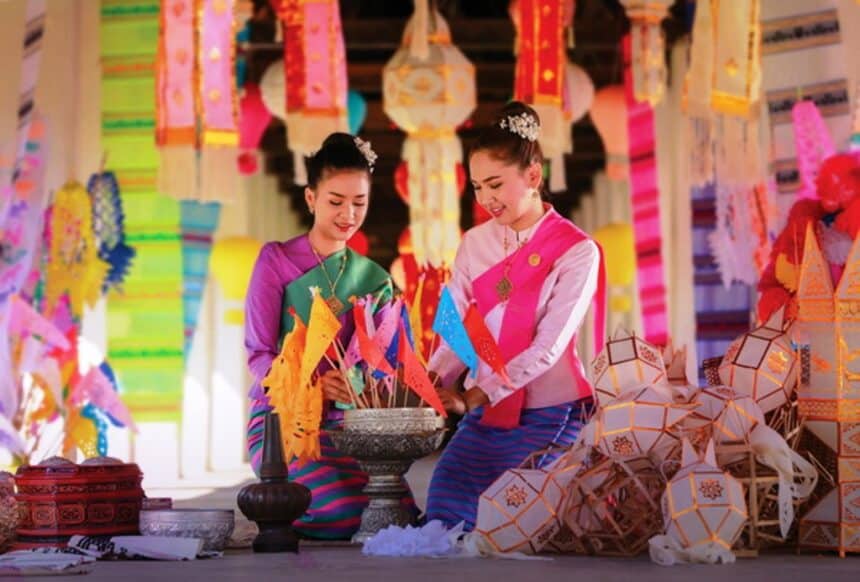
Chiang Rai has a close connection to the old Lan Na kingdom, but Lanna describes a regional history and culture, not everyone who lives in the province. People may connect with Lanna heritage in different ways, and Chiang Rai is also home to communities with distinct identities and histories.
The kingdom’s past still informs the region’s language, traditions, and cultural memory. To understand what Lanna means in Chiang Rai, it helps to look at that history alongside the province’s many communities and perspectives. Explore the history of the Lanna Kingdom.
Key Takeaways
- Lanna identity is tied to northern Tai communities and the history of Lan Na. It describes a regional culture, not every person who lives in Chiang Rai.
- King Mangrai founded Chiang Rai in 1262 as an early seat of Lan Na; Chiang Mai later became the kingdom’s main capital, as EBSCO’s history of Lan Na explains.
- Kham Mueang, temple traditions, and the historic Tai Tham script connect to Lanna heritage, though people express that heritage in different ways. Explore Lanna culture in Chiang Rai.
- Akha, Lahu, Lisu, Hmong, Karen, and other communities have distinct identities and histories, so they shouldn’t be grouped under the Lanna label. Learn about Chiang Rai’s ethnic communities.
Who Are the Lanna People in Chiang Rai?
Lanna, also written Lan Na, refers to a historic kingdom in northern Thailand and the regional culture and identity connected to it. In Chiang Rai, Lanna heritage is associated especially with northern Tai communities, but people relate to that heritage in different ways. Living in Chiang Rai does not automatically make someone Lanna. The province is home to communities with their own identities and histories, as well as people whose family backgrounds and cultural ties cross regional boundaries.
What the name Lanna means and where the kingdom began
The name Lan Na is commonly translated as “a million rice fields,” a phrase linked to the agricultural wealth associated with the kingdom. Its political roots lay in Ngoenyang, a northern Tai principality near present-day Chiang Saen, by the Mekong River. The ancient city of Chiang Saen preserves traces of this early history.
Lan Na took shape in the 13th century as rulers built alliances and expanded their influence across the region. Its reach at different times included areas now within northern Thailand and neighboring parts of Myanmar, Laos, and China. However, its boundaries shifted with political change, so modern national borders do not provide a fixed map of the old kingdom.
Today, Lanna identity describes a connection to that history and to regional cultural traditions. It is often associated with Northern Thai speech, known as Kham Mueang, and with local Buddhist and artistic traditions. Yet the label does not describe every resident of northern Thailand, nor does it replace the distinct identities of communities such as the Akha, Lahu, Lisu, Hmong, and Karen.
Why Chiang Rai matters in Lanna history
King Mangrai founded Chiang Rai in 1262, making it an early seat of his expanding realm. The city’s founding linked the new center of power to the earlier principality of Ngoenyang. Chiang Rai’s history under King Mangrai helps explain why the city remains closely tied to Lanna history.
Mangrai founded Chiang Mai in 1296, and it later became the kingdom’s principal capital. This shift did not erase Chiang Rai’s place in the story: the city was an important early center before political authority settled farther south. A historical account of Lan Na describes Mangrai’s move from Ngoenyang to Chiang Rai in 1262.
That sequence matters when describing Lanna identity in Chiang Rai. The province is part of a region shaped by Lan Na’s history, but its present-day population is diverse. Some residents identify strongly with Lanna heritage, while others connect to different ethnic, linguistic, or family traditions. The term is most useful when it names a historical and cultural connection, rather than assigning one identity to everyone who lives here.
How Lanna history shaped Chiang Rai’s culture and identity
Lan Na’s history helps explain why Chiang Rai’s regional culture includes Northern Thai language, Buddhist traditions, and memories of an older kingdom. Yet those traditions changed over time, and they do not define every person in the province. Today, identity can reflect family history, community, language, and personal ties to the region.
A regional identity, not a label for everyone in the province
Lan Na came under Burmese control in the 16th century, beginning a period of political influence that lasted for more than two centuries. Siamese forces helped end Burmese rule in the late 18th century, while the region’s integration into the Siamese state unfolded later. That shift reduced local political power as Siam centralized authority, a process discussed in this study of Lan Na’s integration into Siam.
These changes shaped how people remember the region, but Lanna culture was never frozen in one historical moment. Language offers a clear example. Kham Mueang, also called Northern Thai, remains an important marker of regional heritage, though residents also use standard Thai and may speak other languages at home. Readers can learn more about Kham Mueang and Northern Thai culture.
Religious life also carries layers of history. Theravada Buddhism has long shaped temple institutions and community observances in northern Thailand, while local practices and histories vary between places. Chiang Rai’s temples and religious traditions connect residents to the past, but shared Buddhist customs do not make every community culturally identical.
For some people, Lanna is a strong part of their identity; for others, it is one connection among several. It is most accurate to use the term for regional heritage and cultural traditions, rather than as a label for everyone who lives in Chiang Rai.
Chiang Rai’s many communities have distinct histories
Chiang Rai is home to Akha, Lahu, Lisu, Hmong, and Karen communities, among others. Each has its own history, language, and traditions. These identities are not simply variations of Lanna culture, even when communities live in the same province or share public spaces and local economies.
People’s identities can overlap. A resident may feel connected to Chiang Rai, to a particular ethnic community, and to wider Thai society, while also participating in regional customs. Those connections do not erase one another. In the same way, the history of Lan Na can shape the province’s shared cultural setting without absorbing the distinct histories of its communities.
Using each community’s name helps keep those distinctions clear. Broad labels such as “hill tribes” can flatten different peoples into one category, while naming Akha, Lahu, Lisu, Hmong, or Karen recognizes that each community has its own story and present-day identity.
What language do Lanna people speak?
Lanna heritage is closely associated with Kham Mueang, the Northern Thai language variety spoken in parts of northern Thailand. However, language use varies, and Lanna identity doesn’t mean every person speaks Kham Mueang. The region also has a historic writing tradition tied to temples and manuscripts.
Kham Mueang and standard Thai in everyday life
Kham Mueang, also called Northern Thai, is distinct from standard Thai. The two are related, but they have differences in pronunciation, vocabulary, and grammar. Someone who speaks standard Thai may not understand every expression in Kham Mueang, especially when speakers use local words or forms.
Standard Thai is widely used in education, government, media, and communication across regions. In Chiang Rai, people may use standard Thai in public or formal settings and Kham Mueang with relatives or neighbors. The choice can depend on the situation, family habits, and a speaker’s generation.
Some people grow up hearing and speaking Kham Mueang at home, while others use it less often or understand more than they speak. Others may speak additional languages connected to their family or community. These patterns vary, so it’s inaccurate to assume that everyone with Lanna heritage speaks Kham Mueang, or that everyone in Chiang Rai identifies as Lanna.
The Tai Tham script and old Buddhist manuscripts
Kham Mueang has a historic written tradition associated with Tai Tham, also called Tham. This script appears in religious and literary works, including Buddhist texts copied onto palm leaves. Monks and temples helped preserve manuscripts that carried teachings, stories, and written knowledge across generations.
Tai Tham is a script, not a separate modern national language. It has also been used in written traditions connected to other northern Tai languages. The Lanna Manuscripts project offers resources for exploring this manuscript heritage.
Today, people commonly write Northern Thai using the standard Thai alphabet. That practical choice differs from the historical use of Tai Tham in manuscripts and religious settings. The distinction helps explain why Lanna heritage includes both a spoken language variety and a separate tradition of writing. Chiang Rai’s creative tourism blueprint also discusses efforts to protect local dialects and Lanna scripts.
Which Lanna traditions can visitors see in Chiang Rai?
Visitors can encounter Lanna heritage in Chiang Rai through temple life and seasonal observances, though these practices aren’t shared by everyone in the province. Theravada Buddhism is important across the region, but it isn’t unique to Lanna. Local history and community customs give particular temples and festivals their own character.
Buddhist temples, merit-making, and Wat Phra Kaew
At temples, visitors may see people making offerings, praying, or taking part in merit-making. These acts are part of Buddhist practice for many people, but beliefs and participation vary among residents. Visitors can observe respectfully, dress modestly, and follow posted guidance or a host’s instructions.
Wat Phra Kaew offers a local historical example. According to tradition, lightning struck a chedi there in 1434, revealing the Emerald Buddha, which is now enshrined in Bangkok. The story connects Chiang Rai to one of Thailand’s best-known Buddhist images. For site details and more temple background, consult this guide to Chiang Rai’s historic temples.
Yi Peng and Songkran are more than spectacles
Yi Peng is associated with the full moon of the second month in the old Lanna lunar calendar, usually around November. People often discuss it alongside Loi Krathong, which falls around the same period, but the two are not interchangeable. Their names refer to distinct observances with different calendar and local contexts. Lantern displays are one visible part of some Yi Peng events, but they don’t tell the whole story of the tradition.
Songkran, celebrated in mid-April, is Thailand’s traditional New Year. In addition to lively public water celebrations, people may visit temples and pour water as part of religious or family observances. The exact customs and public events vary by place. Check the dates and local program before making plans, using the Tourism Authority of Thailand’s events calendar as one starting point.
Local ceremonies depend on the community and occasion
Temple festivals and communal merit-making events can differ between towns, temples, and years. Some gatherings may draw a neighborhood together around a local temple, while others are organized for a particular religious date or community occasion. There isn’t one ceremony that represents all of Chiang Rai.
That variation matters when interpreting what visitors see. A public event may be specific to one temple or organized by a local group, rather than a custom practiced throughout the province. Ask organizers or local hosts about an event’s meaning, and follow their guidance if you attend. This approach gives the tradition its local context and avoids treating diverse communities as though they share a single set of customs.
How Lanna heritage appears in food, crafts, and daily life
Lanna heritage is visible in Chiang Rai’s food, arts, and regional traditions, but no single dish or craft represents everyone in the province. Daily life also reflects the area’s borderland connections and the distinct histories of communities who live and work here.
Northern Thai dishes to know, including khao soi and sai ua
Khao soi is a Northern Thai curry noodle soup, often served with soft noodles, a crisp noodle topping, and condiments on the side. Sai ua is a grilled sausage seasoned with herbs and spices. Both are familiar choices in Chiang Rai’s food scene, though neither should be treated as something every Lanna person eats or as exclusive to Lanna culture.
Khao kan chin is another dish found in the region. It combines rice with minced pork and seasonings, then steams the mixture in a banana leaf. The dish is associated with Tai Yai, or Ngiao, foodways, an example of how Chiang Rai’s food traditions include more than one community’s history. Recipes and names can vary, too. For more local dishes, see this guide to Chiang Rai’s culinary heritage.
Textiles and crafts tell different community stories
Chiang Rai’s material culture includes woven textiles, embroidered clothing, jewelry, lacquerware, and other handmade objects. Some pieces connect to Lanna artistic traditions, while others belong to specific communities or local makers. A textile’s color or pattern alone doesn’t establish who made it or what it means.
When the maker or community is known, name them rather than grouping every object under “Lanna.” This matters in markets, where Akha embroidery, community-made jewelry, and other works may be sold alongside regional souvenirs. Asking who made an item and where it comes from can offer a more accurate account of the craft and the person behind it.
Modern livelihoods show Chiang Rai’s cultural variety
Coffee farming is part of present-day life in places such as Doi Chang, Doi Tung, Pang Khon, and Mae Suai. These growing areas connect farms, village producers, cafés, and local businesses. Doi Chang, in particular, is associated with Akha and Lisu growers, as described in this study of coffee, forests, and community in Doi Chaang.
Coffee is a regional livelihood, not a specifically Lanna custom. Akha, Lahu, Lisu, and Hmong communities are among those connected to coffee farming across Chiang Rai, alongside other residents and producers. Their work reflects the province’s cultural variety and changing rural economies. For travel context on the highland growing areas, see this guide to Chiang Rai’s highland coffee farms.
How to learn about Lanna culture respectfully in Chiang Rai
Learning about Lanna culture in Chiang Rai starts with attention to context. The province’s traditions belong to particular people, families, temples, and communities, not to a single identity shared by every resident. Visitors can learn more by asking who maintains a practice and listening to local explanations, rather than treating culture as a performance arranged for them.
Ask whose tradition you are seeing
When you encounter a textile, ceremony, or community custom, ask who made it, leads it, or cares for it. A clear answer may connect a woven piece to a particular maker or community, or explain that a ceremony belongs to one temple or local group. If the person you ask isn’t sure, that’s a reason to avoid guessing.
Calling every object or practice “Lanna” can blur important distinctions. Chiang Rai is home to people with different histories and identities, including Akha, Lahu, Lisu, Hmong, and Karen communities. Their traditions shouldn’t be folded into a broad Lanna label simply because they are practiced in the same province. When a community name is known, use it; when it isn’t, describe what you see without assigning an origin.
Whenever possible, listen to people with a direct connection to the tradition. A maker, community host, temple representative, or local guide can explain what an object means and whether a practice is open to visitors. For community visits, choose experiences shaped by local residents rather than treating people’s daily lives as a show. These guidelines for respectful visits to Chiang Rai communities offer further advice.
Visit temples and community spaces with care
At temples, dress modestly and follow the rules posted at that particular site. Covering shoulders and knees is a useful starting point, but requirements can differ. Remove shoes or hats when signs or temple staff ask, and avoid touching sacred objects unless someone gives permission. Thailand’s official temple travel guidance also advises visitors to follow each temple’s rules.
Ask before photographing people, monks, or ceremonies, even when others are taking pictures. Some areas prohibit photography, while a service or private observance may call for quiet attention rather than a camera. If permission isn’t clear, put the camera away. For practical details, see this guide to Chiang Rai temple etiquette.
Most importantly, listen to local explanations and instructions. Customs vary by place and occasion, so avoid assuming that one temple or community speaks for all of Chiang Rai. A respectful visit leaves room for people to share what they choose, in their own words.
Frequently Asked Questions
These answers clarify how Lanna heritage relates to language, identity, and local traditions in Chiang Rai. The terms can overlap, but their meanings depend on the context.
Are Lanna and Northern Thai the same thing?
The terms overlap in everyday use, but they aren’t exact substitutes. Lanna usually refers to the historic kingdom and its cultural legacy, while Northern Thai can describe the region and its people. The language variety commonly called Kham Mueang is a more precise term when talking about Northern Thai speech.
Are all people in Chiang Rai Lanna?
No. Chiang Rai is home to people with varied regional, ethnic, and family identities, including Akha, Lahu, Lisu, Hmong, and Karen communities. Their traditions and histories are distinct, so living in a former Lan Na region doesn’t automatically make someone Lanna. Use the community name when you know it, rather than assuming one identity fits everyone.
Is Lanna a language or an ethnic group?
Lanna most often names a historic kingdom and the cultural legacy connected to it. Northern Thai speech is commonly called Kham Mueang, though some people also use “Lanna” when referring to the language. Identity terms can vary by speaker and setting, so it’s helpful to ask what a person means rather than treating the labels as fixed categories.
Can visitors hear Kham Mueang in Chiang Rai?
Yes, visitors may hear Kham Mueang in daily conversations, especially among people with local family or community ties. However, language use varies by person and setting, and standard Thai is widely spoken across the province. A visitor shouldn’t expect every resident, shop, or public event to use Northern Thai.
Is Yi Peng the same festival as Loi Krathong?
They are closely associated in many public celebrations, but Yi Peng and Loi Krathong have different names and calendar contexts. In Chiang Rai, events may combine elements of both, yet the program varies by place and year. Check the local schedule for your destination and travel dates, and see details on Chiang Rai’s Lanna-influenced festivals.
What is one place in Chiang Rai connected to Lanna history?
Wat Phra Kaew is associated with the tradition that the Emerald Buddha was discovered there in 1434, after lightning struck a chedi. That story connects the temple to Chiang Rai’s past, but it is one historical association, not a complete account of Lanna culture. For practical details about visiting, see Chiang Rai’s historic Wat Phra Kaew, alongside this account of the Emerald Buddha’s discovery tradition.
Conclusion
Lanna heritage is an important part of Chiang Rai’s history and regional culture, shaped by its past as an early center of the Lan Na kingdom. Yet the province is home to many communities with distinct identities, so Lanna does not describe everyone who lives there.
Explore Chiang Rai’s history with curiosity, use community names accurately, and listen to local perspectives. For another look at how heritage connects with life in the province, read about local Lanna culture in Chiang Rai.