BANGKOK — Thailand’s Prime Minister Anutin Charnvirakul will chair an urgent cabinet-level meeting at Government House on Saturday to elevate toxic heavy metal contamination in Thailand’s northern waterways to a national priority. The emergency session comes one day after Anutin secured a pledge of technical monitoring and cleanup support from Chinese President Xi Jinping during bilateral talks in Shenzhen on Nov. 20 following the Asia-Pacific Economic Cooperation summit.
The diplomatic breakthrough in China targets a deepening environmental emergency across Chiang Rai province, where high levels of arsenic and other toxic metals have forced authorities to shut down municipal tap water supplies for tens of thousands of residents. Thai officials and environmental researchers trace the poison to unregulated rare earth mining in Myanmar backed by Chinese supply chains, where operators strip hillsides without basic waste containment and flush chemical runoff directly into rivers flowing south into Thailand.
Key Takeaways• Prime Minister Anutin Charnvirakul convenes an emergency Government House task force Saturday to classify heavy metal pollution in Chiang Rai’s rivers as a national priority after winning technical support from Chinese President Xi Jinping. • Arsenic levels reaching 30 times safe limits in the Sai and Kok rivers have halted tap water for more than 20,000 households, crippled local vegetable sales, and threatened over 51,000 acres of northern farmland. • Researchers and Thai officials link the contamination to unregulated rare earth and gold mines across the border in Myanmar, where operations supplying Chinese processors lack basic environmental safeguards. |
Emergency Talks Follow Shenzhen Summit
Anutin landed back in Bangkok late Friday carrying a direct commitment from Beijing to help trace and contain the cross-border pollution crisis. During their meeting in Shenzhen on Nov. 20 after the 33rd APEC Economic Leaders’ Meeting, Anutin pressed Xi on the worsening contamination in the Sai, Kok, Ruak and Mekong rivers, according to government spokesman Ekkapob Pianpises.
Xi expressed readiness to deploy Chinese technical teams and coordinate environmental monitoring with Thai agencies, though the two leaders stopped short of announcing immediate closures of upstream mines. Anutin also proposed placing cross-border river pollution on the formal agenda of the Mekong-Lancang Cooperation leaders’ summit scheduled for December, aiming to bind upstream and downstream neighbors to shared water quality rules.
Saturday’s session at Government House brings together the ministries of Interior, Public Health, Agriculture and Cooperatives, Natural Resources and Environment, and Higher Education, Science, Research and Innovation. Ministers are expected to approve emergency budget allocations, expand disaster zone protocols for border districts, and finalize the mandate for a Thai delegation heading into bilateral talks with Myanmar officials on Nov. 25 and Nov. 26.
“This is no longer a localized provincial nuisance that Chiang Rai can manage alone,” a senior Government House official said ahead of Saturday’s meeting. “When families cannot turn on their taps and farmers cannot sell their harvest, the state has to treat the river basin as a national security and public health emergency.”
Taps Run Dry Across Border Communities
For residents living along the northern border, the diplomatic maneuvering follows weeks of daily disruption and mounting health anxiety. Earlier this month, the Provincial Waterworks Authority suspended raw water intake and tap distribution across 14 villages in Chiang Rai’s Mae Sai district after laboratory tests detected arsenic concentrations at 30 times the national safety limit.
That shutdown cut off piped water to more than 20,000 households, forcing families to line up at mobile water trucks or buy bottled water for cooking, bathing and brushing their teeth. Health workers in Chiang Rai have stepped up biological screening in riverfront communities after urine tests conducted by public health teams found elevated arsenic levels in 31 out of 549 local residents examined.
Doctors warn that prolonged exposure to inorganic arsenic damages skin, nerves and internal organs while raising long-term cancer risks. Residents in Mae Sai and downstream districts along the Kok River report skin rashes after contact with river water, and parents say they no longer allow children near riverbanks where families once swam and fished every afternoon.
Deputy Prime Minister Yodchanan Wongsawat, who oversees science and research agencies, said the Royal Irrigation Department has set aside 22.5 million cubic meters of clean reserve water across three reservoirs and distributed more than 100,000 liters of drinking water while engineers rush to install specialized filtration units at village treatment plants.
Farms and Local Businesses Take Heavy Losses
The economic fallout has spread rapidly from riverbanks to wholesale markets, restaurants and hotels across Thailand’s northernmost province. Local agricultural cooperatives report that fresh vegetable sales in Mae Sai have plunged by more than 50 percent as shoppers avoid produce irrigated with water drawn from the Sai and Kok basins.
Environmental monitoring cited by regional researchers indicates that seasonal floodwaters have carried contaminated silt beyond river channels, affecting roughly 20,800 hectares—more than 51,300 acres—of farmland across nine districts of Chiang Rai. Rice paddies, baby corn fields and orchard plots that rely on gravity-fed irrigation canals face an uncertain harvest season as buyers demand laboratory safety certificates before purchasing crops.
Small businesses in border towns face a double squeeze from rising operating costs and falling customer traffic. Restaurants, laundries and food processors in Mae Sai and Chiang Rai city have spent thousands of baht each week on hauled water and commercial filtration cartridges just to keep kitchens open and reassure diners.
Hotel operators preparing for the winter tourism peak report cancellations and anxious calls from travelers asking whether tap water and local food are safe. Although municipal authorities in central Chiang Rai stress that treated urban tap water meets safety standards, business groups say the stigma of toxic river headlines has damaged the province’s reputation as a clean, nature-focused destination.
Freshwater fishermen along the Kok and Ruak rivers face an equally bleak reality. Many have pulled their boats ashore indefinitely after catches dropped sharply and consumers refused to buy local river fish over fears of heavy metal accumulation in aquatic food chains.
Mining Boom in a Lawless Frontier
Understanding why heavy metals suddenly overwhelmed Chiang Rai’s rivers requires looking north into Myanmar’s Shan State, where years of civil war have fractured state authority and fueled an unchecked extraction boom. Satellite analysis and field investigations by the Stimson Center show a rapid proliferation of mining pits across Mekong tributaries in Myanmar over the past four years, operating inside territories controlled by armed ethnic groups and militias beyond the reach of central regulators.
In these remote mountain valleys, miners extract heavy rare earth elements—critical minerals used in electric vehicle motors, wind turbines and smartphones—alongside gold, manganese and tin. Unlike industrial mines that build lined tailings dams and chemical treatment ponds, operators in eastern Shan State rely on crude in-situ leaching, pumping ammonium sulfate and other chemical solutions directly into hillsides to dissolve minerals out of the clay.
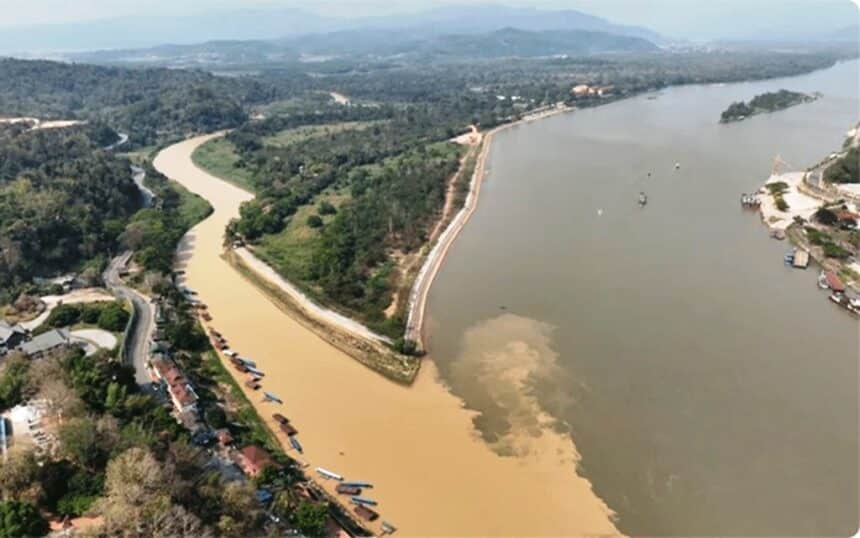
That process strips away vegetation and releases naturally occurring arsenic, lead and cadmium trapped in the rock. Without retention barriers, monsoon rains and wastewater discharge wash massive loads of toxic sludge straight into the headwaters of the Sai and Kok rivers, which flow south across the border into Chiang Rai before emptying into the Mekong.
Researchers at Naresuan University and Chiang Mai University who analyzed river sediment found chemical signatures matching upstream mining zones, with heavy metal indexes at the Mae Sai-Tachilek border crossing spiking nearly 100 times above high-pollution thresholds. Crucially, environmental policy analysts note that almost all of the unrefined rare earth concentrate mined in Shan State is trucked north into China for processing, giving Beijing decisive economic leverage over the supply chain even when the mines sit on Myanmar soil.
Six-Point Containment Plan Faces Diplomatic Test
Ahead of Saturday’s Government House meeting, Deputy Prime Minister Yodchanan outlined a six-point technical action plan designed to shield Thai communities while diplomats push for upstream enforcement. Under the plan, scientists from Mae Fah Luang University will partner with Chinese research institutes to run isotope tracing tests using unified laboratory standards, eliminating disputes over where the arsenic originates.
Engineers from Naresuan University and the Ministry of Higher Education will also pilot a sediment-trapping system called Sai Sai at agricultural water intakes in Mae Sai’s Mueang Daeng subdistrict. The facility is designed to intercept contaminated silt, separate and dewater the solids for hazardous waste disposal, and return tested water to irrigation canals.
At the same time, the Ministry of Agriculture and Cooperatives is rushing to sample soil, water and crops across Chiang Rai and neighboring Chiang Mai districts by Dec. 15 to build a risk-zoning map for farmers, while customs and commerce officials tighten checks on cross-border mineral shipments to ensure Thai roads are not used to supply illegal mines.
Nanotechnology and synchrotron researchers from national science agencies are simultaneously deploying modular filtration units to high-risk villages in Chiang Rai and Chiang Mai’s Fang and Mae Ai districts, aiming to restore safe household water before dry-season river flows concentrate pollutants even further.
Still, local civic networks in Chiang Rai argue that filtration plants and sediment traps only treat symptoms downstream. Community leaders warn that unless Saturday’s national task force pairs domestic relief with firm pressure on Beijing and armed authorities in Myanmar to halt unlined chemical mining at the source, northern Thailand’s rivers will remain poisoned for a generation.