SHENZHEN, China — Thailand and China agreed Friday to accelerate plans for a cross-border rail corridor running south through Thailand to Malaysia and Singapore, linking northern Thailand directly into a continuous mainland Southeast Asian network.
Thai Prime Minister Anutin Charnvirakul and Chinese President Xi Jinping reached the accord during bilateral talks in Shenzhen following the 33rd Asia-Pacific Economic Cooperation summit. The pact expands the active railway from Kunming in southwestern China through Laos to Bangkok, targeting a 2030 completion window that slashes overland freight times and opens new trade arteries for northern Thai provinces.
| Key Takeaways
• Thai Prime Minister Anutin Charnvirakul and Chinese President Xi Jinping agreed in Shenzhen to push forward rail connections extending south to Malaysia and Singapore. • The corridor links Kunming, China, through Laos and northern Thailand to Bangkok before continuing down the Malay Peninsula. • Officials aim to synchronize border gauges, bridge links and southern track upgrades to cut regional cargo transit costs by 2030. |
Closing the Missing Links Along the Central Corridor
The Shenzhen agreement builds directly on Thai-Chinese investment talks held earlier this month in Bangkok, where Anutin and Chinese Premier Li Qiang affirmed a 2030 target for high-speed rail operations. While trains already carry passengers and cargo along the 1,035-kilometer stretch from Kunming to Vientiane, Laos, the route still hits a bottleneck at the Mekong River border.
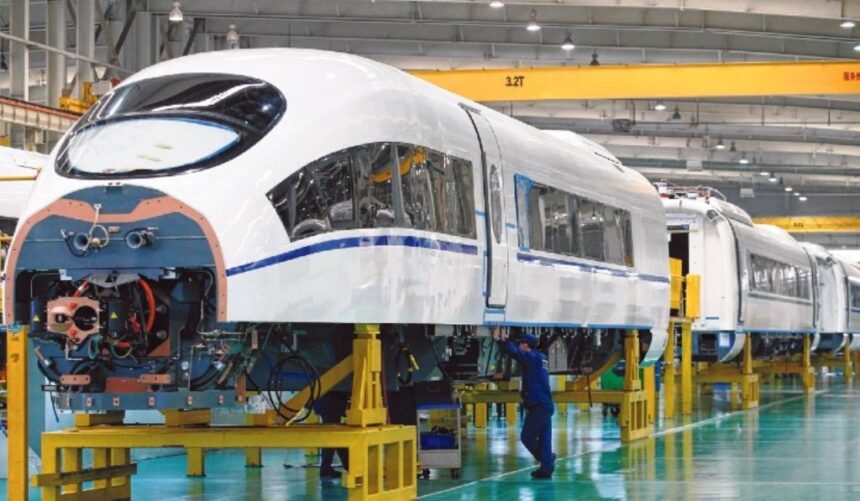
Thailand is moving to clear that choke point. According to the Thai-Chinese High-Speed Railway project office, civil works on the 250.77-kilometer first phase between Bangkok and Nakhon Ratchasima have passed 56% completion. Bidding opens next month for the 357-kilometer second phase running north to Nong Khai, alongside joint Thai-Lao plans for a second Mekong rail bridge capable of handling standard-gauge trains.
Friday’s talks shift diplomatic focus southward. Extending seamless rail service from Bangkok through southern Thailand to Padang Besar on the Malaysian border—and onward to Kuala Lumpur and Singapore—completes the central spine of the 3,900-kilometer Kunming-Singapore Railway.
Track Gauges, Border Bottlenecks and Northern Thailand’s Stake
The push to unify the corridor confronts more than a century of fragmented colonial-era engineering. China and Laos operate modern 1,435-millimeter standard-gauge tracks. Thailand and Malaysia rely largely on 1,000-millimeter meter-gauge lines built between 1896 and 1918, forcing freight operators to unload and reload containers at border yards.
Data compiled by Malaysia’s The Star shows cross-border transit trade between Thailand and China reached 59.37 billion baht ($1.72 billion) this year, while trade with Malaysia surged 49.6% to 39.97 billion baht. Yet truck congestion and gauge transfers at Nong Khai and Padang Besar inflate shipping costs for agricultural exporters and electronics manufacturers.
Northern Thailand stands to gain a major commercial outlet from the southern extension. Farmers and logistics firms in Chiang Rai, Chiang Mai and Lampang currently haul cold-chain fruit, rubber and processed foods south by highway to Bangkok or east to Laem Chabang Port. Connecting northern dual-track feeder lines into the trunk corridor gives northern producers direct rail access to Malaysian and Singaporean consumer markets without coastal port delays.
What Happens Next for Regional Rail Operators
Transport officials in Bangkok and Beijing face immediate technical hurdles before through-trains can run from Yunnan to the Singapore Strait. Thailand’s Ministry of Transport must finalize track-sharing rules between its southern meter-gauge network and planned standard-gauge high-speed lines running toward Hua Hin and Padang Besar.
In Malaysia, state operator Keretapi Tanah Melayu already runs electrified 160-kilometer-per-hour trains from Padang Besar south toward Johor Bahru, where the Rapid Transit System Link to Singapore is scheduled to open in 2027. Coordinating customs pre-clearance and single-ticket freight manifests across four jurisdictions will determine whether the Shenzhen pledge delivers fast, low-cost transit by the end of the decade.
Trending News:
Thailand Advances Rail Link to China With 2027 Tender Plan
Thailand-China High-Speed Rail: Route and Project Status