BANGKOK – For people in remote communities of Thailand, reaching a clinic or pharmacy can mean a long trip, especially when roads are difficult or blocked. Medical drones may help move supplies across those gaps, but the available examples from Thailand describe demonstrations, not proof of routine medicine delivery to individual patients.
Chiang Rai Times has reported on a drone test in Krabi, where a flight took five minutes compared with a boat trip of at least 20 minutes. The report also describes drone activity in Trat, including cooler boxes for medicines and blood bags. These examples point to a possible logistics role for drones. They don’t show that an AI agent diagnosed patients, prescribed medicine, or made clinical decisions.
The distinction matters. AI-supported logistics may help plan or track transport, while licensed clinicians and pharmacists remain responsible for care and medicines. Thailand’s drone demonstrations show potential, but they don’t establish patient outcomes or a dependable nationwide service.
Key Takeaways
- Thai medical-drone reports describe tests and demonstrations, not a proven nationwide delivery service.
- A Krabi test reportedly took five minutes by drone, compared with at least 20 minutes by boat.
- A Chiang Rai Times report describes cooler boxes for medicines and blood bags in Trat.
- Drone logistics can support transport, but they don’t replace clinical decisions by licensed professionals.
- Patient access, safe delivery, and health outcomes need to be measured before claims of broad benefit.
What can AI agents in Thailand do to get medicines to patients?
AI agents and medical drones are often discussed together, but they do different jobs. An AI agent may process information or coordinate tasks. A drone carries a physical payload. A report about a drone flight, on its own, doesn’t establish that an AI agent planned the route or took part in any clinical decision.
The available Chiang Rai Times reports describe drone demonstrations in Krabi and Trat, along with drones used to move supplies during disaster relief. They don’t document an AI system diagnosing patients, choosing medicines, writing prescriptions, or dispensing drugs. The evidence supports a narrower point: drones may help transport medical supplies where road or boat travel takes longer.
A separate Chiang Rai Times article discusses predictions about AI agents supporting healthcare in remote Thai villages. Those predictions are not evidence that autonomous medical agents or routine drone-based prescription deliveries are already in service.
Medical drones transport supplies, not clinical decisions
In the reported Krabi test, a drone carried a medical payload over a route that took five minutes, compared with at least 20 minutes by boat. The report doesn’t identify the payload, the date of the test, or whether the flight became part of regular service.
The same Chiang Rai Times report describes drone activity in Trat and says the drones had cooler boxes for medicines and blood bags. That suggests temperature-sensitive cargo was part of the intended use. However, the report doesn’t provide temperature readings or results showing how well the boxes protected their contents.
Transport is only one part of getting medicine to a patient. A clinician must determine what care is needed, and a pharmacist must handle the professional responsibilities involved in supplying medicine. A drone can carry a package; it cannot replace those decisions.
Demonstrations don’t establish routine patient delivery
The available reports don’t give patient counts, identify individual recipients, or state whether drones delivered prescriptions directly to patients. They also don’t report clinical outcomes or show that the described routes operate as a regular service.
Chiang Rai Times has reported on drones carrying medicine to remote Thai communities and on disaster-response flights carrying supplies. Those accounts offer examples of how drones may help move cargo, but they don’t prove that patients now receive medicine faster or have better health outcomes because of drone delivery.
How Thai medical-drone demonstrations moved supplies
Travel time is a clear reason to test drones. When a route crosses water or difficult terrain, a flight may take less time than a boat or road journey. That can make drones useful for moving a supply to a facility or response team, particularly when other routes are slow or unavailable.
Chiang Rai Times reported a five-minute drone test in Krabi, compared with at least 20 minutes by boat. The report doesn’t provide enough detail to compare the trips fully, such as the exact route, the payload, or the conditions on the day. The figures are therefore an example from a specific test, not a guarantee for other locations.
The outlet also describes drone activity in Trat and reports that the aircraft used cooler boxes for medicines and blood bags. That detail matters because medical cargo can have handling requirements. Still, the report doesn’t give temperature-performance data or explain how teams checked the cargo after landing.
Disaster response is another setting where drones may help. Chiang Rai Times reports that DJI Flycart 100 drones carried food, water, and medicine to remote rescue teams. Its account also describes drone support on Doi Suthep and in Nan. In Pua district, the report says flooding cut off the main road to Ban Huai Pud, leaving around 150 villagers facing a 20-kilometer walk to obtain basic supplies.
These accounts show drones carrying supplies to areas where access was difficult. They don’t say how many patients received medicine, whether the cargo went directly to patients, or whether the deliveries changed health outcomes. The reported flights are best understood as examples of transport during tests or response efforts, not evidence of an established medical-delivery network.
How drone delivery could fit into a care pathway
A drone can move a package, but patients need more than transport. A safe care pathway must connect a patient with a clinician, a pharmacist, and a reliable delivery handoff.
First, a clinician assesses the patient and decides whether a prescription is appropriate. The pharmacist then reviews the prescription and handles the professional steps required to supply the medicine. If a drone is part of the service, the delivery team must receive the correct package and deliver it to the intended destination. The patient or an authorized recipient must then be able to receive it safely.
That process also needs a way to handle problems. A patient might not be home, a flight could be delayed, or a package could arrive damaged. The health team needs a clear plan for those situations, including who contacts the patient and who takes responsibility for resolving the issue.
Clinicians and pharmacists remain responsible for care
Licensed clinicians make diagnosis and prescribing decisions. Pharmacists review prescriptions and handle the professional responsibilities involved in supplying medicines. A drone may connect a pharmacy or health facility with a remote location, but it doesn’t take over either role.
In practical terms, a delivery service needs accurate instructions, a secure package, and a confirmed handoff. A patient also needs a way to ask questions about a medicine and report a problem. If the service cannot provide that support, faster transport alone may not meet the patient’s needs.
This distinction also keeps claims about AI clear. An AI system might support operational tasks, but the available Thailand reports don’t show an AI agent making clinical decisions or managing the complete process from diagnosis to delivery.
Remote care needs counseling and follow-up
Medicine delivery works best as part of care that includes communication with the patient. Before a medicine is supplied, the patient needs the appropriate clinical assessment and prescription review. Afterward, the patient may need counseling about how to use the medicine and a way to follow up about symptoms, adherence, or side effects.
A drone could support the transport portion of that process when distance or difficult terrain makes a conventional trip slow. However, it can’t provide counseling or follow-up by itself. Those tasks require a connection between the patient and qualified health professionals.
The reports available here don’t establish which telepharmacy services operate alongside the drone demonstrations. They also don’t show whether patients received counseling or follow-up after a drone carried medical supplies. Those details matter when assessing whether a delivery method supports a full care pathway.
What patients and health teams could gain, and what must stay safe
A drone may save travel time on a route where roads or waterways are slow, as the Krabi comparison suggests. That could be useful in remote or emergency settings, but a single demonstration doesn’t guarantee the same results elsewhere. Weather, distance, payload, landing sites, and local operating conditions can all affect a flight.
The available reports describe use cases, not comparative proof of safety or improved health outcomes. They don’t provide adverse-event rates, detailed cargo-condition data, or information about what happens when a delivery is delayed. Health teams need those measures before judging whether a service is reliable enough for routine patient care.
Faster routes may matter when access is difficult
Drones may help carry supplies across terrain that slows road or boat journeys. In the Krabi example, the reported flight time was five minutes, while the boat trip took at least 20 minutes. In disaster response, a drone may also reach an area when flooding has cut off a road, as reported in Pua district.
Those examples are specific to the routes and circumstances described. They don’t establish a standard delivery time or show that drones can meet every medicine’s storage and handling needs. A faster flight is useful only if the right package reaches the right recipient in suitable condition.
Safe handling and clear responsibility matter
Medical teams need to know what each package contains, where it is going, and who will accept it. Secure packaging and a confirmed handoff can help prevent mix-ups. For medicines that require temperature control, teams also need a way to verify that the cargo stayed within the required range.
The Chiang Rai Times report describes cooler boxes for medicines and blood bags in Trat, but it doesn’t include temperature-performance results. The available reports also don’t provide comparative safety data or adverse-event rates.
Health information requires protection as well. Any system that connects prescriptions, patient identities, and delivery details needs secure records and clear access controls. Teams should also agree in advance who is responsible when a flight is delayed or a medicine arrives damaged.
What will determine whether drone delivery can scale in Thailand?
Moving from demonstrations to a dependable service takes more than aircraft and flight tests. Health teams need clear operating procedures, reliable handoffs, suitable packaging, and a way to contact patients. They also need evidence that the service reaches people who would otherwise face difficult journeys.
Reports about Thai drones describe tests, equipment, and disaster-relief activity. They don’t establish a national service or document routine delivery of prescriptions to individual patients. A project should be judged by patient access and delivery quality, not by the number of flights alone.
Measure patient access, not just successful flights
A useful evaluation would record how long delivery takes, whether the intended recipient receives the package, and whether the medicine arrives in suitable condition. Teams could also track delays, missed handoffs, the number of people reached, follow-up needs, safety events, and cost.
Those measures would help compare drone delivery with available alternatives on a particular route. They would also show whether the service helps patients obtain care, rather than simply demonstrating that a drone can complete a flight.
Chiang Rai Times reports on heavy-lift drones delivering medicine during disasters, including deliveries to places affected by difficult access. Such reports describe a potential role in response efforts, but they don’t provide the patient-level data needed to establish routine clinical benefit.
Professional oversight must remain part of the service
Any medicine-delivery pathway must keep clinical and pharmacy responsibilities clear. Clinicians make diagnosis and prescribing decisions, while pharmacists handle the professional review and supply of medicines. Delivery teams need to follow agreed procedures for packaging, transport, and handoff.
AI may support operational tasks, but claims about its role should match the evidence. The available reports don’t show an AI agent independently diagnosing patients, prescribing drugs, or dispensing medicine. Until services publish clear operational and patient-outcome data, the strongest supported conclusion is that drones have been tested as a way to move supplies across difficult routes.
Frequently Asked Questions
Are medical drones already delivering prescriptions to Thai patients routinely?
The reports described here document tests and supply deliveries, not a confirmed routine service delivering prescriptions directly to individual patients. They don’t identify the number of patients served or report clinical outcomes.
Did an AI agent prescribe medicine in the reported Thai drone tests?
The available reports don’t say that an AI agent diagnosed patients or prescribed medicine. They describe drone transport and related equipment, not autonomous clinical decision-making.
How much faster was the Krabi drone test?
Chiang Rai Times reported a five-minute drone flight compared with a boat trip of at least 20 minutes. Those figures describe one reported test and don’t establish expected times for other routes.
What supplies have Thai drones reportedly carried?
Chiang Rai Times reports that drones carried food, water, and medicine in disaster-response settings. It also describes cooler boxes for medicines and blood bags in Trat, but doesn’t provide details about specific medicines or their handling results.
Do drones replace pharmacists or clinicians?
No. A drone transports cargo. Clinicians remain responsible for diagnosis and prescribing, and pharmacists retain their professional responsibilities for medicines and patient support.
Conclusion
Thailand’s medical-drone reports show how aircraft may help move supplies when roads or boat routes take longer. A Krabi test reportedly took five minutes by drone compared with at least 20 minutes by boat, while other reports describe supply deliveries during difficult access and disaster response.
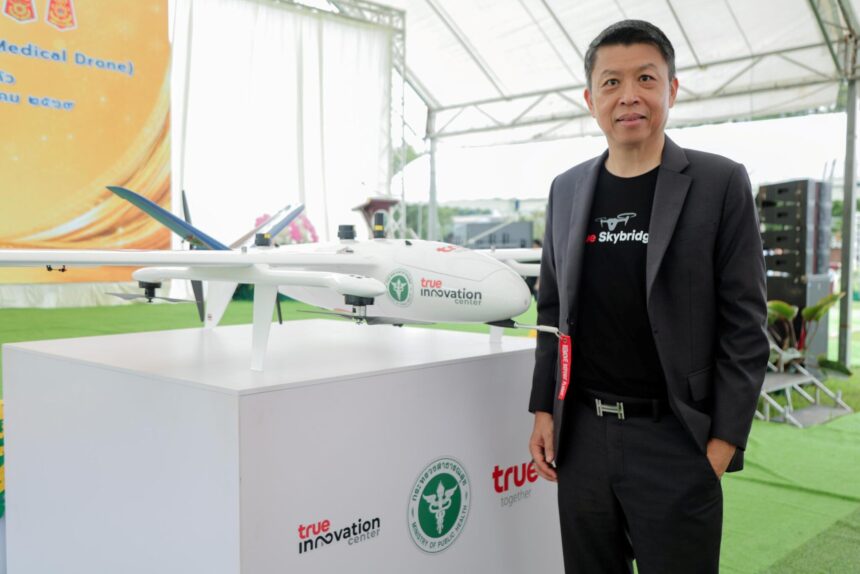
These examples don’t prove that drones routinely deliver prescriptions to patients or improve health outcomes. They also don’t show AI agents making clinical decisions. For patients to benefit, health teams need reliable delivery procedures, safe handling, clear responsibility, and professional care before and after a package arrives. The next measure of progress should be whether these services reliably reach patients and support their care, not simply whether a drone completes its flight. For patients in remote parts of Thailand, reaching a clinic or pharmacy can mean a long trip, especially when roads are difficult or blocked. True Corporation’s SkyBridge offers a real example of AI-enabled logistics: the platform supports medical-drone demonstrations in Nan Province, moving supplies along routes where road travel takes longer.
However, the demonstrations don’t show an AI agent diagnosing patients, prescribing drugs, or independently dispensing medicine. Clinicians and pharmacists remain responsible for those decisions, while SkyBridge focuses on logistics. For wider context, see AI development in Thailand’s healthcare sector.
The reported flights show what the project has tested, but not whether routine deliveries improve patient care. The key distinction is what the drones have demonstrated, who remains responsible for medicines, and what evidence is still needed.
Key Takeaways
- True Corporation’s SkyBridge medical-drone platform supports logistics, including route planning, flight tracking, and payload monitoring.
- A demonstration in Nan reportedly covered a 4-kilometer round trip in about 3.5 minutes, compared with roughly seven minutes by road.
- SkyBridge’s AI supports flight operations; reports don’t show it diagnosing patients, prescribing medicine, or making clinical decisions.
- Clinicians and pharmacists remain responsible for patient care and medicine supply, consistent with AI use in Thailand’s healthcare system.
- Demonstrations show potential for remote delivery, but routine service, patient outcomes, and broader expansion still need confirmation.
What AI agents in Thailand help get medicines into patients’ hands today?
The clearest documented example is True Corporation’s SkyBridge, an AI-enabled platform for managing medical-drone logistics. It helps coordinate flights and monitor cargo, but available reporting does not show an autonomous clinical AI agent diagnosing patients, prescribing medicine, or dispensing it. Those decisions remain with licensed health professionals.
SkyBridge uses AI to plan and manage drone missions
True describes SkyBridge as a prototype platform for medical-drone operations. It supports route planning, live flight tracking, and fleet management, so operators can coordinate aircraft and follow a mission while it is underway. The system also tracks drone readiness and safety checks before flight.
For medical cargo, SkyBridge monitors payload quality during transport. It records flight details, including times and coordinates, to document what happened on a mission. True’s SkyBridge platform description outlines these logistics functions and describes demonstrations that moved medicine and medical supplies in Nan Province.
These tools support transport operations. They don’t determine which patient needs a medicine, assess symptoms, write a prescription, or decide whether a drug is appropriate. Other AI tools in Thai healthcare may support clinical analysis, but that is separate from SkyBridge’s role in AI innovations in Thailand’s healthcare system.
What the project has not proved yet
The demonstrations show that drones can carry medical supplies along selected routes, with SkyBridge supporting flight coordination and monitoring. However, available reporting does not provide patient counts, identify the medicines carried, or report clinical outcomes. It also does not establish that drones routinely deliver prescriptions to individual patients.
The distinction matters because a successful flight is not the same as a completed patient-care pathway. The reports do not show whether each package reached a named recipient, whether a pharmacist reviewed it, or whether patients received follow-up care.
True has stated a plan to expand the project to ten more remote locations. That remains a plan, not evidence that the expansion occurred. Until patient-level results and routine operating details are published, SkyBridge is best understood as an AI-supported logistics prototype, not an autonomous medical agent or proven prescription-delivery service.
How Thailand’s medical-drone demonstrations moved supplies across difficult terrain
True Corporation described two SkyBridge demonstrations in Nan Province, each aimed at a different access problem. One tested a short medicine route for continuity of care; the other crossed steep terrain to reach a remote area with land routes cut off. Both were demonstrations, not evidence of routine delivery service.
A short flight supported medicine continuity for NCD patients
In the NCD Continuity Model, a drone carried medicine from Phaya Pha Nong Stadium to Ban Rong Ngae Community Square for patients with non-communicable diseases. True Corporation reported a 4-kilometer round trip that took about 3.5 minutes, compared with roughly seven minutes by road. The route tested whether a drone could move supplies quickly between sites when patients needed ongoing care.
On the return flight, the drone carried medical samples. However, True’s description does not name the medicines, identify individual patients, or explain how patients received the supplies. The flight shows a tested transport route, not a documented record of completed patient deliveries or health outcomes. The SkyBridge demonstration details from True Corporation describe the project as part of a pilot.
A remote-area route showed the value of bypassing road delays
The Disaster Response Model followed a longer route from Phaya Pha Nong Stadium to the basketball court at Ban Nam Pua School. The reported 46-kilometer round trip took about 35 minutes by drone, while the road journey took more than two hours. The route crossed steep terrain, including mountains, cliffs, and forest, to reach a remote area where land routes had been cut off.
The comparison shows why flight time may matter when road access fails: a drone can carry supplies without following a winding or blocked road. Still, True’s account does not report how many patients the demonstration served or whether it changed health outcomes. Other emergency projects have also tested aerial support, including Chiang Rai’s drone-based disaster safety strategy, but these examples do not establish regular medical-drone service.
How drone delivery can fit into Thailand’s telepharmacy care pathway
A drone can shorten part of a journey, but getting medicine to a patient involves clinical care, pharmacy review, and a reliable handoff. In a telepharmacy pathway, the aircraft would handle transport while licensed professionals remain responsible for decisions about treatment and medicine.
Clinicians and pharmacists still make the key medicine decisions
A licensed clinician assesses the patient’s symptoms and health history, makes a diagnosis, and decides whether to prescribe. When care happens remotely, the clinician still needs enough information to make that decision safely and document the consultation.
Next, a licensed pharmacist checks the prescription for accuracy and suitability before dispensing. The pharmacist can clarify instructions, explain how to use the medicine, and answer questions about possible side effects or interactions. For more on pharmacist guidance and medicine rules in Thailand, patients need to know that delivery doesn’t replace professional review.
If a drone carries the package, it connects facilities or a pharmacy with the patient’s location. The service still needs to protect the medicine, confirm its destination, and arrange a secure handoff to the patient or an authorized recipient. The drone does not diagnose, prescribe, check a prescription, or provide counseling.
Telepharmacy can bring counseling and follow-up closer to home
A typical telepharmacy process starts with a remote consultation and identity checks. The pharmacist then counsels the patient, dispenses the approved medicine, and arranges delivery through a logistics provider. After delivery, the pharmacist can follow up about symptoms, whether the patient is taking the medicine as directed, and any side effects.
A 2026 review of telepharmacy in Thailand reported that 52.12% of 86 surveyed hospitals used home delivery after telemedicine consultation and telepharmacy counseling. That figure describes participating hospitals’ reported service use; it is not a national rate of patient use. The 2026 review of Thailand’s telepharmacy models describes delivery as one part of a broader care process.
Within that process, a drone could carry a dispensed package when distance or difficult access makes ordinary transport slow. The care team would still need to confirm receipt and offer follow-up, so a missed delivery or patient concern reaches the right professional.
What patients and health teams could gain, and what must stay safe
Medical drones could help health teams move supplies when a road is slow, blocked, or difficult to reach. Thailand’s SkyBridge demonstrations show the potential, but flight-time comparisons alone don’t prove safer care or better health outcomes. Patients benefit only when a drone delivery fits into a dependable care process.
Faster routes may matter most in remote and emergency settings
In Nan Province, True Corporation reported a 4-kilometer round trip that took about 3.5 minutes by drone, compared with roughly seven minutes by road. A separate 46-kilometer round trip took about 35 minutes by drone, while the road journey took more than two hours. The longer demonstration crossed steep terrain to reach an area where land routes had been cut off.
These are examples from particular demonstrations, not expected times for every route. Weather, distance, payload, landing locations, and operating conditions can change flight times or prevent a flight. Still, when roads are slow or unavailable, a drone may help clinics move medical supplies or samples between sites sooner. Other access efforts, such as mobile medical care for remote communities in Thailand, address the same challenge through a different approach.
Medicine quality, privacy, and accountability need clear checks
A safe delivery depends on more than tracking a drone. SkyBridge is described as supporting flight tracking, payload monitoring, and mission records, as outlined in this report on the SkyBridge platform. However, available reports don’t provide temperature-performance data, comparative safety results, or adverse-event rates. Payload monitoring should not be treated as proof that a medicine stayed within its required storage range.
Health teams also need secure packaging and a confirmed handoff. The clinic, pharmacist, delivery team, and patient or authorized recipient should know who verifies the package, checks the recipient’s identity, and records receipt. Prescriptions and delivery details require secure handling, too. If a flight is delayed or medicine arrives damaged, a named team must contact the patient and arrange the next step. Without that accountability, a faster route may still leave a patient waiting.
What will determine whether AI-assisted medicine delivery can scale in Thailand?
Moving from demonstrations to dependable patient services depends on more than drone performance. The service must follow pharmacy rules, protect medicine quality, reach patients reliably, and show that it improves access at a reasonable cost.
Telepharmacy rules and drug-sale requirements shape the service
Thailand’s Pharmacy Council issued updated telepharmacy practice conditions on July 6, 2022. These include having licensed pharmacists provide the service, registering patients and providers, and keeping secure records. The telepharmacy practice guidance helps frame how professional oversight fits into remote care, alongside the role of pharmacists in Thailand’s community pharmacies.
In November 2025, a legal alert discussed a draft community-pharmacy telepharmacy notification. The alert described a proposal, not a confirmed rule in force. Its expected timing should not be treated as proof that the notification took effect. The 2025 legal alert on Thai telepharmacy is useful context, but requirements may differ by service and medicine. Operators need to check the rules that apply to the specific pharmacy, delivery model, and product.
Measure real patient access, not just successful flights
A completed flight does not show whether a patient received the right medicine in usable condition. Evaluation should track delivery time, successful handoffs, medicine condition, missed or delayed doses, patient reach, pharmacist follow-up, safety events, and cost. Together, these measures can show whether drone delivery improves access compared with the available alternatives.
Plans to expand SkyBridge to ten additional remote locations, including a hospital in Mae Chaem District, Chiang Mai, have been reported as future plans. They are not confirmation that the rollout has been completed. Before expansion is treated as evidence of scale, operators should publish results that show who received medicines, whether deliveries supported timely treatment, and what each completed delivery cost.
Frequently Asked Questions
The demonstrations leave practical questions about eligible medicines, delivery arrangements, and costs. The available reports answer some of these only in part.
Which medicines can a medical drone carry?
The reports mention medicine and medical supplies, but they don’t identify specific drugs or explain which products the demonstrations could carry. Suitability depends on the medicine’s handling requirements, packaging, and the aircraft’s payload limits. A successful flight alone doesn’t confirm that every medicine can be transported safely.
Who decides when a drone should make a delivery?
The reports describe SkyBridge as a logistics platform, but they don’t explain who authorizes each flight or how health facilities request one. That operational detail matters because a drone mission needs coordination between flight operators and the health team responsible for the supplies. The reported SkyBridge launch and demonstrations describe the routes and payloads, not the full approval process.
Where would a patient receive a drone delivery?
The demonstrations named community sites and a school as destinations, but the reports don’t explain whether patients collected supplies there or received them another way. A routine service would need to identify an authorized recipient and confirm that the package reached them. The demonstration locations alone don’t establish a patient handoff process.
How much would drone delivery cost patients or health providers?
The available reports don’t provide delivery costs, funding arrangements, or comparisons with road transport. Without those figures, readers can’t tell whether drone delivery would reduce expenses or require ongoing public or provider support. Cost per completed delivery would help assess whether the service could work beyond a pilot.
Could AI connect drone delivery with telemedicine?
That connection is possible in a care model, but the reports don’t confirm that SkyBridge integrates with telemedicine consultations, prescriptions, or pharmacy records. Other applications of AI in Thailand’s healthcare system are separate from evidence about this drone platform. Any link between the two would need to be documented before describing it as part of the service.
Conclusion
AI-supported logistics and drones may help move medicine and medical supplies to hard-to-reach communities in Thailand. True SkyBridge’s Nan demonstrations show how route planning and flight monitoring can support that work, but they are not evidence of an autonomous clinical agent or a proven nationwide service.
Licensed clinicians and pharmacists must remain responsible for care and medicine decisions. Reliable safety checks and clear delivery handoffs matter just as much as flight speed. The strongest measure of progress is whether patients receive the right supplies safely and benefit from better access to care.