
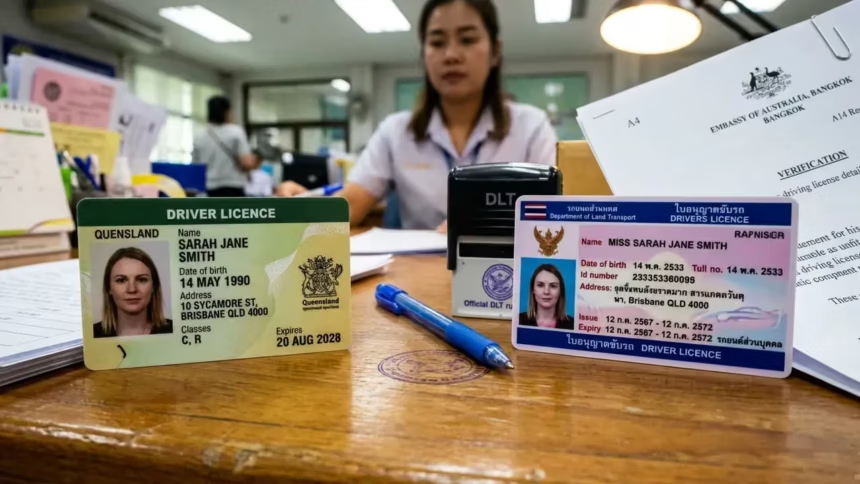
BANGKOK – Foreign residents across Thailand are pushing back against a draft transport rule that would force international applicants to pass local driving exams and hold visas valid for at least two years.
The Department of Land Transport opened public consultation on the proposed amendment Nov. 4, giving motorists until Dec. 4 to submit feedback before officials decide whether to enact the changes.
If approved, the overhaul would scrap long-standing exemptions that allow foreigners with valid home-country licences to convert their credentials without classroom training or road tests. Because most long-term expatriates live in the kingdom on annual visa extensions rather than multi-year entry stamps, the strict two-year validity clause threatens to lock retirees, spouses and foreign workers out of obtaining a first-time Thai licence.
Key Takeaways
- End of Licence Conversions: Foreign applicants would no longer bypass written and practical tests using a home-country licence or International Driving Permit, and all exams would shift strictly to state transport offices.
- The Two-Year Visa Hurdle: Applicants for a two-year temporary Thai licence would need a visa showing at least two years of remaining validity, creating immediate uncertainty for expats on one-year extensions.
- Current Rules Still Stand: Nothing has changed yet; existing conversion exemptions remain active while the public hearing stays open through Dec. 4.
Overhauling the Foreign Conversion Process
Under the department’s 2022 regulations, foreign nationals holding a valid domestic licence of the same vehicle class only need to pass basic physical reaction checks and watch an online safety video to obtain a two-year temporary Thai permit. According to legal briefings analyzing the draft amendment text, the new proposal deletes that waiver entirely. Every foreign applicant would be required to complete full driver training and pass both computerized theory exams and practical road assessments.
The draft also tightens testing oversight. While accredited private driving schools could still conduct classroom instruction for foreign students, they would lose authority to administer final exams. Instead, applicants would have to book and sit for all written and practical tests directly at provincial land transport offices, regional branches or one of Bangkok’s five area offices.
Transport officials emphasized that the consultation document is strictly a draft with no effective date. Until a final notification appears in the Royal Gazette, existing conversion procedures remain unchanged. Visitors driving short-term on a valid 1949 Geneva Convention International Driving Permit or a domestic licence from an ASEAN member state are likewise unaffected by the text, as the amendment governs Thai licence issuance rather than tourist driving privileges.
Why One-Year Visa Holders Face Exclusion
The sharpest outcry centers on a single clause requiring temporary licence applicants to hold a visa with at least two years of validity remaining, unless they meet alternative criteria yet to be defined by the department. In Thai immigration practice, a visa’s initial validity sticker is distinct from an annual extension of stay. Tens of thousands of retirees on Non-Immigrant O visas, foreign spouses and employed expats renew their permission to stay in 12-month increments, meaning their passports never display two full years of remaining validity at any single moment.
This clash between transport rules and immigration realities has flared before. In mid-2025, regional offices in Chonburi and Rayong sparked confusion after tightening local documentation checks on shorter-term stays, including the Destination Thailand Visa, before clarifying renewal standards for annual extensions. Currently, only niche visa categories such as the Long-Term Resident visa, Thailand Privilege cards or Non-Immigrant O-X visas carry multi-year entry stamps on their face.
Beyond daily commuting, losing access to a Thai driving licence carries steep practical consequences for expatriates. Local licences serve as primary government-issued photo identification for domestic flights, banking and hospital registration, while preventing steep penalties if a driver’s home-country permit expires abroad. Immigration advisers note that provincial offices already face multi-week booking backlogs; funneling every foreign resident through full state-run testing without clarifying annual visa eligibility risks stalling renewals nationwide once public comments close Dec. 4.
Trending News:
Thailand Keeps Lifetime Driving Licences Valid
How to Replace a Lost Thai Driving Licence