CHIANG RAI – Toxic arsenic trapped in the riverbed of northern Thailand’s Sai River could remain active for roughly a century even if upstream mines shut down today, a leading environmental scientist warned this week. The projection raises urgent alarms for farming communities across Chiang Rai province that rely on the border waterway for irrigation and daily sustenance.
Assistant Professor Dr. Wan Wiriya of Chiang Mai University’s Environmental Science Research Center issued the warning after university researchers and local monitors detected heavy metals exceeding national safety thresholds in 24 varieties of local produce. Their findings also indicate contamination risks across 100,000 rai of dry-season rice paddies, prompting academics to demand an immediate heavy-metal testing center in Chiang Rai.
Key Takeaways
- Century-Long Persistence: Arsenic bound to Sai River sediment could take around 100 years to clear naturally, even if all upstream mining ceases immediately.
- Widespread Crop Exposure: Researchers recorded heavy metals above safe limits in 24 types of produce and flagged threats to 100,000 rai (about 16,000 hectares) of dry-season rice.
- Urgent Testing Demand: Academics are pressing authorities to establish a dedicated heavy-metal testing laboratory in Chiang Rai to protect consumers and local farmers.
Sediment Traps Toxins Beneath Farmland
Unlike surface water that flushes downstream after seasonal rains, heavy metals bind tightly to fine river silt. Dr. Wan explained that every flood cycle stirs up contaminated mud and pushes it through canal gates directly onto agricultural fields. Even if extraction stops at the source, that buried sediment acts as a slow-release reservoir of poison.
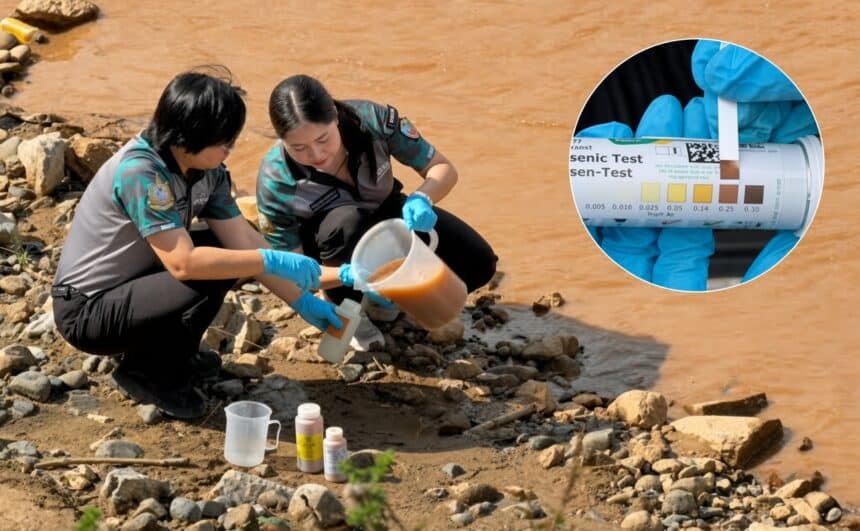
Field testing conducted alongside community networks revealed unsafe concentrations of arsenic and lead across two dozen locally grown vegetables and fruits. Dry-season rice faces acute danger because farmers pump river water onto 100,000 rai of paddies when rainfall disappears. Thailand’s Pollution Control Department previously confirmed arsenic spikes up to 28 times above safety limits following severe flooding, advising growers to halt direct pumping during periods of high water turbidity.
Local irrigation infrastructure lacks large-scale settling basins capable of filtering out toxic silt before water reaches crops. Without engineered barriers, tainted sediment settles directly into paddy soil, where rice roots readily absorb arsenic alongside essential nutrients.
Upstream Mining Drives Cross-Border Crisis
The contamination originates outside Thai jurisdiction. The Sai River begins in Myanmar’s Shan State, an area fractured by civil conflict where unregulated gold and rare-earth mining operations have expanded rapidly along mountain headwaters. Satellite imagery and border inspections show heavy machinery operating around the clock near Doi Kor Wan, using chemical leaching methods that discharge untreated wastewater straight into tributaries feeding Thailand.
Historical regional cases demonstrate how stubbornly mining toxins persist. Along Thailand’s Klity Creek in Kanchanaburi province, lead tailings from an upstream mine poisoned water and fish for decades after operations closed in 1998, forcing costly state cleanup efforts that stretched past 20 years.
Researchers at Mae Fah Luang University have already documented elevated arsenic levels in the urine and fingernails of border residents across the Mekong-Kok-Sai river basin, underscoring the long-term health toll of chronic low-dose exposure.
Diplomatic hurdles complicate cleanup at the source. Thai officials have scheduled urgent cross-border water talks with Myanmar, yet armed ethnic militias control many mining zones, limiting central government enforcement.
Academics Push for Local Testing Hub
Currently, growers and local officials face weeks-long delays when shipping soil, water, and crop samples to distant laboratories in Chiang Mai or Bangkok. That bottleneck leaves farmers guessing whether harvests are safe to eat or sell at wholesale markets.
Dr. Wan and fellow researchers urged the government to fund a permanent heavy-metal testing center inside Chiang Rai. Rapid local screening would let irrigation managers close canal gates during contamination spikes and certify clean produce before it enters the food supply. Without local testing capacity, northern Thailand’s agricultural heartland risks losing both consumer trust and generational livelihoods.
Trending News:
Mae Sai Families Buy Water as Arsenic Lingers in Sai River
Chiang Rai Mae Sai River Crisis: Pollution Agency Tests Water