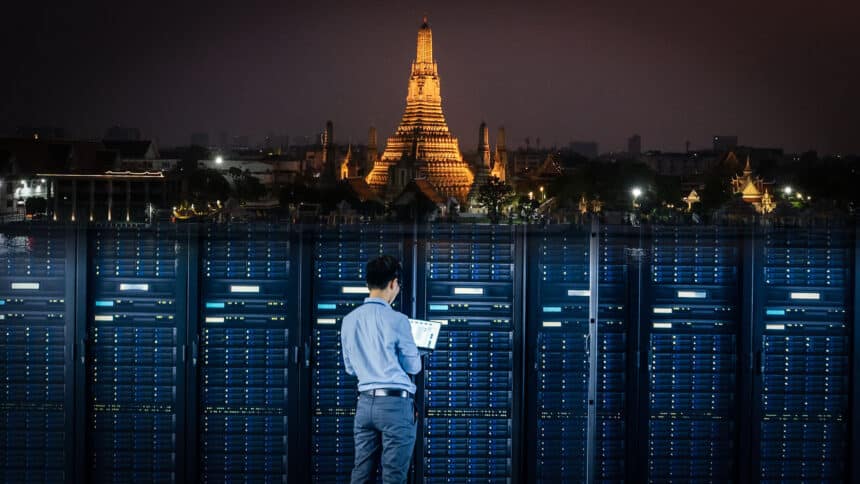
BANGKOK– Thailand’s Cabinet has approved a mandatory 70-decibel noise limit for new data centers, requiring developers to prove environmental compliance before securing final operating approvals.
Under the Cabinet-approved data center framework announced on Nov. 10, facilities must keep noise at or below 70 A-weighted decibels (dBA) at their site boundaries, cap nearby ambient heat increases at 1 to 2 degrees Celsius and recirculate cooling water. The rules aim to curb neighborhood disruptions in dense urban districts like Bangkok as artificial intelligence investment fuels rapid server farm construction.
Key Takeaways
- New data centers must keep noise at or below 70 dBA at their property boundaries, specifically when backup generators and uninterruptible power supplies operate.
- The Board of Investment (BOI) and a centralized One-Stop Service (OSS) center will enforce pre-approval screening, while facilities consuming 20 megawatts or more must relocate to industrial estates.
- Existing and previously approved projects permitted before Aug. 14, 2026, receive a one-year grace period to retrofit equipment and meet the new environmental bar.
How Officials Measure the 70-Decibel Cap
Acoustic compliance will be measured directly at a facility’s outer fence or property boundary rather than inside server halls, according to National Economic and Social Development Council Secretary-General Danucha Pichayanan. The threshold—roughly equivalent to a running vacuum cleaner or hair dryer—specifically targets the roar of diesel backup generators and uninterruptible power-supply systems.
Smaller projects consuming under 20 megawatts may still operate in commercial zones if they adhere to a strict environmental Code of Practice. Developers must incorporate acoustic enclosures, vibration dampeners and strategic setbacks before receiving construction clearance, with final technical measurement protocols slated for public consultation.
Enforcement Gatekeepers and Existing Sites
Enforcement sits with a newly streamlined approval pipeline led by the Thailand Board of Investment and the government’s One-Stop Service center. Finance Minister Ekniti Nitithanprapas confirmed that projects failing environmental or security benchmarks will be denied operating permits, filtering out speculative applicants among the more than 110 firms requesting over 30,000 megawatts of grid power.
Existing facilities are not exempt. Projects that obtained building permits or investment promotion certificates prior to Aug. 14, 2026, are grandfathered into their current locations but must complete acoustic and cooling retrofits within 12 months of the rules taking formal effect. Operators that miss the deadline face regulatory penalties and potential license suspension.
Urban Zoning Gaps and Resident Nighttime Complaints
The regulatory crackdown follows months of mounting friction in central Bangkok neighborhoods, particularly along Rama IX Road, where residential condominiums, hospitals and schools sit beside newly built server complexes. Until this year, Thai law lacked a specific legal classification for data centers, allowing massive computing facilities to obtain permits under outdated warehouse regulations.
That regulatory loophole triggered formal safety inspections across 47 Bangkok sites in September after residents reported nocturnal engine roars and diesel odors. During routine overnight generator testing—often scheduled at night to avoid daytime grid strain—unbuffered exhaust stacks disrupted sleep across adjacent apartment blocks, while inspectors uncovered 200,000 liters of unlicensed diesel stored at one urban facility.
For residents living near planned sites, the new 70 dBA boundary cap aligns with Thailand’s existing 24-hour general environmental noise standard. However, acoustic engineers note that a fence-line reading during daytime traffic differs sharply from low-frequency generator hums echoing off concrete high-rises at 2 a.m. Because the new rules also ban facilities above 20 megawatts from commercial zones, future hyperscale campuses will be pushed out of Bangkok’s residential core into dedicated industrial estates.
Bangkok Governor Chadchart Sittipunt has instructed district offices to investigate nighttime testing violations immediately under existing public nuisance laws. Residents experiencing after-hours noise or fuel fumes can submit timestamped evidence through City Hall’s Traffy Fondue digital complaint platform, triggering municipal inspections and mandatory operating-hour restrictions.
Trending News:
AI Data Centers Drive a $950M Supercapacitor Boom
Bangkok Data Centers Face 60% Clean Energy Rule