
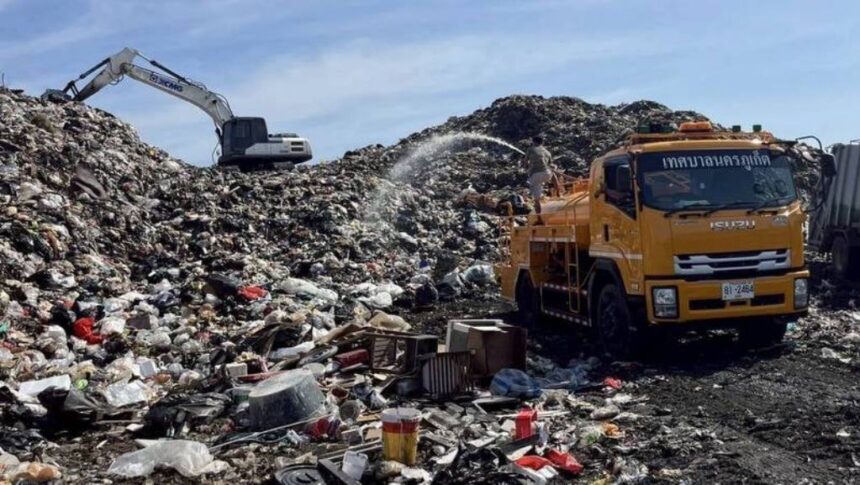
PHUKET – Phuket City Municipality partially resumed accepting rubbish at the provincial landfill on Nov. 12, four days after illegally dumped waste blocked the facility’s main access road and halted deliveries across the island.
The shutdown forced 18 local administrative organizations to suspend or delay garbage pickups, leaving uncollected bags rotting in residential neighborhoods and commercial districts. While crews have cleared enough space to restart limited intake, Phuket’s governor has ordered five emergency measures to prevent a repeat collapse and protect public health.
Key Takeaways
- Partial intake resumed after heavy machinery cleared rubbish blocking the main disposal road, though full site operations remain pending.
- Collection schedules are gradually normalizing, but wet and unseparated waste faces strict rejection at municipal transfer points.
- The provincial governor enacted five urgent mandates covering strict route policing, wastewater runoff containment and mandatory source separation across all 19 local jurisdictions.
Collection Schedules and Waste Diversion
Garbage trucks are rolling again, but residents and long-stay visitors should not expect immediate normality. Mayor Suppachoke Laongphet confirmed that crews are still reorganizing dumping zones inside the Saphan Hin disposal center, meaning daily intake caps remain in place until full capacity returns next week.
During the four-day closure that began Nov. 8, municipal districts diverted incoming rubbish to temporary holding plots and prioritized clearance around hospitals, fresh markets and dense housing estates. Workers are now shredding fallen branches and converting organic refuse into soil conditioner to free up space inside the main cells. Households must drain liquids from food scraps and bag organic waste separately before placing bins curbside.
Phuket Governor’s Five-Point Mandate
To break the cycle of recurring bottlenecks, the provincial governor issued five binding directives. First, emergency crews must clear backlogged street piles and restore truck traffic flow. Second, police and municipal inspectors will patrol landfill access roads and prosecute anyone caught dumping loads illegally or obstructing haulers.
Public health protection anchors the third directive. Provincial environmental officers must monitor leachate — the toxic liquid that drains from rotting garbage — to ensure zero runoff reaches nearby canals or coastal waters, while health teams track respiratory and sanitation complaints in surrounding communities. The fourth rule compels all 19 local administrative bodies to enforce source separation and moisture reduction across households, restaurants and hotels. Finally, officials must draft short- and long-term expansion plans, including rewards for businesses that cut landfill volume.
Decades of Overload Behind the Bottleneck
This month’s roadblock exposed a structural deficit years in the making. Phuket’s sole integrated waste facility was originally engineered to hold roughly 900,000 metric tons of refuse. When the shutdown began, accumulated waste on-site has surpassed 1.2 million metric tons.
Rapid urban expansion, year-round population growth and heavy rains routinely push daily garbage output beyond what the existing incinerator can burn. When wet waste clogs sorting lines, private and municipal haulers queue for hours, tempting rogue drivers to dump loads along the perimeter road.
Construction is underway on a second incinerator designed to burn 500 metric tons daily, but until that plant comes online, Phuket’s sanitation network remains one rainstorm or blocked lane away from another standstill.