
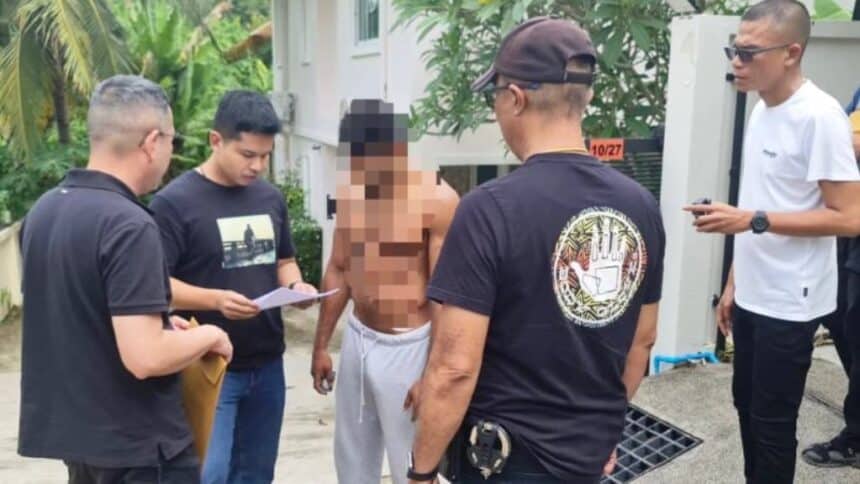
PHUKET – Thai immigration officers arrested a 33-year-old American fugitive wanted by the FBI on human trafficking charges at a luxury villa in southern Phuket, authorities confirmed Saturday, Nov. 14.
Officers with Phuket Immigration tracked the suspect, identified officially only as Ronald, to the Chalong subdistrict on Friday, Nov. 13, after receiving intelligence from U.S. federal agents that he had entered Thailand and registered a local address. Police immediately revoked his permission to stay in the country and placed him in custody ahead of formal removal proceedings.
Key Takeaways
|
Tracking the Suspect in Chalong
According to Police the operation began after the FBI alerted Thai counterparts that the wanted man had arrived in the kingdom. Investigators cross-referenced travel records against the Immigration Bureau’s database and traced his registered accommodation to a high-end residential property in Chalong.
Officers placed the villa under surveillance before moving in to verify the man’s travel documents. Police reported that his identity matched the physical details and warrant records supplied by U.S. investigators. Police informed him of his legal rights, documented his arrest and transported him to the Phuket Immigration Office for processing.
Legal Status and Extradition Path
Immigration Division 6 revoked Ronald’s visa immediately upon his arrest, citing his status as a foreign fugitive wanted on an overseas warrant. Thai officials have not disclosed the specific U.S. district court that issued the human trafficking indictment, nor have they confirmed whether a Thai court hearing has been scheduled.
Under Thailand’s Extradition Act B.E. 2551 and the bilateral treaty between Bangkok and Washington, U.S. authorities typically have 60 days from a provisional arrest to submit a formal extradition package through diplomatic channels. In many immigration cases, however, Thai authorities cancel a fugitive’s visa and deport them directly into the custody of U.S. federal marshals, bypassing lengthy courtroom battles.
The arrest highlights how Thailand’s strict foreigner-tracking laws turn resort islands into difficult hiding spots for international suspects. Under Section 38 of the Immigration Act, hotel managers, villa owners and private landlords must report the arrival of any foreign guest to immigration police within 24 hours.
That digital paper trail gives Thai investigators real-time visibility across Phuket’s sprawling rental market. Over the past year, Immigration Division 6 has used those mandatory filings alongside tip-offs from the 1178 public hotline to capture several high-profile fugitives, including a 24-year-old Kazakh fraud suspect in Patong earlier this month and an American wanted on child abuse warrants at Nai Yang Beach in August. For Phuket’s tourism-reliant neighborhoods, rapid joint operations with foreign agencies aim to deter transnational offenders from using the island as a safe haven.
Trending News:
South African Tourist Missing in Phuket Found Dead
American Woman Wanted By FBI Arrested in Bangkok