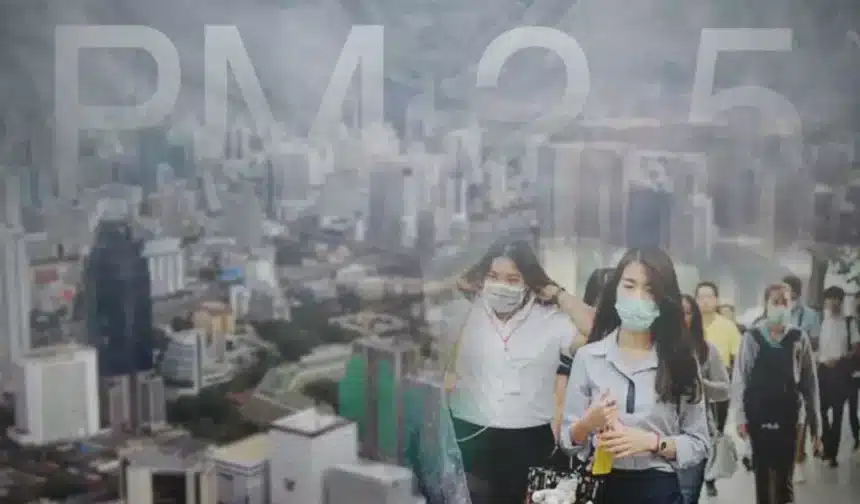
BANGKOK — Fine-dust pollution pushed past Thailand’s national safety threshold in five Bangkok districts over the weekend, signaling an early start to the capital’s annual cool-season haze and prompting health warnings ahead of another forecast spike on Nov. 19–20.
State environmental monitors recorded unhealthy levels of PM2.5 — tiny airborne particles small enough to enter the bloodstream — across outer industrial corridors and dense downtown neighborhoods. For expatriates managing asthma, young children or older relatives, the shifting readings make checking real-time government data essential before scheduling outdoor workouts.
Key Takeaways• Five Districts Breached Limits: Weekend monitoring showed Lat Krabang, Bang Khen, Pathum Wan, Pom Prap Sattru Phai and Yannawa exceeded the 37.5-microgram safety limit. • Next Surge Forecast Nov. 19–20: A strengthening cold air mass is expected to trap pollutants near ground level again later this week after brief midweek wind relief. • Check Live Data Before Exercise: Sensitive groups should verify hourly district numbers on the state Air4Thai portal rather than relying on daily news summaries. |
Affected Districts and Official Readings
A Nov. 16 news roundup citing weekend data from the Pollution Control Department showed nine locations across Bangkok and neighboring provinces entered the orange health-warning tier, where air pollution begins affecting sensitive residents. Within the capital’s 50 districts, Bangkok Post reported that five stations surpassed Thailand’s 24-hour standard of 37.5 micrograms per cubic meter (µg/m³).
Eastern industrial hub Lat Krabang logged the highest city reading at 40.1 µg/m³, followed by northern suburb Bang Khen at 39.4. Central shopping district Pathum Wan and historic Pom Prap Sattru Phai both hit 39.0, while riverside Yannawa reached 37.8. Nearby Khlong Sam Wa, Nong Khaem, Prawet and Klong Toey hovered just below the cutoff. Because weather shifts quickly, those weekend figures serve only as a baseline rather than live conditions.
Why Cool Weather Traps Bangkok’s Dust
Bangkok’s air crisis follows a predictable seasonal trap every November. While agricultural crop burning in northern Thailand and neighboring countries dominates headlines later in the dry season, satellite data showed no abnormal heat hotspots around the capital this week.
Instead, municipal studies show diesel trucks and commuter traffic generate up to 70% of Bangkok’s fine particulate matter year-round. During rainy months, sea breezes and afternoon storms wash those exhaust fumes away. When cooler high-pressure air pushes south from China, a stagnant atmospheric lid forms over the flat Chao Phraya River basin, pinning vehicle exhaust and construction dust at street level. State forecasters expect brief relief from daytime winds between Nov. 17 and 18 before a stronger cold air mass stalls ventilation again on Nov. 19–20.
How to Check Live Readings and Protect Your Family
Morning news digests reflect past 24-hour averages, which can mask sharp midday spikes along congested roads. Before heading to Lumphini Park or letting children play outside, residents should check live district sensors on the government’s Air4Thai website or mobile app.
Match daily routines to Thailand’s color-coded thresholds. When a neighborhood station turns yellow (25.1 to 37.5 µg/m³), healthy adults can exercise normally, though people with asthma should watch for coughing or shortness of breath. Once readings cross 37.5 µg/m³ into orange, children, seniors and anyone with heart or lung conditions should move workouts indoors and wear a snug N95 or KN95 mask outside. Keep bedroom air purifiers running on auto mode overnight, especially ahead of Thursday’s forecast surge.