
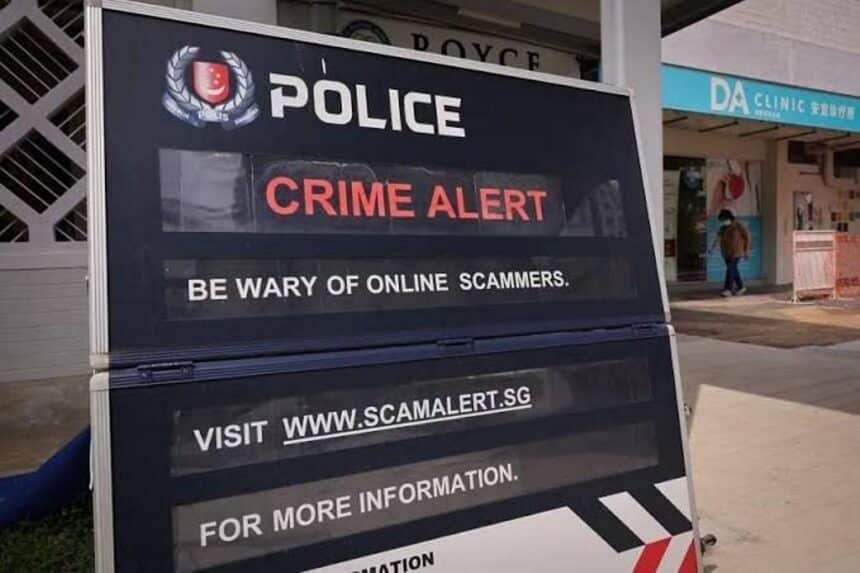
SINGAPORE — Singapore police are investigating 235 people over alleged roles in more than 536 scam cases involving victim losses of around SGD 4.2 million following an islandwide enforcement operation.
The Singapore Police Force said on November 19, 2026, that officers from its Cyber Command and seven Police Land Divisions conducted the two-week operation between November 5 and November 18, 2026.
A total of 159 men and 76 women, aged between 16 and 93, are assisting with police investigations for their suspected involvement as scammers or money mules, according to the police statement.
Preliminary investigations indicated the 235 individuals were linked to more than 536 scam cases, comprising mainly e-commerce scams, phishing scams, job scams, government official impersonation scams, investment scams and lucky draw scams.
Police said the individuals are being investigated for alleged offences including cheating, money laundering or providing payment services without a licence.
Penalties Under Singapore Law
Under Section 420 of Singapore’s Penal Code 1871, the offence of cheating carries a maximum jail term of up to 10 years and a fine, according to the police release. According to local news outlet AsiaOne, money laundering offences carry up to 10 years in jail, a fine of up to SGD 500,000, or both, while providing unlicensed payment services carries up to three years in prison, a fine of up to SGD 125,000, or both.
Scammers and members or recruiters of scam syndicates face mandatory caning of between six and 24 strokes under criminal law amendments passed in late 2025. Scam mules who assist syndicates by laundering proceeds, providing SIM cards or handing over Singpass digital identity credentials face discretionary caning of up to 12 strokes, the Singapore Police Force said.
Restrictions on Banking and Telecom Access
Police said individuals involved in mule-related offences are also subject to the Facility Restriction Framework, which limits access to banking services and mobile lines to prevent further facilitation of scams.
These restrictions apply to individuals who have been warned, fined, prosecuted or convicted of mule-related offences, as well as suspects under investigation who are assessed to be at risk of continuing to assist scammers.
Data released by the Ministry of Home Affairs showed that between the rollout of the Facility Restriction Framework in October 2025 and June 30, 2026, authorities placed 1,423 money mules, 1,439 SIM card mules and 53 corporate mules under the regime.
Broader Anti-Scam Legislation
The enforcement operation followed legislative steps by Singapore authorities to curb online fraud across financial and telecommunications networks.
In August 2026, the Ministry of Home Affairs introduced the Scams (Countermeasures) and Other Matters Bill in Parliament to empower police to issue disclosure orders and account disabling orders to service providers for up to 30 days, extendable once for another 30 days.
The legislation also supports the National Scams List, a platform being developed by the Home Team Science and Technology Agency and police to enable scam-related information sharing between authorities and service providers.
In a separate parliamentary update on November 3, 2026, the Ministry of Home Affairs proposed default jail or reformative training sentences for young scam offenders aged 16 to 20, saying, “If a deterrent approach is not taken, Singapore’s scam and youth offending situation could deteriorate.”
Ongoing Police Investigations
Singapore police said investigations into the 235 individuals are ongoing and that authorities take a serious view of anyone involved in scams.
Police urged members of the public to reject requests from others to use their bank accounts or mobile lines, warning that account holders will be held accountable if those facilities are linked to crimes.
Anyone with information related to scam cases can contact the Singapore Police Force hotline at 1800-255-0000 or submit details online through the police i-Witness portal, the statement said.