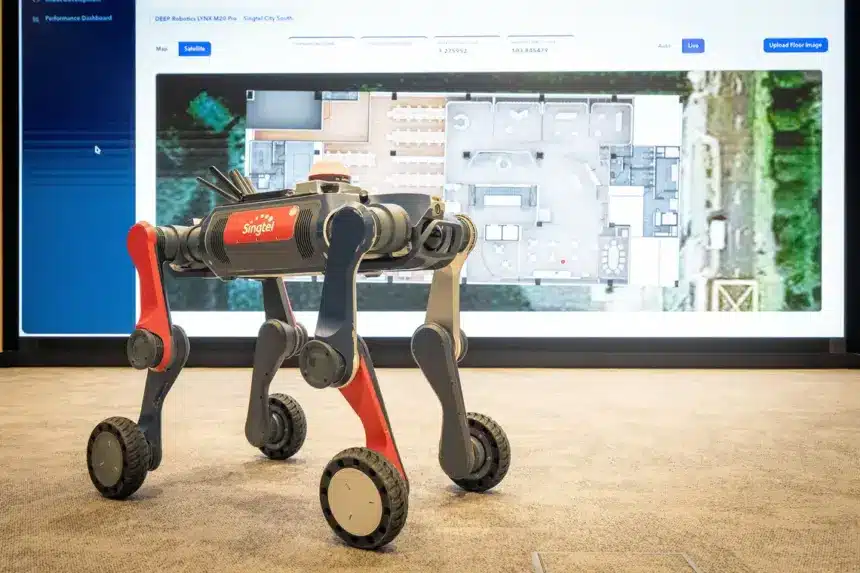
SINGAPORE — Singapore Telecommunications Ltd. will become the first private company to adopt a government-built digital system that lets autonomous robots, artificial intelligence tools and building hardware work together, officials announced Nov. 26. Under a new agreement with the Government Technology Agency of Singapore, the telecom giant will deploy the Open Digital Platform at its redeveloped Orchard Road headquarters, One Comcentre, when the complex opens by late 2028.
The partnership moves Singapore’s public-sector smart-city software into commercial real estate for the first time. By pairing Singtel’s 5G+ wireless network with GovTech’s integration software, the project creates a live test bed for managing multi-brand robot fleets alongside human office workers while guarding against cyber intrusions into physical building controls.
Key Takeaways
- First Commercial Rollout: Singtel will deploy GovTech’s Open Digital Platform at its One Comcentre headquarters in Somerset by late 2028, marking the system’s debut outside state estates.
- Cross-System Coordination: The software acts as a universal translator, allowing delivery, cleaning and security robots to summon lifts, open doors and share data with building controls over 5G+ networks.
- Strict Data Isolation: Multi-tenant walls, identity-based access rules and public-sector cybersecurity standards restrict robots and tenants strictly to authorized zones and data streams.
How the Digital Translator Works
Modern office towers often run on fragmented software. Elevators, air-conditioning units, security turnstiles and service robots typically speak separate digital languages, forcing facility managers to juggle disconnected screens. Co-developed by GovTech and industrial landlord JTC Corporation, the Open Digital Platform bridges those gaps through open interfaces and adaptors for over 20 types of building systems.
At One Comcentre, that shared foundation will coordinate parcel deliveries, floor cleaning, security patrols and predictive maintenance. Instead of waiting for a guard to badge a machine through a lobby, an authorized cleaning robot can request lift access directly from the platform. Operators will also monitor live operations through 3D digital twins—virtual building replicas that simulate foot traffic, flag equipment faults early and adjust cooling loads based on room occupancy.
Locking Down Cyber and Physical Access
Connecting physical infrastructure to autonomous machines raises immediate security stakes. Weakly protected links to operational technology—the hardware running lifts, doors and power grids—can expose commercial towers to digital hijacking or unauthorized entry.
GovTech’s platform counters that risk with strict multi-tenancy and identity-based key management. Every robot, sensor and application receives verified credentials that restrict it to approved floors and tasks. Tenant data streams remain isolated behind separate digital walls, while governance controls enforce Singapore’s public-sector data protection and cybersecurity rules. Singtel will layer private 5G+ network intelligence on top to keep machine commands encrypted and responsive.
Labor Pressures and the Punggol Blueprint
The push into automated building management reflects acute demographic and cost pressures in Singapore. Under the government’s Progressive Wage Model, minimum monthly pay for entry-level resident cleaners rose to S$2,080 in July 2026 and will reach S$2,420 by 2028, alongside tight foreign-worker quotas. Over 60 percent of resident cleaners are aged 60 or older, leaving contractors short-handed.
GovTech and JTC first proved the platform at the state-run Punggol Digital District, linking over 20,000 sensors to trim estate energy use and operational manpower needs by up to 30 percent. Exporting that model to Somerset tests state-grade automation in a dense commercial hub.
Singtel Singapore Chief Executive Ng Tian Chong said buildings must recognize and safely accommodate autonomous machines working alongside people as AI enters physical spaces. GovTech briefings note that while the software resolves technical coordination, human oversight stays vital because AI models recommend actions without holding unrestricted control over physical hardware.
Labor specialists caution that robots remain workplace aids rather than full replacements. Singapore’s Tripartite Cluster for Cleaners has urged firms to pair automation with skills training so older staff move into higher-paid machine-operator and supervisory roles. Complex sanitation, tenant hospitality and split-second emergency judgment still depend on people.