
GUANGZHOU – China’s electric vehicle maker XPeng plans to begin hardware mass production of its IRON humanoid robot in January 2027, setting up a commercial release in the second quarter after internal store trials, Chairman and CEO He Xiaopeng announced at the company’s annual technology event in Guangzhou on Nov. 25.
The aggressive manufacturing timeline tests whether an automaker can translate assembly-line speed into commercially viable robotics before real-world customer demand is proven. Rather than sending early units directly into heavy industrial plants, XPeng will deploy its first production batch as trainee sales assistants across its Chinese retail showrooms in early 2027, separating factory output from complex enterprise deployment.
Key Takeaways
• Hardware mass production for XPeng’s IRON humanoid robot starts in January 2027 on an automated Guangzhou assembly line built to complete one unit every 2.5 minutes at full capacity.
• Deployment follows a two-step rollout: units will work as trainee sales guides in XPeng’s domestic car showrooms during Q1 2027 before public sales and external deliveries begin in Q2 2027.
• Robotics analysts note that while Chinese firms dominate global hardware shipments, building thousands of robots is distinct from proving profitable, autonomous labor outside controlled retail spaces.
Assembly Speed Versus Field Readiness
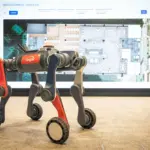
At the 2026 XPeng AI Day, He Xiaopeng drew a sharp line between laboratory prototypes and commercial work tools. Standing 170 centimeters tall with 76 degrees of freedom and more than 1,500 tactile sensing points, the upgraded IRON unit walked onto the Guangzhou stage and answered questions in Chinese and English without human remote control. The robot runs on XPeng’s Turing Physical AI Architecture, pairing three proprietary AI chips with a solid-state battery rated above 300 watt-hours per kilogram.
XPeng has already built a dedicated Guangzhou factory where more than 80% of core assembly processes are automated. According to company disclosures, the line is engineered to roll out a finished robot every 2.5 minutes at peak pace, targeting roughly 1,000 units per month once volume ramps up. Every unit passes through more than 600 AI-assisted quality checks and over 1,000 component tests before leaving the floor.
High factory throughput does not equal immediate industrial autonomy. In the first quarter of 2027, IRON will enter controlled retail environments as a showroom greeter, product guide and internal trainer, allowing engineers to gather operational telemetry. XPeng also plans to sell the machine through a hybrid model combining upfront hardware purchases with token-based software subscriptions, letting business buyers unlock specialized tasks after delivery.
China’s EV Supply Chain Spillover
XPeng’s ability to move from prototype validation to an automated assembly line in months stems directly from China’s massive electric vehicle manufacturing base. Roughly 85% of IRON’s hardware components overlap with existing automotive supply chains, allowing XPeng to repurpose lithium cells, sensors, actuators and precision tooling already scaled for passenger cars. Institutional investors have backed that industrial overlap: XPeng’s robotics unit raised more than $900 million in August 2026 from backers including IDG Capital, Tencent and Alibaba at a post-money valuation exceeding $6.3 billion, the largest single private funding round in China’s embodied AI sector.
This domestic ecosystem has reshaped global robotics economics. Data compiled by the Robotics Center shows Chinese companies accounted for roughly 90% of global humanoid installations in 2025, led by shipments from Unitree and AgiBot. Supported by Beijing’s Ministry of Industry and Information Technology technical standards and municipal land and capital subsidies across Guangzhou, Shenzhen and Shanghai, local parts makers have broken foreign monopolies on precision reducers and servo motors.
For local factory workers and supply-chain vendors in southern China’s Pearl River Delta, the shift creates immediate upstream demand for micro-actuators and tactile sensors while raising long-term questions about service-sector displacement. Yet XPeng has withheld IRON’s retail price tag, signaling that unit economics remain delicate.
Experts Weigh Shift in China’s Automation Strategy
Robotics researchers and industry analysts say XPeng’s roadmap highlights a broader pivot in China’s automation strategy—from subsidizing hardware factories to hunting for repeatable commercial workloads. Historically, Beijing’s industrial policy prioritized building physical manufacturing capacity first, driving down unit costs through sheer volume across solar panels, batteries and electric cars.
An industry analysis published by AndroidShow notes that China’s largest humanoid customer base remains research laboratories, state-backed testbeds and data-collection centers rather than profit-driven factories. Analysts warn that shipping thousands of machines creates a supply-chain triumph, not yet a commercial one, because unstructured workplaces still challenge bipedal balance, fine hand manipulation and battery endurance.
XPeng’s decision to start in its own car dealerships reflects that operational reality, a point echoed in coverage by TechNode. Showrooms offer flat floors, predictable wireless networks, nearby technicians and continuous human interaction to feed XPeng’s 50,000-square-meter Robot Data Factory. Rivals are testing parallel paths: UBTech has placed walkers inside BYD and Foxconn plants, while Tesla and Hyundai prepare their own automotive-backed lines.
Whether XPeng’s showroom trainees evolve into reliable warehouse or factory workers by late 2027 will determine if China’s automakers can turn assembly-line speed into lasting artificial intelligence dominance.