
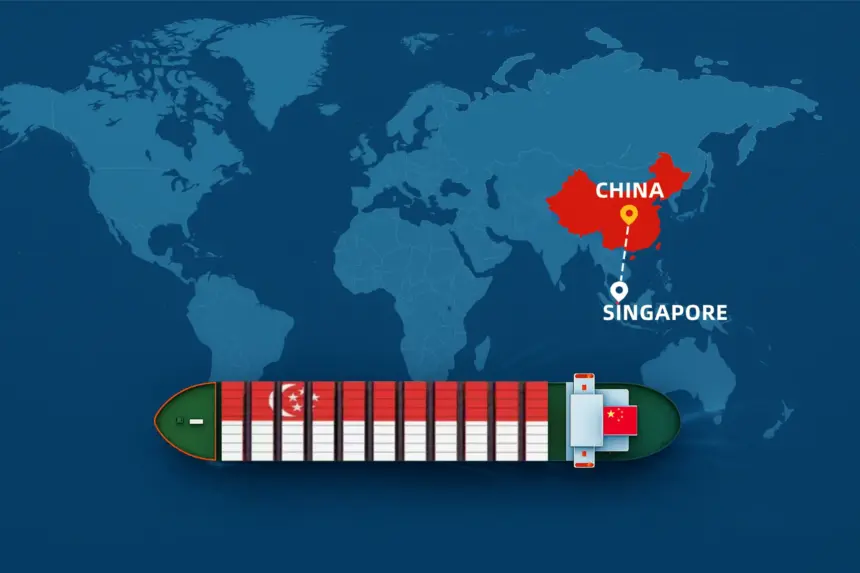
SINGAPORE — Singapore and China formalized new partnerships on green shipping corridors and artificial intelligence safety governance during Prime Minister Lawrence Wong’s working visit to Shenzhen and Beijing from Nov. 18 to 21, 2026.
Signed by senior transport, environment and technology agencies, the agreements establish biennial ministerial oversight and cross-border compliance mapping, creating immediate regulatory clarity for maritime carriers and tech firms ahead of the 22nd Joint Council for Bilateral Cooperation in Singapore on Nov. 23.
Key Takeaways
- Singapore’s Ministry of Transport and China’s Ministry of Transport signed a memorandum of understanding to implement Green and Digital Shipping Corridors, overseen by a ministerial committee meeting every two years.
- Singapore’s Infocomm Media Development Authority and the China Academy of Information and Communications Technology completed a joint mapping of their AI risk management frameworks to reduce duplicate compliance burdens.
- While transport and green industry pacts are signed commitments, a planned memorandum on AI in education and broader digital trade rules under an upgraded free trade agreement remain under negotiation.
Signed Pacts Anchor Maritime Decarbonization
On Nov. 21, Singapore Minister for Transport Jeffrey Siow and Chinese Minister of Transport Liu Wei signed a bilateral transport memorandum targeting low-carbon maritime logistics. The pact prioritizes the rollout of Green and Digital Shipping Corridors connecting Singapore with Chinese ports, alongside intelligent transport systems and transport safety.
To enforce accountability, both ministries established a Joint Ministerial Steering Committee co-chaired by Siow and Liu. The committee will convene every two years, alternating between Singapore and China, supported by technical working groups.
Ahead of Wong’s trip, Singapore Minister for Sustainability and the Environment Grace Fu and China National Development and Reform Commission Chairman Zheng Shanjie also signed a green industry memorandum. That commitment covers energy-saving technologies, circular economy initiatives, clean energy transitions and biodiversity conservation.
AI Governance Mapping Cuts Compliance Friction
In the technology sector, Singapore’s Infocomm Media Development Authority and the China Academy of Information and Communications Technology completed a joint mapping of their respective AI governance standards. Regulators aligned Singapore’s AI Verify Testing Framework with China’s AI Safety and Governance Capability Requirements for System Risk Management Standard (YD/T 7173-2026), which Beijing’s Ministry of Industry and Information Technology published in July 2026.
The technical crosswalk clarifies organizational capacity-building, process controls and risk assessment protocols across both jurisdictions. Companies deploying generative or industrial AI models across Southeast Asia and mainland China can now benchmark safety audits against a shared reference rather than conducting redundant testing.
Distinguishing Commitments From Future Talks
Officials drew a clear boundary between finalized agreements and broader areas slated for future negotiation. While the transport, green industry and AI risk-mapping deliverables represent completed work, an educational technology memorandum led by the National University of Singapore’s AI Centre for Educational Technologies and East China Normal University’s Shanghai Institute of AI for Education awaits formal signing.
Similarly, Wong and Chinese President Xi Jinping met in Shenzhen on Nov. 20 to launch negotiations on Version 4.0 of the China-Singapore Free Trade Agreement. Chinese Premier Li Qiang affirmed on Nov. 21 that Beijing will accelerate those talks, which aim to codify binding rules for the digital economy, public procurement and artificial intelligence, though no timeline for conclusion was announced.
Regional Supply Chains and Strategic Context
The agreements arrive as global maritime regulators tighten emissions mandates and supply chains fragment under U.S.-China technology competition. Singapore handles roughly one-fifth of global container transshipment, while Chinese ports dominate East Asian manufacturing exports. Linking port infrastructure through digitalized, zero-emission fuel corridors addresses acute commercial bottlenecks in bunker fuel availability and customs clearance.
The bilateral push also builds on existing regional corridors, including the Chongqing Connectivity Initiative’s International Land-Sea Trade Corridor and China’s Pinglu Canal project in Guangxi. By establishing interoperable AI safety rules and green shipping lanes now, Singapore positions itself as a neutral regulatory bridge ahead of its 2027 chairmanship of the Association of Southeast Asian Nations.
Opportunities for Regional Businesses
Once agencies publish detailed implementation schedules following the Nov. 23 Joint Council for Bilateral Cooperation, regional enterprises face clear entry points. Maritime fuel suppliers, port terminal operators and logistics software providers can bid for pilot projects supporting alternative marine fuels—such as green methanol and ammonia—and electronic bills of lading along the Singapore-China shipping lanes.
For technology vendors and financial institutions, the IMDA-CAICT governance mapping lowers market-entry costs. Software developers certified under Singapore’s AI Verify framework can leverage the technical alignment to demonstrate baseline risk compliance to Chinese enterprise clients, accelerating cross-border commercial deployment without waiting for multi-year trade treaty ratifications.