
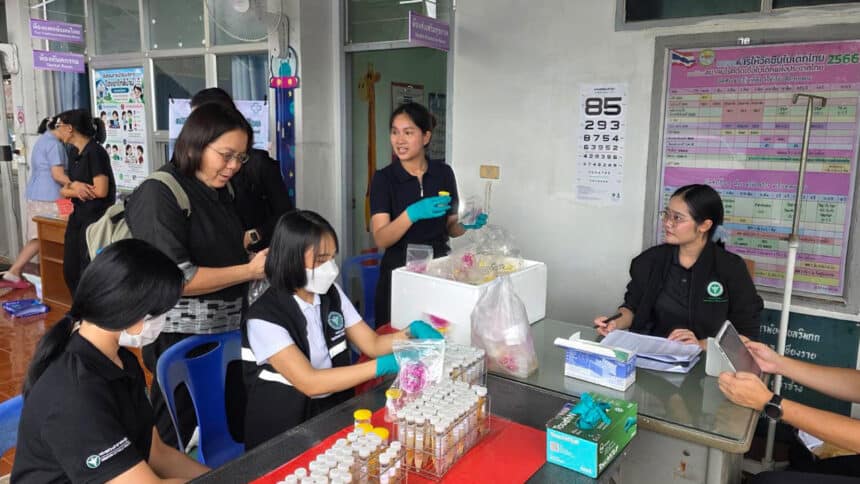
CHIANG RAI — Urine tests show that 31 of 549 Chiang Rai residents carry inorganic arsenic levels above the safe reference limit, provincial health chief Dr. Somruek Jungsaman announced Thursday, providing the first human health data from northern Thailand’s ongoing river contamination crisis.
Results for another 399 people in the border district of Mae Sai remain pending as authorities scramble to trace how residents were exposed. Health officials will closely monitor the 31 affected individuals while cross-border river pollution disrupts water supplies for more than 20,000 households across the province.
Key Takeaways• Elevated exposure: 31 out of 549 tested Chiang Rai residents recorded inorganic arsenic in their urine above the safety threshold. • Pending border data: Laboratory results for 399 additional residents in Mae Sai district are still awaiting analysis. • Active containment: Medical teams are monitoring the 31 patients and tracing whether exposure stems from polluted local rivers or food sources. |
Tracing Exposure Across Border Districts
Health teams screened 6,269 people across 338 villages in all 18 districts of Chiang Rai before collecting urine samples from high-risk groups,Dr. Somruek, who also serves as Thailand’s permanent secretary for public health, announced the initial findings during field inspections in Mae Sai and Chiang Saen districts.
Investigators have not yet confirmed whether the 31 residents ingested the toxin through the Kok, Sai or Ruak rivers. Inorganic arsenic, the toxic form commonly found in contaminated groundwater and industrial runoff, is a known human carcinogen that accumulates quietly in the body without immediate symptoms.
Mae Sai Hospital reported Friday that no patients have arrived with acute arsenic poisoning symptoms, though staff have prepared screening protocols for worried residents. Doctors urged villagers to avoid untreated river water for drinking, cooking or crop irrigation while tracing teams interview the 31 positive cases about their daily water and food habits.
Upstream Mines and a Troubled Watershed
The human test results follow months of escalating heavy-metal contamination flowing south from neighboring Myanmar. Chemical analysis and satellite modeling by Naresuan University researchers traced much of the toxic sediment in the Sai River to unregulated gold and rare-earth mining operations across the border in Myanmar’s Shan State.
Heavy monsoon runoff and mining discharge pushed arsenic concentrations in the Sai River to 25 to 28 times Thailand’s safe drinking limit this fall. In early November, extreme turbidity forced Mae Sai’s municipal waterworks to suspend tap water production for 14 villages, leaving over 20,000 households reliant on bottled water and emergency tank deliveries.
Pollution has since migrated downstream into the Kok and Ruak rivers before entering the Mekong River at Chiang Saen. Similar health warnings emerged in October when authorities detected elevated arsenic in 17 of 177 residents tested downstream in Nong Khai province.
Emergency Water and Cross-Border Talks
Prime Minister Anutin Charnvirakul ordered state agencies this week to secure alternative water supplies and intensify tap water monitoring across northern border communities. Crews have already distributed more than 100,000 liters of clean water while installing specialized filtration units in vulnerable villages.
Bangkok is pairing local relief with diplomatic pressure ahead of regional talks scheduled for Nov. 24. Under a newly unveiled six-point government plan, Thai researchers will use isotope testing to pinpoint exact mining sources, trap contaminated river sediment before it reaches rice paddies and tighten customs controls on mineral shipments. Agricultural teams are also mapping soil and crop risks across affected border farms.
For residents in Mae Sai, the pending batch of 399 urine results will determine whether exposure remains isolated or signals a wider public health emergency along the border.