PRACHIN BURI — Seasonal floodwaters swept across central and eastern Thailand this autumn, flushing hazardous runoff from towering illegal e-waste dumps into the Prachin Buri River and surrounding farmland. The chemical surge destroyed rice paddies and pomelo orchards across Si Maha Phot and Si Mahosot districts while tainting groundwater supplies for hundreds of rural households.
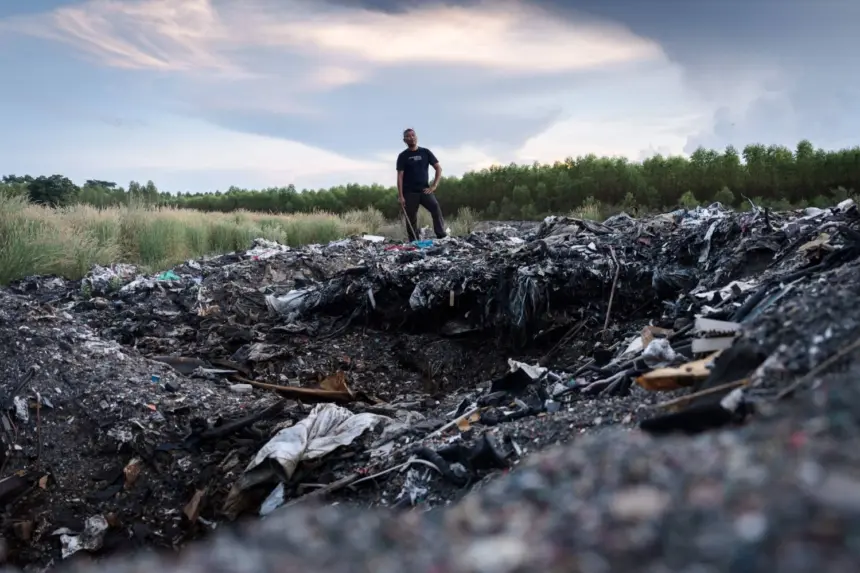
A field investigation by The Nation Thailand documented ten-story mounds of smuggled electronics and industrial refuse bleeding toxic heavy metals into waterways that residents rely on for drinking, farming and fishing. The contamination forced temples to cancel annual Loy Krathong festivities, triggered unexplained illnesses among villagers and prompted Industry Minister Varawut Silpa-archa to order immediate factory freezes and nationwide inspections of nearly 3,000 waste facilities.
Key Takeaways
- Floodwater runoff from illegal, 10-story electronic and industrial e-waste dumps contaminated the Prachin Buri River, killing crops and forcing residents to truck in drinking water.
- Medical urine tests confirmed excessive heavy metal levels in local village headman Tira Srimongkol, while hundreds of neighbors report respiratory distress and mysterious illnesses.
- Industry Minister Varawut Silpa-archa ordered a freeze on offending Type 105 and 106 waste plants and launched nationwide audits of nearly 3,000 licensed facilities.
Poisoned Waters and Destroyed Livelihoods
For generations, communities along the Prachin Buri River lived off a fertile floodplain famed for freshwater fish and geographical indication-certified pomelos. That abundance vanished once rainbow-colored oil slicks and black, pungent runoff began seeping from nearby industrial landfills into village canals.
Tira Srimongkol, 59, who has served as a local village headman for a decade, told reporters that residents previously harvested food effortlessly from their own fields and streams. Now, nothing from the floodplain is safe to eat. Public health officials warned villagers not to touch or consume local river water two days after floodwaters rose, yet families say authorities failed to deliver follow-up water test results or clarify when farming can resume.
The crisis halted daily life and cultural traditions alike. A committee member at Wat Nong Sakae confirmed that the temple canceled this year’s Loy Krathong festival because the river had become hazardous. Farmers also barred water buffalo from drinking at local ponds out of fear of cancer and acute poisoning, while households now depend entirely on trucked-in water supplies to survive.
Exposure has already left measurable damage inside human bodies. Tira confirmed that clinical urine tests detected heavy metals exceeding safety thresholds in his system. Even after regulators ordered a nearby facility to suspend operations, acrid chemical fumes continued rolling across villages at night, leaving the headman and his neighbors with chest tightness, dizziness, nausea and burning throats.
Global E-Waste Shifts and Loopholes Created a Dumping Ground
Prachin Buri’s environmental emergency stems from a decade-long upheaval in global scrap trading and weak domestic enforcement. According to United Nations trade data cited in the broadcast, China once absorbed 70% of the world’s discarded electronics before Beijing abruptly banned foreign waste imports in 2018. Global waste brokers immediately redirected millions of tons of scrap toward Southeast Asia, where regulatory oversight lagged behind industrial expansion.
Thailand imported up to 100,000 tons of electronic waste annually between 2017 and 2018 before enacting import bans in 2020 and tightening customs rules in 2025. Despite those prohibitions and international safeguards under the Basel Convention, customs officers still intercept mislabeled shipping containers concealing circuit boards and unsorted hazardous scrap behind legitimate metal declarations. Industry data indicates that foreign capital and local brokers profit twice: collecting disposal fees abroad while extracting valuable metals and cheap plastics inside Thailand.
Domestic regulatory gaps compound the smuggling problem. Thailand hosts 3,049 factories licensed under Industry Ministry Type 105 and Type 106 permits for waste sorting, recycling and disposal, with roughly half clustered across five eastern provinces including Prachin Buri. Proper hazardous waste treatment costs operators between 800,000 and 1 million baht per batch, whereas legal fines for illegal dumping often top out at 200,000 to 300,000 baht, creating a financial incentive to break the law.
Unscrupulous operators also exploited rural landowners through a practice villagers call the “free soil” scheme. Factories distributed pulverized electronic residue and spent industrial solvents free of charge as landfill material to help farmers level low-lying plots. Unaware that the gray fill contained lead, cadmium and other heavy metals, residents spread toxic dust directly over agricultural soil and shallow water tables.
Public Anger Over Official Stunts and Slow Testing
Local frustration boiled over after Prachin Buri’s acting governor staged a public fish-eating demonstration in Prachantakham district to reassure consumers that provincial seafood remained safe. Villagers in Si Maha Phot and Si Mahosot quickly pointed out that Prachantakham sits upstream from the industrial zone and lacks the waste plants polluting their canals.
Tira noted that while upstream fish in clean zones may be edible, staging media meals miles away does nothing for downstream families afraid to cast nets in their own waterways. Residents compared the event to past political publicity stunts during avian flu outbreaks, arguing that officials prioritized public relations over root-cause remediation.
Environmental advocates warn that slow forensic sampling threatens accountability. The government pledged in early November to test riverbed sediment for heavy metals, campaigners fear seasonal currents will wash away chemical evidence needed to prosecute polluters in court.
Government Crackdown Targets Permits and Nominee Networks
Facing mounting street protests and petitions signed by over 1,300 Prachin Buri residents, Industry Minister Varawut Silpa-archa inspected the contaminated sites and declared the illegal dumps an encroachment on protected forest land. Acting under directives from Prime Minister Anutin Charnvirakul, Varawut ordered a freeze on offending Type 105 and Type 106 plants and vowed to prosecute violators regardless of political or business connections.
The ministry is pushing a three-strike penalty system that would permanently revoke operating licenses after three violations, alongside criminal asset-seizure probes with the Anti-Money Laundering Office. Parallel investigations by the Department of Business Development have also flagged four Prachin Buri waste firms suspected of using Thai nationals as illegal nominee shareholders to mask foreign ownership.
For villagers staring at ruined rice fields and blackened canals, enforcement promises remain a first step rather than a cure. Community leaders are demanding permanent closure of illegal waste sites, physical removal of the ten-story toxic mounds and direct financial compensation so farmers can rebuild their soil, water and health.