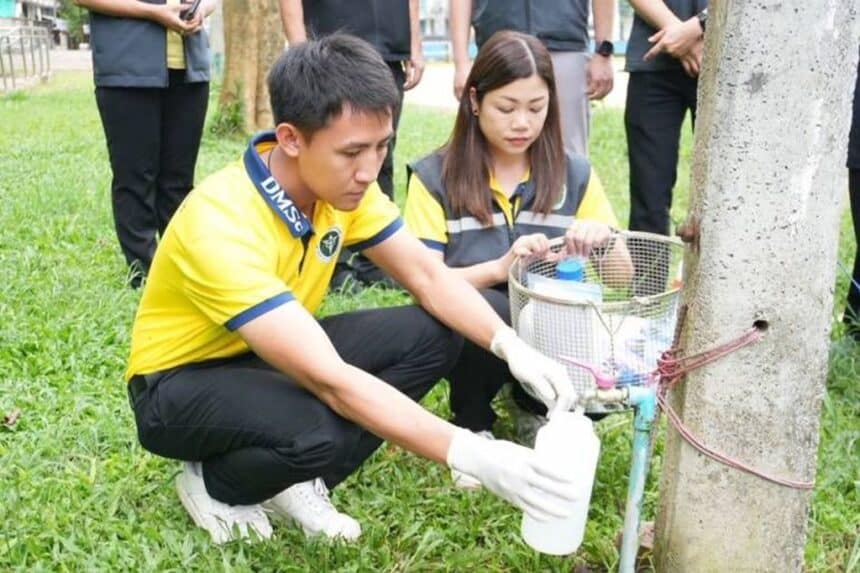
CHIANG RAI — Thai health authorities will test tap water across 91 village supply systems and inspect 390 drinking-water factories in seven northern and northeastern provinces over the next two weeks after severe arsenic contamination forced water shutoffs near the Myanmar border.
The Department of Health announced the sweep on Friday, ordering biweekly follow-up checks in Chiang Rai, Mae Hong Son, Loei, Nong Khai, Bueng Kan and Nakhon Phanom, along with one additional province along affected river basins. The emergency inspections follow a crisis earlier this month in Chiang Rai’s Mae Sai district, where officials cut tap water to 14 villages after arsenic readings spiked to roughly 30 times the national safety limit.
| Key Takeaways
• Health teams will test 91 village tap water systems and inspect 390 drinking-water plants across seven provinces within two weeks, repeating checks twice a month. • The sweeps target communities within 1 kilometer of rivers and natural waterways after arsenic hit 30 times safe limits in Mae Sai, cutting water to 14 villages. • Upstream mining across the border in Myanmar’s Shan State is driving toxic runoff into the Sai, Kok, Ruak and Mekong river basins. |
Factory Audits and Crop Screening Expand
Inspectors will focus on water infrastructure within 1 kilometer of rivers and natural streams. Department of Health Director-General Thiti Sawaengtham said teams from his agency, the Food and Drug Administration and the Department of Medical Sciences will also collect 53 fruit and vegetable samples alongside 25 rice samples to screen for arsenic, cadmium, mercury and lead.
Early commercial checks offered limited reassurance. Random FDA testing of 37 sealed bottled-water samples — five in Mae Sai and 32 in Chiang Rai’s Mueang district — found no heavy metals exceeding legal thresholds.
Community-run systems face higher risks. While the state-run Provincial Waterworks Authority operates industrial filtration plants that test water four times a month and keep arsenic below the 0.01 milligrams-per-liter standard, dozens of rural villages rely on small local waterworks. Those smaller systems often pump directly from rivers or shallow wells without heavy-metal treatment.
Cross-Border Mining Fuels Downstream Contamination
The contamination did not start inside Thailand. Chemical tracking and satellite analysis by researchers at Naresuan University traced the toxic sediment in the Sai River to unregulated gold and rare-earth mining upstream in Myanmar’s conflict-torn Shan State.
Roughly 143 kilograms of arsenic flow into Thailand each day through border waterways, according to provincial task force estimates cited by Chiang Rai Gov. Chucheep Pongchai. Heavy rains wash chemical extraction residues from hillside mines into the Sai, Kok and Ruak rivers, which feed into the Mekong.
When river levels dropped in early November, pollutant concentrations surged and turbidity overwhelmed local intakes. More than 20,000 households in Mae Sai and Wiang Phang Kham subdistricts lost piped water, forcing families to buy bottled water for drinking and cooking. Thai authorities responded by deploying water trucks, drilling deep groundwater wells and opening diplomatic talks with Myanmar.
Health Screenings Target At-Risk Border Residents
Toxic heavy metals are already showing up in residents and local wildlife. Urine screenings conducted by the Department of Disease Control detected elevated arsenic levels in 31 of 549 Chiang Rai residents tested so far, with lab results still pending for another 399 people in Mae Sai.
Inorganic arsenic is odorless, tasteless and classified as a human carcinogen. Chronic exposure through tainted water or irrigated crops raises the risk of skin lesions, cardiovascular disease and developmental harm in children. To speed up detection, the Public Health Ministry is producing rapid urine screening kits for distribution across high-risk villages.
River ecosystems are absorbing the same shock. Department of Fisheries tests along the Sai, Kok, Ruak, Mekong and Salween rivers found wild freshwater shrimp, snails and mussels carrying arsenic at nearly four times the legal limit and lead at almost six times the threshold, prompting warnings against eating wild-caught river shellfish.
Trending News:
Chiang Rai Schools Demand Urgent Water Arsenic Tests
How Safe Is Thailand’s Tap Water, Really?