
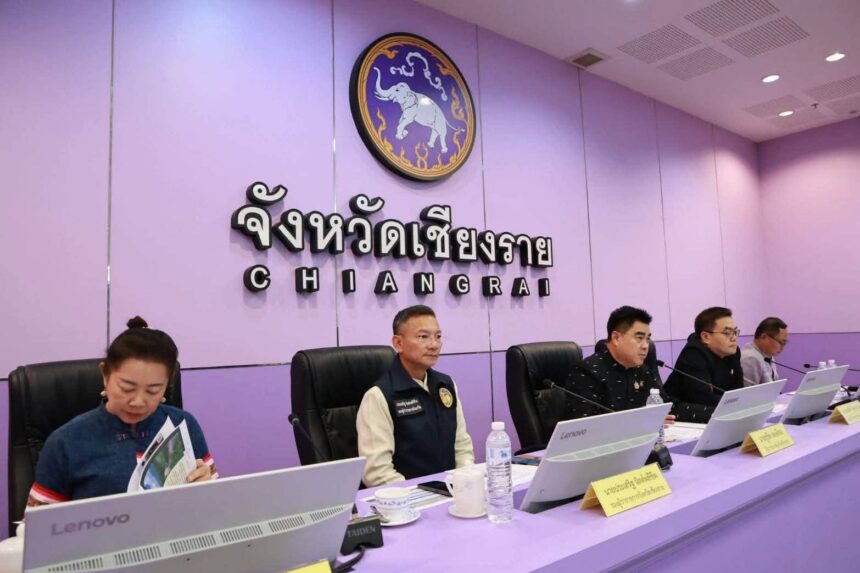
CHIANG RAI — Chiang Rai Gov. Chucheep Pongchai convened an emergency incident command center on Tuesday to unify provincial agencies, security forces and environmental regulators fighting heavy-metal contamination in northern waterways.
Established under Provincial Disaster Prevention and Mitigation Order 35/2569 on Monday, the command center executes urgent directives from Deputy Prime Minister and Higher Education, Science, Research and Innovation Minister Yodchanan Wongsawat. Officials at Chiang Rai City Hall reviewed water and sediment test results while rolling out agricultural risk maps, public health checks and daily briefings to counter online misinformation.
Key Takeaways• Chiang Rai Gov. Chucheep Pongchai activated an interagency command center on Nov. 24 to manage water pollution, farmland risk mapping and daily public updates. • Provincial engineers and researchers will hold a technical workshop Thursday to deploy sediment-trapping basins along the Sai River. • The response follows tests showing arsenic from upstream mining in Myanmar reaching up to 30 times safe drinking limits, prompting bilateral talks. |
Upstream Mining Fuels Border Water Crisis
The mobilization follows severe arsenic contamination in the Sai River, a transboundary waterway flowing from Myanmar’s Shan State into northern Thailand. Earlier this month, Thai regulators found arsenic levels at a Mae Sai waterworks reaching 30 times the national drinking limit of 0.01 milligrams per liter, temporarily cutting tap water to 14 villages and over 20,000 households.
Thai researchers using satellite modeling and chemical tracing linked the toxic sediment to unregulated gold and rare-earth mining across the border. Roughly 143 kilograms of arsenic enter Thailand daily via the river, threatening downstream rice paddies and eroding local trust after delayed early warnings forced residents to rely on bottled water.
Engineering Fixes and Cross-Border Diplomacy
To block heavy metals before tainted water enters irrigation canals, provincial officials and academic experts will host a technical workshop on Thursday. Engineers are fast-tracking smart sediment-trapping weirs that divert muddy river water into treatment basins—a design simulations show can strip up to 94.6% of arsenic and protect more than 4,300 hectares of farmland.
Chucheep ordered regional environmental, natural resource and agricultural offices to compile detailed operational papers for national cabinet review. At the same time, Bangkok has elevated the crisis into bilateral talks with Myanmar and Chinese representatives to establish joint water monitoring and cut cross-border mine runoff.
Inside the province, Chucheep instructed civil administrators, military units and police to feed verified lab findings directly into the command center. Rapid, transparent public updates, he told agency heads, are essential to stop rumors on social media and restore confidence across border communities.
Trending News:
Chiang Rai Farmers Seek Action on Rice Prices and Testing
Wa State Army Controlled Mines Poison Chiang Rai Rivers