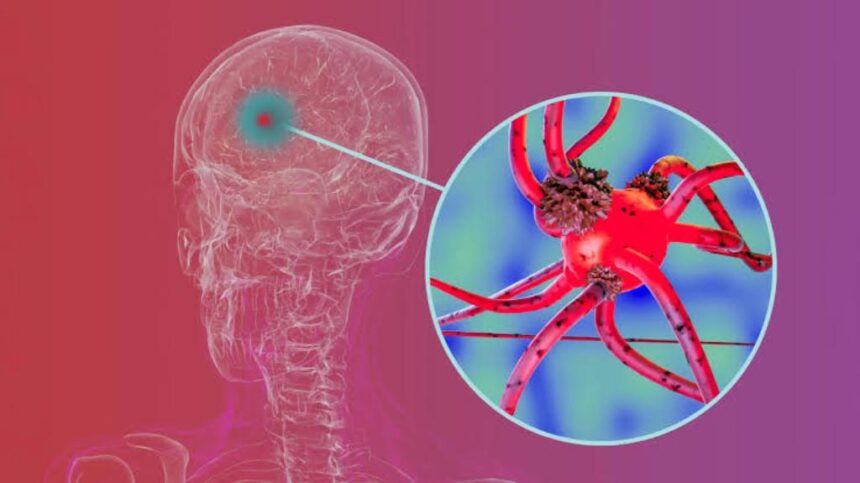
A protein linked to Parkinson’s disease may spread damage by encouraging more protein to misfold inside connected brain cells. But describing it as “mutated” can mislead: in most cases, the concern is misfolding, a change in protein shape, rather than a gene mutation.
Scientists are studying whether this process helps explain how the disease progresses. The evidence supports that possibility, but important details remain uncertain, and Parkinson’s isn’t contagious. Understanding the distinction starts with what alpha-synuclein normally does and what happens when its shape changes.
Key Takeaways
- Misfolding changes alpha-synuclein’s shape; it doesn’t necessarily involve a mutation in the gene that produces it.
- Laboratory studies support protein seeding and cell-to-cell spread, but human evidence remains indirect.
- Parkinson’s varies between people, so one proposed route through the brain doesn’t explain every case.
- Current treatments ease symptoms; approaches targeting alpha-synuclein remain under investigation.
A Mutated Protein Invades The Brain In Parkinson’s Disease
The phrase “mutated protein” blurs two different changes. A genetic mutation alters DNA instructions. Protein misfolding changes how a protein folds, even when those instructions haven’t changed.
Rare disease-causing variants in the SNCA gene, which encodes alpha-synuclein, can contribute to Parkinson’s. However, most discussions of abnormal alpha-synuclein concern its shape and tendency to aggregate, or clump together.
Normally, alpha-synuclein sits mainly near nerve-cell connections called synapses. It helps handle vesicles, the small packages that carry chemical messengers between cells. Researchers haven’t fully defined all its normal functions.
Abnormal alpha-synuclein is a major component of Lewy bodies, deposits inside nerve-cell bodies, and Lewy neurites, deposits within their extensions. A review of alpha-synuclein pathology describes these deposits and their relationship to disease. They also contain other material, and their presence alone doesn’t explain why neurons die or why symptoms differ.
How misfolded alpha-synuclein may spread between brain cells
Cell-to-cell spread is a proposed mechanism, not a proven account of every person’s Parkinson’s disease. It depends on abnormal protein encouraging further misfolding.
How one protein seed could trigger more clumping
An abnormal alpha-synuclein assembly may act as a “seed.” After leaving one cell and entering another, it could encourage that cell’s alpha-synuclein to aggregate. Newly formed assemblies might then move onward.
Researchers are investigating how cells release and absorb these assemblies, including through vesicles and cellular uptake processes. The research on alpha-synuclein spreading also leaves an important question unresolved: which protein forms are most capable of spreading and causing injury.
Why researchers study the gut, nose, and connected brain regions
The Braak hypothesis proposes that, in some cases, early pathology appears in the smell-processing system or lower brainstem, including gut-connected pathways. Other brain regions may become involved later.
This proposal comes largely from patterns in tissue examined after death. Those patterns suggest possible routes, but they don’t establish where misfolding began. Some people don’t fit the proposed sequence, so scientists cannot assign everyone the same starting point.
What the evidence means for symptoms and treatment
Human observations and controlled experiments answer different questions. Together, they support further investigation without proving that protein transfer causes each new symptom.
What studies show, and what they cannot yet prove
Researchers found Lewy-like pathology in some dopamine-producing neurons transplanted into people with Parkinson’s years earlier. The Michael J. Fox Foundation describes findings in transplanted neurons that were consistent with a possible influence from the surrounding brain.
Meanwhile, cell and animal experiments show that introduced alpha-synuclein assemblies can seed aggregation and produce pathology in connected regions.
However, experimental injections don’t reproduce every feature of disease that develops spontaneously over many years. Graft findings also cannot establish exactly how pathology arose. These observations support possible propagation, but they don’t prove it drives typical disease progression.
How this research could shape future treatments
Current Parkinson’s treatments mainly ease symptoms. No established therapy reliably slows or halts the disease, and none has been shown to stop the underlying alpha-synuclein process.
Researchers are investigating ways to reduce alpha-synuclein production, prevent clumping, block transfer between cells, or improve protein clearance. Each approach targets a different proposed step.
These remain experimental strategies, rather than approved disease-modifying treatments. Researchers must show that changing a protein process produces meaningful benefits for patients, as well as acceptable safety. Reducing clumps in a laboratory model alone cannot establish that benefit.
Frequently Asked Questions
Is Parkinson’s disease contagious?
Parkinson’s isn’t known to spread between people through ordinary contact, including touching or sharing meals. The term “prion-like” describes proposed protein seeding inside the body; it doesn’t mean Parkinson’s is a contagious infection.
Do all people with Parkinson’s have the same pattern of brain changes?
No. Parkinson’s differs between people, and the distribution of protein deposits doesn’t always match the proposed Braak sequence. That variation is one reason scientists don’t treat a single route through brain regions as a settled explanation.
Can researchers watch alpha-synuclein spread in a living brain?
Researchers cannot directly follow this process across a living human brain as they can in some laboratory models. Human studies rely on indirect evidence, including tissue findings and patterns of pathology. That limits conclusions about the timing and direction of spread.
Does every alpha-synuclein clump cause damage?
Researchers haven’t established that every clump has the same effect. Smaller assemblies and larger deposits may behave differently, and scientists are still identifying which forms cause the most harm. Visible deposits alone don’t explain the full course of Parkinson’s.
What protein spread research means for Parkinson’s
Misfolded alpha-synuclein may seed further clumping and move between connected cells. Experiments support that possibility, but its exact role in human Parkinson’s remains uncertain.
The distinction between misfolding and mutation matters, as does the distinction between protein seeding and infection. “Prion-like” doesn’t mean contagious. This research may guide future treatments, while current care focuses on managing symptoms.