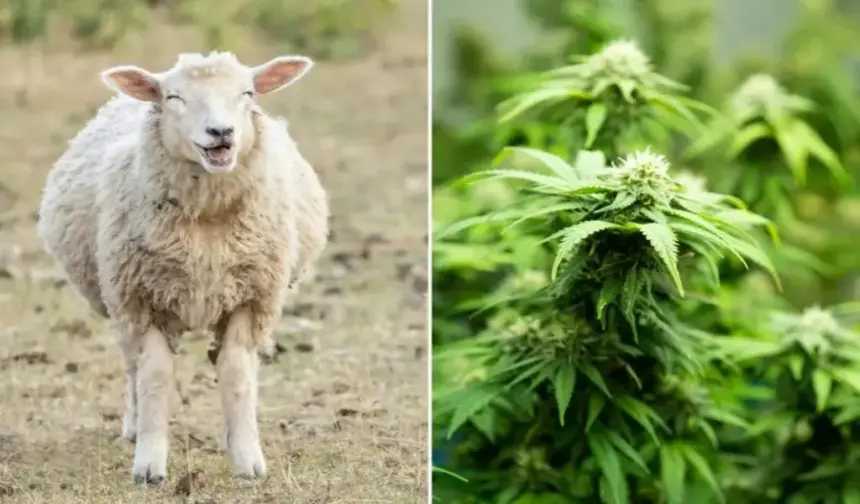
Sheep entered a medical-cannabis greenhouse near Almyros, Greece, after severe flooding in September 2023, according to local and international reports. Headlines put the amount eaten at more than 600 pounds, but early accounts gave a much lower estimate: about 220 pounds.
The greenhouse intrusion attracted widespread coverage, yet the quantity needs careful attribution. The larger figure came from a later estimate, while descriptions of unusual behavior never amounted to a veterinary diagnosis.
Understanding what happened means separating the reported events from the changing numbers and the claims about how the animals reacted.
Key Takeaways
- The incident occurred near Almyros in Greece’s Thessaly region after Storm Daniel flooded surrounding farmland.
- Early reports put consumption at up to 100 kilograms, approximately 220 pounds, rather than 600 pounds.
- Later coverage cited a revised estimate of 300 kilograms, approximately 660 pounds, without documenting an independently verified weighing.
- Accounts mentioned both sheep and goats inside the medical-cannabis greenhouse.
- Eyewitness descriptions of strange behavior don’t establish intoxication, and the main reports provided no veterinary findings.
What Happened When a Herd Of Sheep in Greece Accidentally Eats Over 600 Pounds Of Cannabis?
The incident surfaced in September 2023 near Almyros, in Magnesia, part of central Greece’s Thessaly region. The animals reportedly entered a greenhouse growing medicinal cannabis after Storm Daniel flooded the surrounding area.
eKathimerini’s early account described sheep eating up to 100 kilograms of cannabis plants. Although headlines concentrated on sheep, another account also placed goats inside the greenhouse.
How the sheep reached the cannabis greenhouse
News accounts described livestock grazing on flood-affected plains before reaching the greenhouse. Damaged pasture and disrupted farming explain the setting in which the animals were searching for food.
However, that sequence doesn’t establish exactly how they gained access. The available reporting doesn’t provide a detailed reconstruction of their route or prove that flooding alone caused the intrusion. The central reported event is straightforward: livestock entered a greenhouse and ate part of its cannabis crop.
What the greenhouse owner and workers reported
The Brussels Times identified greenhouse worker Yiannis Bourounis as a source who spoke to a Greek radio station. According to that account, workers discovered sheep and goats grazing inside.
The owner also described the animals’ behavior afterward. His most memorable observation was that the sheep were “jumping higher than the goats.”
That colorful description helped the story spread, but it remained an eyewitness anecdote. It wasn’t a measured comparison of the animals’ movements or a medical assessment of their condition.
Why Reports Put the Cannabis Amount at 100 or 300 Kilograms
The conflicting numbers come from different stages of the reporting. Early accounts used about 100 kilograms; later coverage introduced an estimate three times larger.
Keeping those figures attached to their sources is more accurate than treating either as a final, measured total.
The 600-pound headline comes from the later estimate
eKathimerini reported “up to” 100 kilograms on September 21, 2023. Sky News reported around 100 kilograms in its September 26 coverage, citing the Greek outlet TheNewspaper.gr. That amount equals approximately 220 pounds.
Then, on September 28, The Brussels Times cited French newspaper La Voix du Nord and reported a revision to around 300 kilograms.
At approximately 2.2 pounds per kilogram, 300 kilograms equals about 660 pounds. That conversion explains the “over 600 pounds” headline. It doesn’t match the quantity several earlier outlets published.
What the reports can and cannot confirm
Multiple publications covered the greenhouse incident, but some drew on the same local reporting. Their coverage therefore shouldn’t be treated as a series of independent measurements.
The available accounts don’t explain how anyone calculated the amount eaten. They also don’t show a documented weighing that resolves the difference between 100 and 300 kilograms.
Converting the later 300-kilogram estimate into pounds doesn’t turn that estimate into an independently verified measurement.
The most defensible reading is that the reported quantity changed. There’s no clear evidence explaining whether the revision followed a new crop assessment or another calculation.
Did the Sheep Get High, and Were They Examined by a Vet?
Reports of strange behavior gave the incident much of its appeal. However, the published observations don’t establish what the animals experienced or whether cannabis caused the behavior.
The distinction matters because a description such as “acting strangely” provides far less information than a clinical examination.
Unusual behavior is not the same as a confirmed diagnosis
Sky News reported that the shepherd noticed unusual behavior, while also noting that the details were unclear. The owner’s jumping comparison added another observation, but neither account supplied a structured description of symptoms.
Eyewitnesses can describe what they see. They can’t establish intoxication simply by finding an animal’s movements unusual.
The reports also don’t identify how much each animal ate, which parts of the plants it consumed, or the crop’s chemical composition. A flock-wide estimate can’t answer those individual questions. As a result, the reported total offers little basis for judging any particular sheep’s exposure.
Why the veterinary details remain unclear
The main eKathimerini, Sky News, and Brussels Times accounts don’t provide a veterinary diagnosis, toxicology result, or examination record confirming intoxication.
A later secondary account says the shepherd took the animals to a veterinarian. However, it doesn’t identify the veterinarian or provide records or independent corroboration. That claim remains unverified.
The absence of published records doesn’t prove that no veterinarian examined the sheep. It means readers don’t have clinical evidence establishing their condition, treatment, or recovery. Claims that every animal became intoxicated, or that all recovered without complications, go beyond the documented information.
How Storm Daniel and Farm Losses Set the Scene
Storm Daniel’s flooding provides the essential background to the greenhouse intrusion. Thessaly’s agricultural land had suffered extensive disruption before the sheep became an international news story.
Still, the storm’s effects and the animals’ later behavior are separate questions. Flood damage helps explain the farming conditions, not a medical outcome.
Flooding disrupted pasture and local farming
The reports placed the flock on flood-affected grazing land near Almyros. Greek Reporter’s account of the incident described the surrounding Thessaly plain as partly flooded.
That setting matters because livestock depend on accessible grazing. When water covers pasture, the presence of vegetation doesn’t necessarily mean animals can reach or graze it normally.
However, the reporting doesn’t trace the flock’s complete movements or establish every factor behind its search for food. Describing the event as occurring after severe flooding is supported. Claiming a proven, single cause for the greenhouse entry would go further than the evidence allows.
The cannabis crop had already faced losses
The greenhouse owner described a difficult sequence for his business. Heat had already reduced production before flooding caused further damage. According to his account, the animals then ate what remained of the affected crop.
His comments put the unusual story in a less comic context: the greenhouse had suffered repeated agricultural losses.
The reports don’t provide a verified financial total for those losses. Nor do they offer a crop inventory separating heat damage, flood damage, and livestock consumption. Those missing details also limit attempts to calculate the incident’s cost from the headline weight alone.
Frequently Asked Questions
How many sheep were involved?
The cited reports don’t establish a reliable flock size. They describe a herd or flock, and one account mentions goats alongside the sheep. Without a confirmed animal count and individual feeding information, there’s no sound basis for calculating consumption per sheep.
Did the reports identify the cannabis strain or THC concentration?
The reports don’t provide a confirmed strain or cannabinoid concentration. They describe a medical-cannabis crop, but that description doesn’t establish its potency. A weight of plant material can’t, by itself, reveal the amount of THC an animal encountered.
Have farmers deliberately fed cannabis to other animals?
Yes. Chiang Mai University researchers studied chickens given cannabis as part of their feed, as described in reporting on cannabis-fed chickens in northern Thailand. That managed feeding research involved a different species and different conditions. It doesn’t establish that unrestricted access to a medical-cannabis crop is safe for sheep.
What should an owner do if livestock eat cannabis?
Contact a veterinarian promptly and prevent further access to the plants. Describe what the animals may have eaten, when the exposure happened, and any changes in behavior. Veterinary attention is more useful than assuming unusual movements confirm intoxication or that the animals will recover without assistance.
What the Headline Leaves Unsettled
The reported greenhouse intrusion near Almyros has a consistent core: sheep, with goats also mentioned, entered a medical-cannabis growing site after severe flooding. The amount they consumed remains less certain.
Early accounts gave up to roughly 100 kilograms, or 220 pounds. Later coverage cited around 300 kilograms, or 660 pounds, without establishing an independently verified total.
The same distinction applies to the animals’ condition. Eyewitness accounts described unusual behavior, but reported behavior isn’t veterinary proof. The story is memorable enough without treating its least certain details as established facts.