
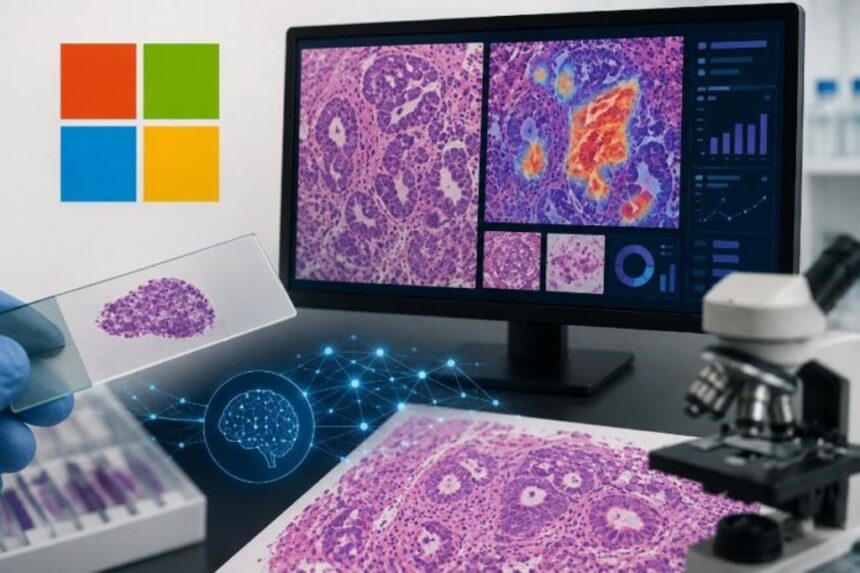
AI can scan cancer tissue slides at a scale that’s difficult for pathologists to match, but its findings still need careful testing before they can guide care. Paige and Microsoft announced a partnership in September 2023 to develop a large image-based AI model, with plans to draw on up to four million digitized slides.
That figure was a planned ceiling, not a confirmed count used to train the first model. The partnership later led to the Virchow models, and the story behind them shows both the promise of AI in cancer research and the need to distinguish research results from clinical proof. The development of AI tools for cancer research offers further context for why these efforts matter.
Key Takeaways
- Paige and Microsoft announced their partnership on September 7, 2023, with plans to use up to four million slides, not a confirmed training total, as described in Paige’s announcement.
- Microsoft planned to provide supercomputing support and Azure infrastructure for model development and potential deployment to hospitals and laboratories.
- The collaboration produced Virchow, followed by Virchow2 and Virchow2G, trained on more than 3.1 million whole-slide images.
- A published study reported a 0.95 specimen-level AUC on evaluated cancer detection tasks, not a universal measure of diagnostic accuracy or proof of better outcomes.
- Research access and clinical use have different requirements, so AI findings still need appropriate validation and clinician review, as with AI in clinical practice.
Paige and Microsoft Partner to Build a Large Image-Based AI Model for Cancer Research
The September 7, 2023, announcement paired Paige’s pathology expertise and slide archive with Microsoft’s computing and cloud infrastructure. Their goal was to develop a large AI model for cancer research and pathology.
How the partnership combines Paige’s pathology data with Microsoft Azure
Paige brought expertise in digital pathology and access to digitized microscopy slides from its clinical archive. The company planned to use up to four million slides spanning multiple cancer types. That number was a planned upper limit, not a confirmed count used to train the first model.
Microsoft planned to provide supercomputing support for model development, then make Azure available for potential deployment to hospitals and laboratories. The announcement described the partnership’s intended scale and roles, but did not specify the hardware or technical methods. Its announcement of the collaboration laid out those plans. Similar efforts to apply AI to medical imaging are also discussed in coverage of AI-assisted healthcare in Thailand.
How the Virchow models grew from the original research plan
Paige and Microsoft announced their partnership in September 2023, with plans to use up to four million digitized slides. That was a proposed ceiling, not a confirmed training total. The first model from the collaboration was Virchow; in August 2024, Paige introduced the later generations, Virchow2 and Virchow2G.
What more than 3.1 million pathology slides add
Paige and Microsoft reported that Virchow2 and Virchow2G were trained on more than 3.1 million whole-slide images, totaling 2.4 petabytes. The de-identified data represented more than 225,000 patients, over 40 tissue types, and 45 countries. It included hematoxylin-and-eosin (H&E) slides and immune-stained slides. This broader collection gave the models examples of tissue patterns across many cancer and non-cancer contexts. Microsoft’s summary of the Virchow2 research outlines the scale of the dataset. The role of large, curated datasets in oncology research is also discussed in this overview of health data for cancer research.
Why a pathology foundation model may help researchers
A pathology foundation model learns patterns from many kinds of tissue images, then researchers can adapt it to narrower tasks. For example, teams could investigate whether it can help identify cancer, study biomarkers, or locate particular cells in a slide. Those are potential research and product uses, not proof that every task works reliably in clinical care. Each application needs its own evaluation before clinicians can rely on its results.
What testing shows, and what it does not prove
The published Virchow study reported a 0.95 specimen-level AUC for pan-cancer detection across nine common and seven rare cancers. That result shows how well the model distinguished cases in the study’s evaluated tasks; it does not establish a universal diagnostic accuracy rate. Read the Virchow study and its evaluation details for the scope of those tests.
An AUC result also does not prove that using the model improves patient outcomes, or that it is approved for every clinical use. Each intended use requires appropriate validation, and clinicians must interpret model results within the context of patient care. That distinction matters across clinical validation requirements for healthcare AI.
What researchers should know about access and clinical use
Paige announced research-community access to Virchow through OpenPFM, but research access is different from commercial or clinical permission. Access and licensing vary by model and intended use, so a model available to researchers should not be treated as cleared for unrestricted diagnosis. Before using any model in a clinical workflow, teams need to check its license and confirm that the specific use has the required validation and authorization.
Frequently Asked Questions
Paige and Microsoft’s work raises practical questions about what the Virchow models can do, how they relate to the original partnership, and what their results mean in clinical settings.
Is Virchow Microsoft’s AI model or Paige’s?
Virchow grew out of Paige and Microsoft’s collaboration, but Paige developed the pathology models. Virchow2 and Virchow2G are later generations, with Paige reporting that Virchow2G has 1.8 billion parameters in its announcement of the second-generation models.
Can Virchow detect every type of cancer?
No. The published study evaluated pan-cancer detection across nine common and seven rare cancers, which is a defined set of tasks rather than proof that the model can detect every cancer. Performance can vary by cancer type, tissue, and test conditions.
Does the model replace pathologists?
No. Virchow can help analyze digitized tissue slides, but a model’s output needs clinical interpretation. Pathologists remain responsible for evaluating findings alongside other evidence about the patient.
Has the model been deployed in hospitals?
The original partnership announcement described Azure as a possible route for future deployment to hospitals and laboratories, but it did not give a launch date. That plan alone does not confirm that Virchow itself is in routine hospital use.
Does a research model have the same status as a clinical product?
No. A research model and a clinical product can have different licenses, intended uses, and regulatory requirements. Those distinctions matter because AI tools in FDA approval must meet requirements tied to their specific role, rather than relying on a model’s research results alone.