
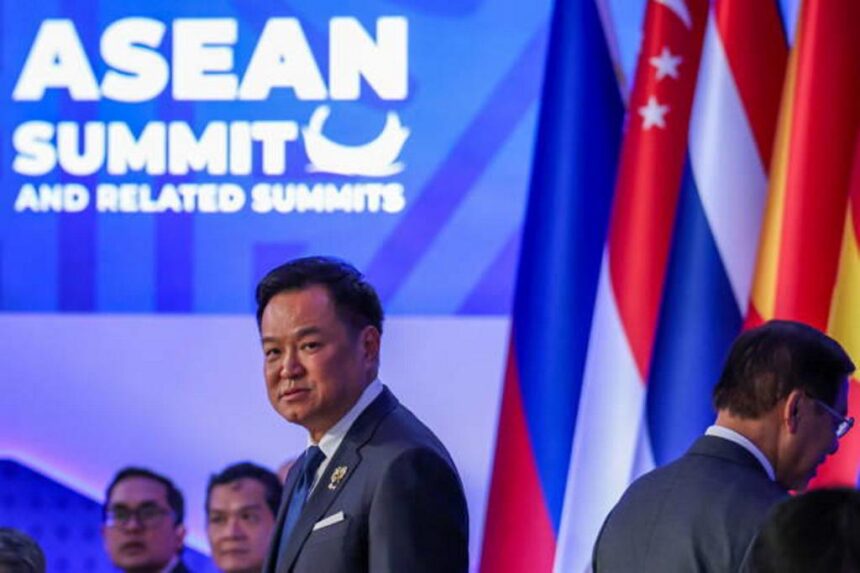
MANILA — Thailand’s Prime Minister Anutin Charnvirakul urged Southeast Asian leaders on Sunday to build an independent artificial intelligence strategy, accelerate clean energy grids and launch joint operations against online scam networks during the 49th ASEAN Summit in Manila.
Addressing regional counterparts at the Philippine International Convention Center, Anutin framed his proposals as nonbinding priorities designed to shield the 10-nation bloc from superpower rivalry and supply chain shocks. While the summit formally celebrated milestones like the ASEAN Digital Economy Framework Agreement, Anutin’s specific policy wishlist requires separate consensus from member states before becoming binding regional law.
Key Takeaways
- Prime Minister Anutin Charnvirakul proposed an ASEAN-led artificial intelligence framework, expanded clean power trading and a regional anti-scam network at the Nov. 15 summit.
- Anutin’s proposals represent Thailand’s strategic agenda rather than ratified bloc-wide mandates, distinguishing them from formal agreements already signed in Manila.
- Full adoption would lower cross-border business friction, stabilize electricity costs for households and attract foreign capital seeking politically neutral tech hubs.
Strategic Autonomy and Economic Integration
Anutin warned that declining trust in global trade rules forces Southeast Asia to rely on its own market scale. According to Thai government spokesman Ekapop Phianphiset, the prime minister pushed for rapid implementation of the upgraded ASEAN Trade in Goods Agreement alongside the digital economy pact to unlock a projected $2 trillion regional digital market.
To prevent Washington and Beijing from forcing member states into rigid technology camps, Anutin pitched a homegrown artificial intelligence roadmap tailored to local industries, regulations and languages. He also pressed for diversifying fuel suppliers and expanding the ASEAN Power Grid to enable cross-border renewable electricity sales. For foreign investors, a unified digital rulebook and reliable green power supply would reduce compliance costs across multiple jurisdictions. Local factories and exporters would gain seamless customs clearance, wider consumer access and protection against sudden energy price spikes.
Cross-Border Crime and Upstream Pressures
Anutin’s push for joint enforcement stems from escalating domestic crises along Thailand’s borders. Cyber-scam syndicates operating out of poorly regulated border enclaves in neighboring countries have defrauded thousands of Southeast Asian residents, prompting Bangkok to propose a permanent intelligence-sharing hub under the Global Partnership Against Online Scams.
Environmental degradation carries equally urgent stakes for northern Thai communities. Seasonal agricultural burning across mainland Southeast Asia routinely blankets Chiang Mai and Chiang Rai in hazardous smog, while upstream mining operations along transboundary waterways have sparked severe heavy metal contamination fears in the Kok and Sai rivers. Anutin demanded that member states tackle haze and river pollution directly at their sources rather than relying on reactive disaster relief. If enacted, coordinated cross-border policing and upstream environmental monitoring would directly safeguard household savings, public health and agricultural livelihoods.
Ambition Meets ASEAN Consensus Hurdles
Turning Anutin’s Manila speech into concrete action faces steep institutional hurdles. ASEAN operates strictly by consensus, meaning any single member state can delay or dilute collective initiatives. Unlike formal treaties ratified at the summit, Thailand’s proposals on artificial intelligence governance, power grid integration and source-level pollution enforcement remain diplomatic pitches rather than binding bloc decisions.
To bypass diplomatic gridlock, Anutin suggested allowing willing member nations to pilot projects first while laying groundwork for Thailand’s scheduled ASEAN chairmanship in 2028. He also proposed a leadership troika linking past, current and incoming chairs to prevent annual policy resets. For ordinary residents and multinational firms across Southeast Asia, tangible economic and security benefits depend entirely on whether neighboring capitals convert Bangkok’s proposals into enforceable national regulations over the coming year, testing whether regional diplomacy can deliver practical results at home and across border towns.