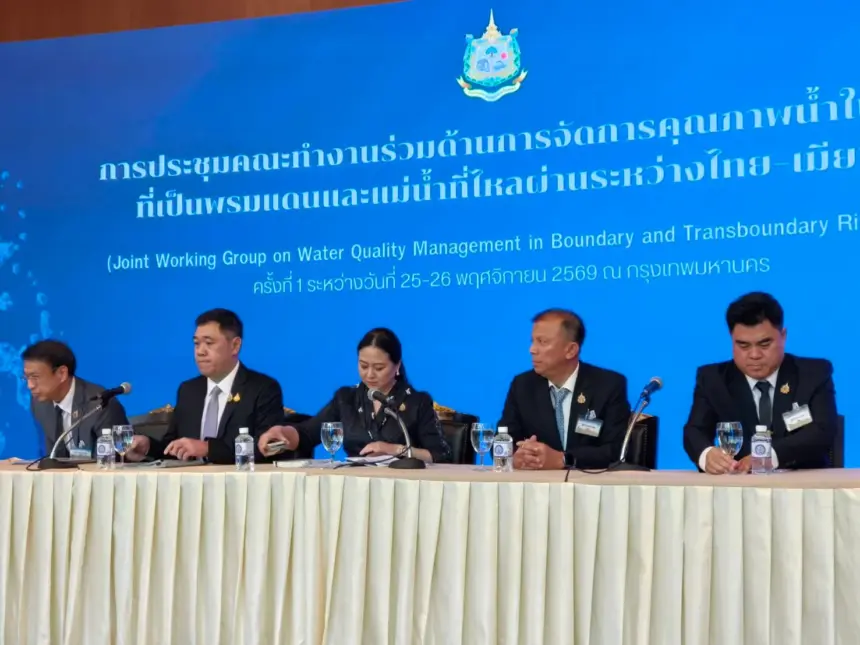
BANGKOK — Thailand and Myanmar agreed Wednesday to establish six joint water-monitoring points along two polluted northern border rivers, launching a one-year plan to track toxic runoff flowing into Thailand’s Chiang Rai province.
Meeting in Bangkok for the first session of their bilateral Joint Working Group on water quality management, officials approved four sampling points on the Kok River and two on the Sai River in each country. The pact gives Thai authorities direct access to upstream water data for the first time since arsenic contamination sparked public alarm across northern communities.
Key Takeaways
- Thailand and Myanmar will set up four monitoring checkpoints on the Kok River and two on the Sai River on each side of the border, with initial joint sampling targeted for December 2026 to January 2027.
- Designated environmental agencies will exchange water-quality data at least twice a year, focusing first on surface water and public health before expanding to sediments, fish and crops.
- The Bangkok agreement covers monitoring and data exchange only; Thai officials separately traced high arsenic loads to upstream mining in Myanmar’s Shan State without naming individual operators.
Rollout Timeline and Agency Roles
None of the new cross-border stations are operating yet. According to a joint media release summarized by Xinhua, both governments scheduled the first joint water-quality sampling between December 2026 and January 2027, contingent on field readiness and bilateral coordination.
Under the framework, designated environmental departments will exchange water-quality findings at least twice a year. Raweewan Bhuridej, permanent secretary of Thailand’s Ministry of Natural Resources and Environment, reported that Phase 1 targets surface water conditions and public health impacts. Testing river sediments, fish and vegetables will follow in a second phase alongside laboratory capacity upgrades.
Thailand’s Pollution Control Department is leading technical implementation alongside Myanmar’s environmental authorities and Shan State representatives. Ahead of the Bangkok talks, Thai Prime Minister Anutin Charnvirakul and Natural Resources Minister Suchart Chomklin pushed to accelerate the working group schedule to secure upstream visibility.
Upstream Mining Drives Cross-Border Crisis
Geography puts Chiang Rai directly in harm’s way. The Kok River originates in Myanmar’s eastern Shan State before winding into northern Thailand, while the Sai River forms part of the international boundary before joining the Mekong basin. For over a year, residents in Mae Sai and downstream districts have reported turbid water and feared heavy metals entering tap supplies and rice paddies.
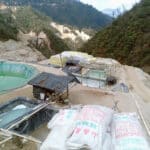
A regional study by the Stimson Center identified more than 2,400 mines across mainland Southeast Asia — many unregulated gold and rare-earth operations in conflict-affected borderlands — capable of discharging cyanide, mercury and arsenic into shared rivers. Because Myanmar’s frontier mining zones lie outside Thai jurisdiction, Bangkok previously relied on downstream border checks after toxins had already entered Thai territory.
To shield local residents immediately, Thai authorities are preparing to declare a 150-kilometer stretch of the Kok River a formal pollution-control zone on Dec. 2 and develop alternative groundwater supplies for roughly 20,000 people.
Monitoring Deal Distinct From Source Tracing
Officials drew a clear line between Wednesday’s monitoring agreement and separate technical findings regarding where the pollution originates. The Bangkok pact establishes joint sampling protocols and biannual data sharing, but it does not assign legal blame or pinpoint individual mine owners.
Earlier scientific assessments presented by Thai officials ahead of trilateral discussions with China and Myanmar estimated that an average of 143 kilograms of arsenic crosses the border daily via the Sai River.
Those chemical fingerprint analyses linked the contamination to upstream mining activity in Shan State without identifying specific operators, leaving enforcement and mine regulation to separate diplomatic tracks.