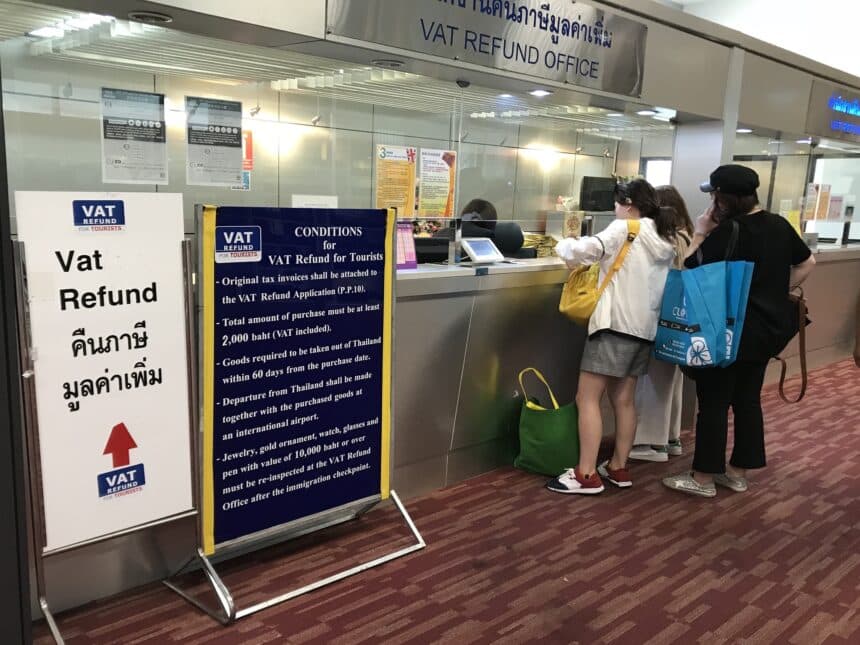
A Thailand VAT refund can be missed if you check your bags before showing your purchases to Customs or leave the paperwork until the last minute. Keep your claim goods accessible and complete the Customs inspection before check-in.
This guide covers who qualifies, which documents to collect while shopping, and the airport steps to follow. Because counter procedures can change, confirm current details with Thailand’s Revenue Department or airport staff before departure.
Start by checking whether you’re eligible and what to request at the store, including the Suvarnabhumi Airport VAT refund process.
Key Takeaways
- Non-Thai tourists who leave Thailand by air may qualify for a VAT refund; land departures and airline crew are excluded.
- Shop at participating stores, spend at least ฿2,000 per store per day, and request a P.P.10 form and original tax invoice with your passport.
- Keep purchases accessible, then present them with your forms and invoices to Customs before check-in. Follow the Revenue Department’s P.P.10 instructions.
- After immigration, submit stamped paperwork at the VAT Refund Office. At Suvarnabhumi, review airport VAT refund directions.
- Confirm current claim requirements and airport counter details before departure, especially if you bought luxury goods that may need an additional inspection.
Check Your Eligibility and Get the Right Paperwork Before You Shop
Before buying, check that you qualify for Thailand’s tourist VAT refund and that the store participates. Generally, eligible shoppers are non-Thai visitors who aren’t airline crew and leave Thailand by air through an international airport. Departures by land do not qualify. Since not every purchase or service is eligible, confirm the rules for your specific item before paying.
Look for the “VAT REFUND FOR TOURISTS” sign. At checkout, show the passport you’re traveling with and ask the store to issue a P.P.10 form and original tax invoice on the purchase date. Thailand’s Revenue Department lists the tourist VAT refund conditions, including the purchase and export deadlines.
A purchase must total at least ฿2,000, including VAT, per store per day. Each P.P.10 form must meet that minimum on its own, so purchases from separate stores can’t be combined to qualify for one form. Goods must leave Thailand with you within 60 days, counting the purchase date as day one.
Keep each store’s form, receipt, and goods together
While you’re still at the store, review the paperwork before leaving. Check that your name matches your passport, the purchase details are correct, and the amount on each P.P.10 meets the minimum. Ask the store to fix any errors while staff can still access the transaction.
Keep the original tax invoice with its matching P.P.10 and goods. Photos and card statements aren’t substitutes for original invoices. A small envelope for each store makes it easier to match documents to purchases later. Keep these envelopes and the goods in your carry-on or another accessible bag, since you may need to show them to Customs before checking your luggage.
Some items have extra rules or may need closer review, so don’t assume a purchase qualifies just because a store issued a form. If you’re buying gold, check the details on Thai gold purchases and VAT refund eligibility before relying on a refund.
Thailand VAT Refund: A Tourist’s Airport Checklist
Treat the VAT refund as two separate airport steps: first, get your purchases inspected by Customs before check-in; then submit the stamped claim after Immigration. Keep the goods and paperwork accessible until both steps are complete.
Before check-in, get Customs to inspect your purchases
Before checking in or passing through Immigration, take your purchases, P.P.10 or e-P.P.10 forms, and original tax invoices to the airport Customs Office. A Customs officer must inspect the claim and stamp the forms. The Revenue Department’s airport procedure outlines the documents to present.
Keep eligible goods in your carry-on or another bag you can access easily. If you pack them in checked baggage first, you may not be able to show them when Customs asks to inspect them. Skipping the Customs inspection can void your refund claim, even if your forms and receipts are complete.
Allow extra time for this stop, especially if you’re traveling during a busy period or have several purchases to present. Follow the airport signs or ask staff where to find the Customs Office. Suvarnabhumi and Don Mueang are among Thailand’s participating airports, but counter locations, hours, and queues can change. Check with your airport before departure, and leave room in your schedule for a wait.
After Immigration, submit the stamped claim
Once Customs has inspected and stamped your paperwork, continue through Immigration. After you pass through, take the stamped forms and original tax invoices to the VAT Refund Office. This is a separate step from the pre-check-in inspection: Customs verifies the goods and stamps the claim, while the post-Immigration office handles the refund submission.
The Revenue Department lists airport VAT Refund Office locations, including offices at Suvarnabhumi and Don Mueang. Still, confirm the current counter details with your airport before you travel. At the office, present the stamped documents and follow staff instructions for your chosen payment method. Keep your paperwork until the refund process is complete, in case staff need to check a detail.
Before leaving for the airport, check that your P.P.10 or e-P.P.10 forms match the original invoices and that you can reach the goods without unpacking checked luggage. That simple check helps you move through both counters without having to retrieve a bag or correct paperwork at the last minute.
Know the Claim Minimums, Extra Checks, and Refund Options
A few details can change how much time you need at the airport and which refund option you can use. Check the total claim value, identify any goods that need a second inspection, and confirm current airport procedures before departure.
Plan extra time if you bought high-value goods
Official guidance describes ฿5,000 in total purchases as the minimum for an airport refund claim. That is separate from the ฿20,000 Customs-procedure exemption mentioned for mailed claims. The ฿20,000 figure is not a general threshold for skipping an airport inspection. It also concerns VAT refund procedures, not Thailand’s customs allowances for travelers.
After Immigration, Revenue Department officers may need to inspect listed luxury goods at the VAT Refund Office. These include jewelry, watches, phones, laptops, handbags other than suitcases, and belts valued at ฿10,000 or more per item. The official airport VAT refund procedure describes the reinspection requirement.
Keep these purchases with you and easy to reach after passing Immigration. Guidance also mentions a separate ฿50,000 value condition for goods carried with the traveler. Confirm with the Revenue Department or airport staff how that condition applies to your claim, and check airport instructions before departure so you can plan enough time for both inspections.
If you miss the airport counter, check the mailed-claim rules
If you can’t submit your claim at the airport, official guidance allows some travelers to mail their Customs-stamped P.P.10 or e-P.P.10 forms and original tax invoices to the address printed on the form. The instructions also call for copies of the passport and credit card. For luxury goods, Customs and Revenue Department stamps may still be required, so mailing the paperwork doesn’t remove the inspection rules for those items.
Available guidance gives a 60-day mailing deadline from the first purchase date. Since requirements can change, verify the current deadline, documents, and mailing procedure before relying on this option.
Payment methods also depend on the refund amount and airport arrangements. Refunds of ฿30,000 or less may be available in Thai-baht cash or through supported e-wallets; larger refunds are paid to a credit-card account. Confirm which options your airport supports, and don’t assume a particular method will be available at every counter.
Frequently Asked Questions
A few details can affect whether a claim qualifies and how much you receive. Check the paperwork and purchase rules before leaving Thailand, then confirm any unclear point with the airport VAT Refund Office.
Does the refund equal the full 7% VAT?
No. The cash refund may be less than 7% of the receipt total because Thailand calculates it under the tourist refund system, rather than simply returning the VAT shown on each receipt. The amount can depend on the purchase value and applicable refund rules. For an estimate, check the Revenue Department’s tourist VAT refund information or ask the refund counter to confirm the current amount.
Can I claim VAT on hotel stays, meals, or transport?
No. The tourist refund program covers eligible goods bought from participating shops, not everyday services such as hotel stays, restaurant meals, or transportation. A business may charge VAT for those services, but that doesn’t make them eligible for a tourist goods refund. Keep your claim focused on qualifying purchases that you can present for inspection.
Can purchases from different stores count toward the total claim minimum?
Yes, purchases from multiple stores can contribute to the overall airport claim minimum of ฿5,000. However, each store purchase must still meet the ฿2,000 minimum per store per day, and every P.P.10 form must independently cover at least ฿2,000. Check each form before leaving the shop, since separate forms can’t be combined to meet that form-level minimum.
What should I do if my purchase is in checked baggage?
Ask airport staff for help before checking in. Customs must inspect the goods before check-in, and an officer may require you to present the purchase alongside your P.P.10 form and original tax invoice. Don’t assume staff can retrieve or inspect a bag after you’ve checked it.
What happens if I lose the original invoice or P.P.10 form?
Original supporting documents are part of the claim, and a photo or card payment record may not replace them. Contact the shop or an airport VAT Refund Office promptly to ask whether it can help with the missing paperwork. A replacement isn’t guaranteed, so keep the original invoice and form together until your claim is complete.