CHIANG RAI — Thai companies supply 70% to 80% of the industrial chemicals shipped into Myanmar for gold and rare-earth mines that are poisoning northern Thailand’s waterways, according to Thailand’s National Security Council.
To stop the toxic flow, Bangkok will designate more than 150 kilometers (93 miles) of the Kok River as a formal pollution control zone starting Dec. 2 and arrange emergency clean water supplies for nearly 20,000 residents in Chiang Rai province.
Deputy Prime Minister Yodchanan Wongsawat announced the crackdown ahead of high-stakes trilateral talks this week with officials from Myanmar and China, pledging to block exports of mining reagents across the northern border.
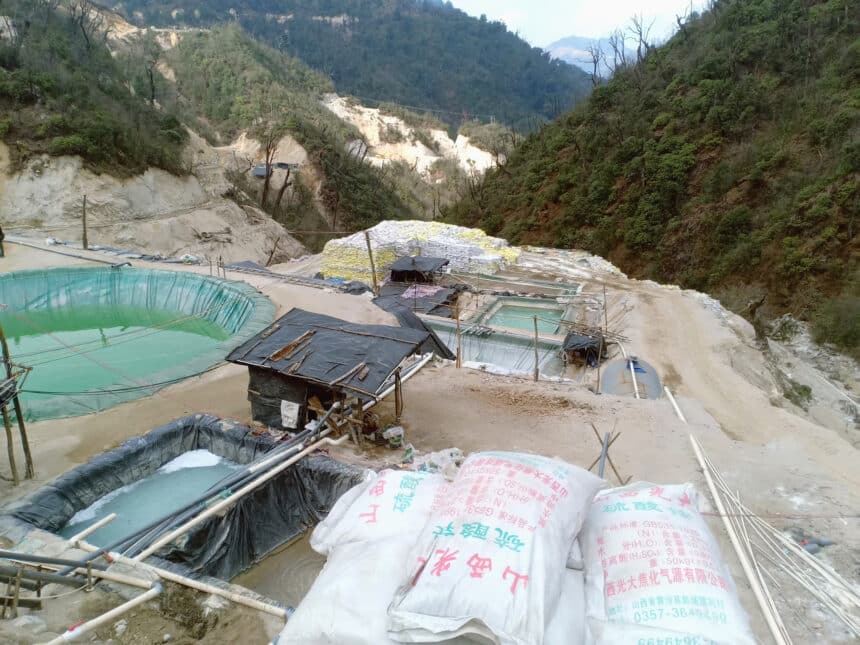
The crisis highlights a bitter cross-border trade loop: hazardous compounds exit Thailand through weak customs checks, fuel unregulated extraction in Myanmar’s Shan State, and wash back downstream as arsenic and heavy metals into the Kok and Sai rivers, leaving local Thai communities to bear the health and environmental toll.
Key Takeaways
|
A Toxic Boomerang Across the Northern Border
For months, residents along the muddy banks of the Kok and Sai rivers noticed the water turning an unnatural, milky gray. Government water sampling confirmed their worst fears. Tests conducted by Thailand’s Pollution Control Department detected alarming concentrations of arsenic and heavy metals in both river water and riverbed sediment across Chiang Rai province.
The contamination traces directly upstream to a rapid boom in rare-earth and gold extraction in Myanmar’s eastern Shan State. According to National Security Council findings released following weekend inspections in Chiang Rai, NSC Secretary-General Gen. Chaipruak Doungprapat confirmed that Thai exporters account for up to four-fifths of the chemical inputs used at those scrutinized mining sites. The NSC has already forwarded a list of specific industrial reagents to the Defense Ministry to classify them as controlled goods and choke off cross-border shipments.
The economic math behind the crisis is starkly lopsided. Chemical brokers and mine operators pocket the profits from cross-border sales and mineral extraction, while farmers, fishermen and families downstream absorb the damage. Thai researchers estimate that an average of 143 kilograms (315 pounds) of arsenic crosses the border daily in the Sai River alone, threatening municipal water intakes and prompting health warnings against eating 10 local aquatic species.
How Transit Loopholes Fuel Unregulated Extraction
Stopping the chemical flow requires closing regulatory blind spots that traders have exploited for years. Industrial acids, ammonium sulfate and cyanide compounds used to leach minerals from hillsides legally enter Thailand’s ports or roll out of domestic plants under broad commercial classifications. Once they head north toward border crossings in Chiang Rai and Chiang Mai, oversight breaks down.
Security officials say weak end-user verification allows buyers to declare shipments for legitimate agricultural or industrial use, only for the cargo to be diverted into conflict-ridden areas of Shan State. “Transit goods” loopholes further complicate enforcement. Cargo moving through Thailand from third countries toward Myanmar often bypasses rigorous inspection of its final destination, leaving customs officers unable to verify whether drums of chemicals are bound for licensed facilities or clandestine jungle pits.
At a meeting of more than 250 scientists and agency specialists at Mae Fah Luang University, Yodchanan—who also serves as minister of higher education, science, research and innovation—instructed the NSC to impose an immediate temporary halt on mining-chemical exports while the Commerce and Industry ministries draft permanent legal controls. “We are leveraging every possible avenue,” Yodchanan said, stressing that Bangkok will target chemical supply chains feeding rare-earth production across the border.
Supply Chains, Militias and Upstream Geopolitics
The sudden spike in river contamination in northern Thailand is rooted in a major shift in global mineral supply chains and Myanmar’s fractured civil war. Rare-earth elements—vital for electric vehicle motors, wind turbines and defense electronics—are heavily concentrated in northern and eastern Myanmar, which serves as a primary raw-material feeder for processing refineries in neighboring China. When Beijing tightened environmental rules on domestic rare-earth mining and later restricted exports of refined metals, illicit mining operators pushed deeper into Myanmar’s borderlands to meet soaring demand.
Unlike traditional underground mining, rare-earth extraction in Shan State relies heavily on a destructive technique known as in-situ leaching. Miners bore holes into forested hills and pump thousands of tons of chemical solutions directly into the earth to dissolve rare-earth oxides. The toxic slurry drains straight into mountain streams that feed the Kok, Sai and Ruak rivers, all of which flow south into Thailand before joining the Mekong River. A regional assessment by the U.S.-based Stimson Center identified more than 2,400 unregulated and artisanal mines across mainland Southeast Asia leaching cyanide, mercury and arsenic into shared river basins.
Enforcement inside Shan State remains exceptionally difficult because large swaths of the territory fall outside central government control, governed instead by ethnic armed groups and border militias that tax mining operations to fund their forces. Historically, downstream communities in Chiang Rai have had little leverage over upstream land use. By targeting the Thai side of the chemical supply chain, Bangkok is attempting to cut off a vital bottleneck that upstream militias cannot easily replace.
Pollution Control Zone and Emergency Water Relief
While diplomats negotiate across borders, Thai authorities are rolling out immediate domestic protections before the dry season concentrates toxins in shrinking river channels. On Dec. 2, the National Environment Board is scheduled to formalize the designation of more than 150 kilometers of the Thai stretch of the Kok River as a pollution control zone. Under Thailand’s Enhancement and Conservation of National Environmental Quality Act, the status grants provincial officials sweeping authority to regulate wastewater discharges, mandate cleanup operations and unlock emergency central government funding.
Clean water access tops the emergency agenda. Nearly 20,000 residents in Chiang Rai whose household taps and farms rely on surface water from the Kok and Sai basins are being shifted to alternative supplies. Provincial waterworks crews are drilling deep groundwater wells, installing mobile filtration units and laying backup distribution pipelines to bypass contaminated river intakes.
In Mae Sai district, where river water has repeatedly breached safety thresholds, engineers tested a new chemical precipitation and filtration process that removed up to 94.6% of dissolved arsenic in simulations, offering a blueprint to keep municipal tap water running safely. Simultaneously, the government is expanding regional testing laboratories and deploying roughly 20 automated monitoring points across Chiang Rai and neighboring Chiang Mai to track heavy-metal plumes in real time.
Trilateral Diplomacy With Myanmar and China
Domestic barriers alone cannot clean up a transboundary watershed, pushing Thailand to take its scientific evidence directly to Naypyitaw and Beijing. During trilateral talks held Nov. 24–26 alongside bilateral working group sessions in Bangkok, Thai negotiators presented chemical “fingerprints” linking the exact arsenic and rare-earth signatures in Chiang Rai’s rivers to upstream mining districts.
Bangkok has pressed China—whose companies purchase and refine the vast majority of Myanmar’s rare-earth output—to use its economic influence to halt operations at polluting mines in northeastern Myanmar for at least six months while remediation standards are established. Yodchanan also stated that Thailand intends to identify and publicly disclose the corporate owners behind the mines discharging toxic waste once diplomatic consultations conclude. “There is no reason for the Thai government not to disclose it,” he told reporters.
Early diplomatic steps yielded a modest operational breakthrough. At the conclusion of the Thai-Myanmar working group meetings in Bangkok, both nations agreed to establish four joint water-monitoring stations along the Kok River and two along the Sai River, committing designated environmental agencies to exchange water-quality data at least twice a year. Natural Resources and Environment Minister Suchart Chomklin noted that Thailand aims to place four of those monitoring stations inside Myanmar territory with technical backing from Thai and Chinese laboratories.
Long-Term Recovery and Community Vigilance
For farmers preparing dry-season rice and vegetable crops along the Kok River valley, diplomatic pledges offer cautious hope rather than instant relief. Local civic networks in Chiang Rai have welcomed the Dec. 2 pollution control zone and the export freeze on mining chemicals, yet community leaders warn that heavy metals trapped in river sediment can persist for years, washing back into irrigation canals every monsoon season.
Thailand Science Research and Innovation has fast-tracked 10 urgent field studies—selected from 25 university proposals—to track heavy-metal uptake in crops, livestock and freshwater fish across northern Thailand. Health officials say widespread blood and urine screenings along four northern rivers have so far found no acute arsenic poisoning cases, though medical teams will continue regular monitoring to catch chronic exposure early.
With export restrictions moving toward Defense Ministry approval and bilateral monitoring stations slated for installation, Bangkok is betting that choking off chemical supplies at the border will succeed where diplomatic protests alone have failed. For the 20,000 residents waiting on clean groundwater taps in Chiang Rai, the true measure of the crackdown will be whether the Kok and Sai rivers run clear again.