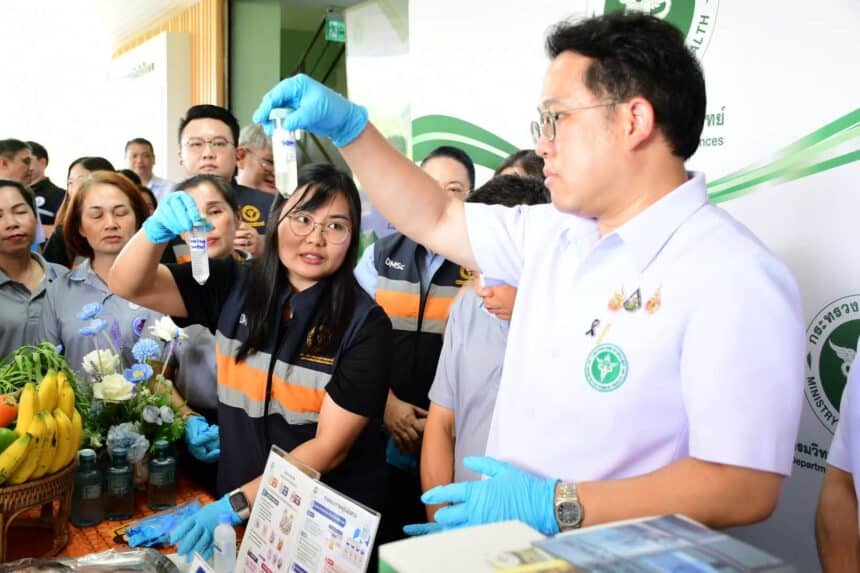
CHIANG RAI — Public Health Minister Pattana Promphat opened a frontline command center in Chiang Rai on Tuesday to coordinate medical screening and distribute 2,000 arsenic test kits to residents at risk from contaminated waterways.
Launched at the Chiang Rai Provincial Public Health Office alongside Permanent Secretary Dr. Somruek Chungsaman and Deputy Gov. Prasert Jitpleecheep, the hub centralizes health surveillance, food safety checks and emergency response as authorities work to contain heavy metal pollution flowing into local rivers.
Key Takeaways• The Ministry of Public Health opened a frontline command center in Chiang Rai on Nov. 25 to manage health risks from arsenic and heavy metals in local water sources. • Officials are distributing 2,000 preliminary arsenic test kits and mobilizing village health volunteers to screen vulnerable residents across affected communities. • Operations focus on four core actions: tracking elevated urine arsenic cases, monitoring water and food safety, communicating health risks and linking environmental and medical data. |
Three-Phase Medical Strategy and Community Outreach
Pattana said the ministry structured its medical response around three phases: screening residents for heavy metals, providing clinical treatment when indicated and maintaining long-term symptom tracking. Health teams will work alongside environmental and agricultural agencies testing tap water and farm crops.
No new spike in human arsenic poisoning has been recorded, officials said, though vigilance remains essential. Village health volunteers are fanning out across high-risk neighborhoods to explain exposure risks, administer the 2,000 rapid kits and refer abnormal cases for hospital diagnostics. The command center also opened a public hotline to field resident concerns and guide safe water and food choices.
Upstream Mining and Cross-Border Pollution Context
The emergency mobilization follows mounting evidence of transboundary runoff entering northern Thailand from unregulated mining operations upstream in Myanmar’s Shan State. Recent government monitoring found unsafe arsenic levels in 10 Kok River aquatic species, prompting warnings against consuming certain bottom-dwelling fish and shellfish.
Earlier this month, provincewide screening identified elevated urine arsenic in 31 of 549 residents across Chiang Rai after health officials expanded testing eligibility along the Kok and Sai river basins. Thai diplomats and environmental scientists are simultaneously using chemical fingerprinting in trilateral water talks with Myanmar and China to curb an estimated 143 kilograms of arsenic crossing the border daily in the Sai River, where community leaders have demanded stronger action on border river pollution.
Four Core Measures Drive Local Response
To translate diplomacy into local protection, the Chiang Rai command center is executing four operational measures. Medical staff are closely monitoring residents whose urine arsenic exceeded reference thresholds while inspecting drinking water supplies and local food markets.
Public health communicators are issuing clear guidance on avoiding contaminated river sediment—noting that boiling water does not remove heavy metals. By merging environmental, agricultural and clinical databases, the center aims to tailor relief directly to each district’s exposure level.