CHIANG RAI – Toxic arsenic has breached underground water supplies across northern Thailand, contaminating nine community wells in Chiang Mai and Chiang Rai provinces, the Department of Groundwater Resources confirmed Tuesday. Laboratory testing of 133 groundwater samples collected throughout 2026 found arsenic concentrations exceeding Thailand’s safety limit of 0.01 milligrams per liter at nine sites near major border waterways.
The findings prove that heavy-metal pollution from the Kok, Sai and Ruak river basins is no longer confined to surface currents. Faced with tainted shallow aquifers that rural households rely on for daily water, the Ministry of Natural Resources and Environment launched an emergency clean-water recovery plan on Nov. 17 to install 11 community reverse-osmosis filtration plants and drill real-time monitoring wells across affected border districts.
Key Takeaways
- Nine of 133 groundwater samples tested across Chiang Mai and Chiang Rai in 2026 exceeded the 0.01 mg/L arsenic safety threshold.
- Contaminated surface water from the Kok, Sai and Ruak rivers is seeping directly into shallow underground aquifers tapped by village wells.
- Officials will deploy 11 community reverse-osmosis filtration systems, one large-scale farm water system and new observation wells through 2027.
Two-Year Testing Reveals Spreading Subsurface Risk
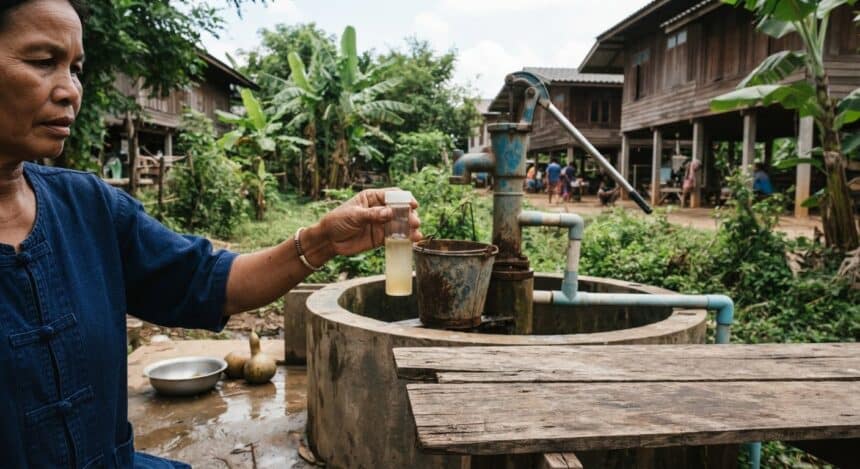
Engineers from the Bureau of Groundwater Conservation and Restoration, the Bureau of Groundwater Standards and Regional Office 1 in Lampang compiled the results after a three-phase field operation spanning 2025 and 2026. During initial inspections of 18 village waterworks systems in 2025, crews detected excess arsenic at four sites and flushed the boreholes to clear contaminated sediment and restore safe flow.
Expanded surveillance in 2026 widened the net to 133 high-risk wells across both provinces. While 124 samples met national drinking standards, the nine failed wells confirmed persistent pockets of underground contamination. To stabilize rural supplies through 2027, the department budgeted for 11 community reverse-osmosis filtration units alongside one large-scale agricultural groundwater system.
Upstream Mining and Shallow Aquifers Drive the Crisis
The underground readings follow months of escalating surface-water alarms along the Thai-Myanmar border. Satellite tracking and water sampling linked heavy-metal runoff in the Kok and Sai rivers to unregulated rare-earth and gold mining across Myanmar’s Shan State. Earlier tests by Thailand’s Pollution Control Department recorded raw river arsenic levels up to 28 times above safety limits following seasonal floods, forcing Mae Sai households to buy bottled water and threatening more than 16,000 hectares of irrigated rice land.
Hydrogeologists with the Department of Groundwater Resources identified two mechanisms driving arsenic into northern wells. First, naturally occurring arsenic trapped in bedrock and sediment layers dissolves when underground water chemistry shifts. Second, polluted river water percolates downward through porous soil directly into shallow aquifers. Because rural families routinely drill shallow domestic boreholes rather than deep bedrock wells, surface-to-groundwater seepage exposes residents to chronic poisoning even when municipal tap water remains treated.
Village Health Volunteers Join Early-Warning Network
Filtration plants alone cannot outpace shifting underground plumes. To track contamination before it reaches household taps, the department will drill dedicated observation wells adjacent to the Kok, Sai and Ruak rivers. These sentinel boreholes will measure real-time water chemistry and map how heavy metals migrate through shallow water tables during dry and rainy seasons.
State water officials are also pairing technical monitoring with grassroots surveillance. Working alongside local administrative organizations and provincial public health offices, the department is training village health volunteers across Chiang Mai and Chiang Rai to spot early signs of water contamination and issue rapid community alerts. Residents in affected districts have been advised to monitor official water advisories closely and rely strictly on certified reverse-osmosis or agency-approved filtration systems for drinking and cooking.