
BANGKOK — Senior officials from Thailand, Myanmar and China convened in Bangkok to confront severe arsenic contamination poisoning northern Thailand’s border waterways, launching an urgent diplomatic push to trace upstream mining runoff and protect downstream farms and tap water across Chiang Rai.
Hosted at the Ministry of Foreign Affairs, the trilateral courtesy talks set the political groundwork for a Nov. 25–26 bilateral working group tasked with installing joint river sensors, testing chemical fingerprints and weighing a six-month suspension of upstream mining operations in Myanmar’s Shan State.
Key Takeaways• Top Thai cabinet ministers met Myanmar environment officials, China’s ambassador to Thailand and Yunnan specialists in Bangkok on Nov. 24 ahead of Nov. 25–26 technical talks. • Negotiators are reviewing an eight-station river monitoring network split evenly across the Thai-Myanmar border, alongside Chinese-backed laboratory isotope testing in Chiang Rai. • Thai authorities promised daily public briefings and an online risk map before Dec. 15, though border communities still await firm enforcement dates for upstream mines. |
Envoys Assemble Around Isotope Evidence
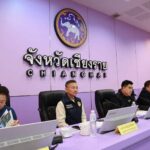
Deputy Prime Minister and Foreign Minister Sihasak Phuangketkeow led the Thai delegation alongside Deputy Prime Minister and Higher Education, Science, Research and Innovation Minister Yodchanan Wongsawat and Natural Resources and Environment Minister Suchart Chomklin. Permanent secretaries from the Thai and Myanmar environment ministries joined the session, flanked by China’s ambassador to Thailand, Myanmar embassy diplomats and technical specialists from China’s Yunnan province and Myanmar’s Shan State.
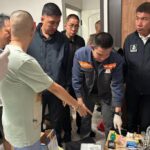
Beijing’s presence marks a decisive diplomatic shift. Sihasak noted that Chinese leaders confirmed they do not back illegal or destructive mining in Shan State and agreed to assist with technical verification. Thai researchers are presenting chemical isotope signatures indicating roughly 143 kilograms of arsenic cross the border daily via the Sai River, giving negotiators scientific leverage to demand accountability without waiting years for disputed mine ownership records.
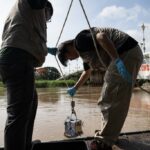
On the table during the Nov. 25–26 Joint Working Group sessions are eight coordinated water-quality monitoring stations—four in Thailand and four inside Myanmar—plus a standardized testing laboratory at Mae Fah Luang University calibrated to Chinese analytical benchmarks. Yodchanan also confirmed plans to seek a six-month halt to upstream mining while Thailand moves to ban exports of rare-earth extraction chemicals.
Upstream Mountains Dictate Downstream Survival
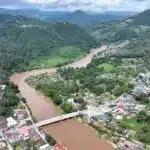
Geography leaves Chiang Rai exposed. The Kok, Sai and Ruak rivers originate in the rugged highlands of eastern Shan State before winding into northern Thailand’s agricultural plains and feeding the Mekong River. While recent Chiang Rai Times reporting documented a 50 percent drop in local hotel bookings and nervous rice mills pausing paddy purchases, the deeper vulnerability lies in rural water infrastructure.
Municipal tap networks in downtown Chiang Rai rely on treated reservoir supplies, yet hundreds of thousands of border villagers and dry-season rice growers draw water from village-run systems and river-fed irrigation canals lacking heavy-metal filtration. Past regional crises—from cross-border haze to sudden Mekong dam releases—showed that unilateral Thai monitoring stations only record damage after plumes cross the frontier, leaving farmers guessing when canal gates are safe to open.
Daily Briefings Promise Clarity, Not Yet a Cure
Following the Bangkok talks, Thai, Myanmar and Chinese delegates are scheduled to conduct joint field inspections in Chiang Rai on Nov. 28–29. Domestically, the National Environment Board will review a proposed 150-kilometer pollution control zone along the Kok River on Dec. 2, while the Ministry of Agriculture and Cooperatives races to publish a public online risk map of soil, crop and water safety by Dec. 15.
To keep residents informed, the Department of Disaster Prevention and Mitigation is centralizing test data through Chiang Rai’s emergency operations center to issue daily public briefings, infographics and updates via a dedicated website and Facebook page.
Still, community networks along the Mae Sai–Tachileik crossing warn that while Thailand’s domestic testing schedule is clear, affected towns still lack a binding diplomatic timetable proving when upstream discharges will actually stop.