The BTS Skytrain and MRT help you cross Bangkok without getting stuck in road traffic, but they’re separate systems with different fares and payment rules. Choosing the right ticket or card matters, especially when your route includes a transfer.
Fares and accepted payment methods can change, so check the relevant operator’s current information before you travel. Start by identifying which train line serves your destination with this Bangkok rail network and interchange guide, then check the fares and ticket options for each system.
Key Takeaways
- BTS and MRT charge separate fares, so switching systems usually means exiting one paid area and paying again at the next gate.
- BTS fares depend on distance. Before buying or topping up a Rabbit Card, check BTS’s Rabbit Card information.
- MRT Blue and Purple lines have separate fare and payment rules. Confirm your bank card works before relying on contactless payment.
- Rabbit Card doesn’t cover every Bangkok rail line, so keep another payment option ready for transfers and airport trains.
- Review the Bangkok BTS and MRT fare guide and operator notices before travel, since fares and card rules can change.
Bangkok BTS and MRT Guide: Know Which Train System to Take
Bangkok’s BTS and MRT are separate train networks, each with its own routes, stations, and fares. Before you head to a platform, find your destination on the right line map and check whether your route crosses between systems. Even at an interchange, changing trains doesn’t automatically make the trip one continuous fare.
When the BTS Skytrain is the easiest choice
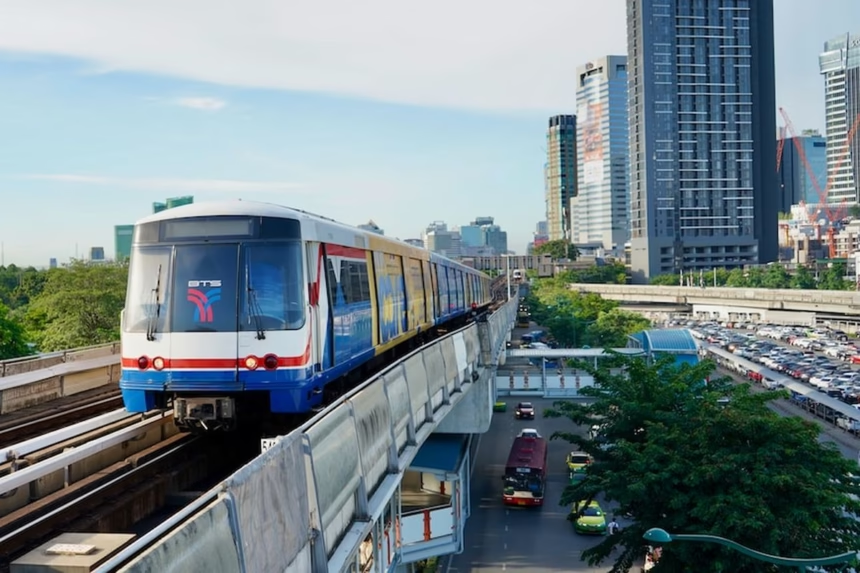
The elevated BTS Skytrain is useful for getting around central Bangkok, especially along the Sukhumvit and Silom lines. The Sukhumvit Line runs through busy areas such as Siam and Sukhumvit, while the Silom Line serves Silom and connects with Siam. Siam is the main interchange between the two BTS lines, and Phaya Thai connects the BTS with the Airport Rail Link.
To choose a route, locate your destination on the BTS route map, then follow the line that reaches its nearest station. If you need to switch BTS lines, look for Siam. For more general transit planning, see this Bangkok public transportation guide.
Where the MRT goes and how it connects
The MRT Blue Line circles through central Bangkok and reaches destinations and stations that the BTS doesn’t serve directly. It can be useful for areas such as Chinatown and the Old Town, as well as connections with other rail lines. The Purple Line extends northwest toward Nonthaburi, making it useful for trips beyond the central BTS network.
Check the MRT line map against the BTS map rather than assuming similarly named areas have nearby stations. Some interchange points connect the networks, but passengers may need to leave one system’s paid area and enter the other. As a result, a BTS-to-MRT change usually means paying a separate fare for the second ride.
Don’t confuse the Airport Rail Link with BTS or MRT
The Airport Rail Link is a separate train service between Suvarnabhumi Airport and the city. At Phaya Thai, transfer to the BTS. For the MRT Blue Line, get off at Makkasan and connect to Phetchaburi station.
These connections help you continue your trip, but they don’t combine the services into one fare. The Airport Rail Link has its own fares and payment rules, so check what each leg accepts before traveling.
BTS and MRT fares, tickets, and cards: What you’ll pay
BTS and MRT fares are charged separately, even when you change trains at an interchange. Use the ranges below as estimates, then confirm the fare and payment rules for each ride before entering the station.
How BTS fares work, including longer trips and extensions
BTS fares depend on the stations you travel between, so a short ride costs less than a trip across the network. Reported adult fares commonly range from 17 to 47 baht, but some journeys that use extensions may cost more. The final fare depends on your route and ticket type.
You can buy a single-journey ticket at a station machine or ticket office, or use stored value on a Rabbit Card. Before you travel, check the current BTS fare information and confirm the fare shown at the station machine. Extension charges and package terms can affect the total, so don’t rely on a range alone for a longer trip.
MRT fares and the payment options to check before you ride
Reported adult fares are about 17 to 44 baht on the Blue Line and 14 to 42 baht on the Purple Line. Treat these as estimates, not guaranteed prices, and check the operator’s current fare information before boarding.
For a single ride, buy a token or ticket at the station, or use an accepted contactless payment method. Reports list Visa, Mastercard, and UnionPay among the bank cards accepted at MRT gates. However, card-brand rules can change, and a foreign-issued card may not work, so confirm acceptance before depending on tap-to-pay. The MRT stored-value card change is another reason to check current ticket options before your trip.
Rabbit Card, contactless bank cards, and other stored-value choices
Rabbit Card is a stored-value option for BTS rides. It can save time if you expect to make several trips, but it is not a universal Bangkok rail card. Don’t assume it works on the MRT Blue or Purple lines. For BTS payment details, see how to use Rabbit Card with LINE Pay.
On the MRT, reported contactless bank-card acceptance offers another way to pay, subject to the card and station rules in effect when you travel. Reports also say older MRT stored-value cards stopped being accepted on the Blue and Purple lines in 2026. Before buying a replacement card, check with the operator about eligibility, issue fees, top-up terms, and how to claim any remaining balance.
When a route switches between BTS and MRT, expect to exit one paid area and pay a new fare to enter the other system. Keep a backup payment method handy, especially if you’re relying on a bank card.
How to buy tickets and transfer between Bangkok train lines
At the station, check the route map first, then buy a fare for the system you’re about to ride. BTS and MRT tickets and fares are separate, so a card or ticket for one network may not work on another.
Buying a single-journey ticket at the station
Look for ticket machines near the station entrance or ticket gates. On a BTS machine, select your destination on the screen or map, check the fare shown, then pay using one of the methods the machine accepts. The BTS ticketing system lists one-trip tickets as a machine option. MRT stations also have ticket machines, with instructions displayed at the machine.
Keep your ticket or token until you exit. At the destination gate, follow the marked instructions to insert the ticket or return the token. If a menu is unclear, or the machine won’t accept your payment, ask staff at the staffed counter near the gates. They can point you to the right fare option or explain the machine.
Using a card at the gate and adding value when needed
For a stored-value card, tap it on the reader at the entry gate and wait for the gate to open. At your destination, use the same card to tap out. Check the remaining balance before you travel, especially if you expect a longer ride, and add value at a ticket office or an available top-up machine when needed.
Payment rules differ by line. A Rabbit Card is a BTS option, but don’t assume it works on the MRT Blue or Purple lines. If a gate rejects your card, try once more after checking that you’re at the correct system’s gate, then ask station staff for help rather than switching to another card mid-trip.
For a quick refresher on the different options, see these Bangkok BTS and MRT ticket tips.
Changing trains without assuming it’s a free transfer
Some changes stay within one system. For example, transferring between BTS lines at Siam does not require you to enter the MRT network. However, a BTS-to-MRT change, such as at Asok and Sukhumvit, usually means exiting one paid area and paying a separate fare to enter the other.
At an interchange, follow signs for the line and station you need, then check the route map and platform signs before boarding. Some stations have long passageways or separate entrances, so allow extra time to find the correct gate.
Simple BTS and MRT Tips That Save Time and Prevent Mistakes
A little preparation can prevent missed trains, confusing transfers, and payment surprises. Check the details for your route and station before leaving, since schedules, access, and fare rules can vary across Bangkok’s rail network.
Plan your route and check station-specific train times
Before you board, check an up-to-date network map and confirm which line serves your destination. At an interchange, follow signs for the correct line and check whether you need to exit one paid area before entering another. That helps you avoid paying for the wrong ride or heading to the wrong platform.
Train hours aren’t identical across every station or day. Check the relevant operator’s first- and last-train schedule for the station and direction you need, especially if you have an early flight or plan to travel late. BTS publishes its station timetable, while BEM provides MRT Blue Line train times. Don’t rely on one network-wide opening or closing time for your whole trip.
Travel more comfortably during busy periods
If your schedule allows, avoid the busiest commuting periods, when platforms and trains can feel crowded. Conditions vary by line, station, and time, so leave extra time if you have luggage or need to change lines.
At escalators, stand to one side so people who want to walk can pass. Wait for passengers to exit before boarding, then move farther into the carriage when there’s room. Keep backpacks and shopping bags close to your body, especially near doors and in crowded cars. These small habits make boarding easier for you and other passengers.
Check passes, fare caps, and accessibility before relying on them
The available information doesn’t verify a general BTS and MRT visitor pass or a network-wide fare cap. A reported Purple Line daily cap runs only through November 30, 2026; it isn’t a general benefit across Bangkok’s rail lines. Any promotion may depend on the line, card type, dates, or passenger eligibility, so confirm its terms with the operator before counting on a lower fare.
Reports about Bangkok’s planned common rail ticket concern a future policy, not a pass you can assume is available for your trip. Check current operator notices for payment rules and fares. If you need step-free access, elevators, or other assistance, confirm the facilities at your specific stations with the relevant operator before setting out.
Frequently Asked Questions
Bangkok’s rail lines can look connected on a map, but some airport routes and card rules need a little extra checking. These answers cover a few details that can affect your plans.
Can I take the BTS or MRT directly to Don Mueang Airport?
No. From the MRT Blue Line, ride to Bang Sue and follow signs to Krung Thep Aphiwat Central Terminal, then take the SRT Dark Red Line toward Rangsit to Don Mueang station. From the BTS, transfer to the Blue Line first, then continue to Bang Sue.
Why do maps show both Bang Sue and Krung Thep Aphiwat?
They refer to stations on different rail systems in the same interchange area. Bang Sue is the MRT Blue Line station; Krung Thep Aphiwat is the SRT Red Line terminal. Follow interchange signs between them, and allow time to find the correct platform.
Does the Airport Rail Link go to Don Mueang?
No. The Airport Rail Link serves Suvarnabhumi Airport, while the SRT Dark Red Line serves Don Mueang. For the Suvarnabhumi route, see this guide to transferring from the Airport Rail Link to Bangkok.
Is the Don Mueang train station connected to the airport?
Yes. Don Mueang station connects to the airport terminals by a covered pedestrian walkway. Follow airport signs after leaving the train station, and allow extra time if you have luggage or need to locate your terminal.
Can I get an adult Rabbit Card if I’m under 23 or over 60?
BTS lists adult Rabbit Card eligibility as ages 23 through 60, based on the date of birth on the holder’s ID. Other card categories may have different requirements, so check BTS Rabbit Card eligibility before buying.
Conclusion
The BTS Skytrain and MRT make it easier to get around Bangkok, but they remain separate networks with different fares and payment options. Check the relevant operator’s current details before setting out, since fares and promotions can change.
Leave time for transfers, and plan to pay separately when your route switches systems. Knowing which line you need and how you’ll pay helps keep your journey predictable.