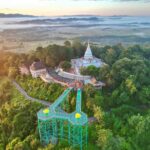
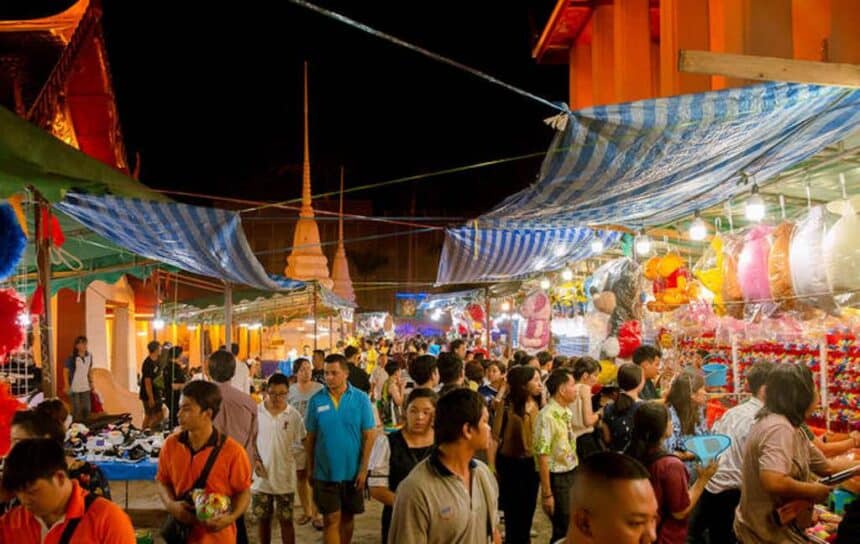
BANGKOK – Thousands of merit-makers, residents and foreign visitors converged on Wat Saket Ratchawora Maha Wihan on Tuesday as the historic temple launched its annual Golden Mount fair, a 13-day festival running through Nov. 29. Opening day centered on the dawn procession of a massive crimson cloth carried up 344 spiral steps and wrapped around the gilded summit chedi.
Organizers with the Bangkok Metropolitan Administration and temple authorities expect heavy evening crowds across Pom Prap Sattru Phai district over the next two weeks, particularly around Loy Krathong on Nov. 24. The fair transforms the canal-side sanctuary into Rattanakosin Island’s largest open-air night market, pairing Buddhist devotion with carnival games, regional street food and panoramic city views.
Key Takeaways• Dates & Entry: The fair runs daily from Nov. 17 to Nov. 29; ground-level market access is free, while climbing the mount costs 100 baht for foreign visitors. • Rituals & Attractions: Highlights include the red-cloth chedi wrapping, relic veneration, vintage Ferris wheels, dart booths and Thai regional food stalls. • Transit & Dress: Visitors should ride the MRT Blue Line to Sam Yot Station or take a Khlong Saen Saep canal boat, wearing clothing that covers shoulders and knees. |
Red-Cloth Ritual Anchors Century-Old Bangkok Tradition
The crimson-draping ceremony traces its roots to the late 19th century, when King Rama V enshrined Buddha relics brought from India inside the hilltop stupa. The 77-meter artificial hill itself emerged from an engineering failure during King Rama III’s reign, when soft alluvial soil swallowed a massive brick chedi under construction.
King Rama IV later stabilized the sunken mound with timber logs before concrete reinforcements were added in the 1940s. Wrapping the summit spire in red cloth—symbolizing protection, vitality and devotion—has anchored Wat Saket’s twelfth lunar month festivities ever since. For surrounding Ban Bat and Pom Prap Sattru Phai neighborhoods, the 13-day fair remains a vital economic engine, drawing tens of thousands of nightly shoppers to family-run food stalls, traditional craft vendors and old-fashioned carnival booths.
Opening Hours, Transit Routes and Crowd Strategy
While standard temple visiting hours run from 7 a.m. to 7 p.m., festival activities keep the lower courtyards and perimeter lanes buzzing past midnight each evening. Entry to the fairgrounds is free for everyone. Foreign visitors climbing to the summit terrace pay a 100-baht cash admission fee at the base of the stairs, while Thai nationals enter free.
Street closures and heavy traffic make private cars impractical after 5 p.m. Public transit guides from Visit Thailand Today advise taking the MRT Blue Line to Sam Yot Station, followed by a 15-minute walk north across the historic canal bridge. Commuters coming from central Sukhumvit or Pratunam can also ride the Khlong Saen Saep express boat to its western terminus at Panfa Leelard Pier, located a five-minute walk from the temple gates.
Photography Angles and Temple Etiquette for Visitors
Photographers seeking sweeping views over Rattanakosin Island should begin the climb around 5:15 p.m. Golden hour light illuminates the nearby iron spires of Loha Prasat and Mahakan Fort before neon fairground lights flicker on below. Along the shaded stairwell, visitors can capture rows of bronze prayer bells and mist-covered rock gardens, though tripods are discouraged on narrow landings during peak evening bottlenecks.
Despite the festive carnival atmosphere at ground level, Wat Saket remains an active royal monastery. Temple staff enforce strict dress rules at the stairway checkpoint: shoulders and knees must be covered, and sleeveless tops or short skirts are turned away. Visitors should carry small bills for food vendors and water, remove shoes before entering ordination halls, and walk clockwise around the summit chedi without blocking kneeling worshippers.
Trenfing News:
Bangkok Warning: PM2.5 May Rise Again This Week
Watching Muay Thai in Bangkok: Rajadamnern vs. Lumpinee