CHIANG RAI – Senior Interior Ministry officials deployed to Chiang Rai on Monday to secure emergency water supplies after severe arsenic contamination forced tap water shutdowns across border communities.
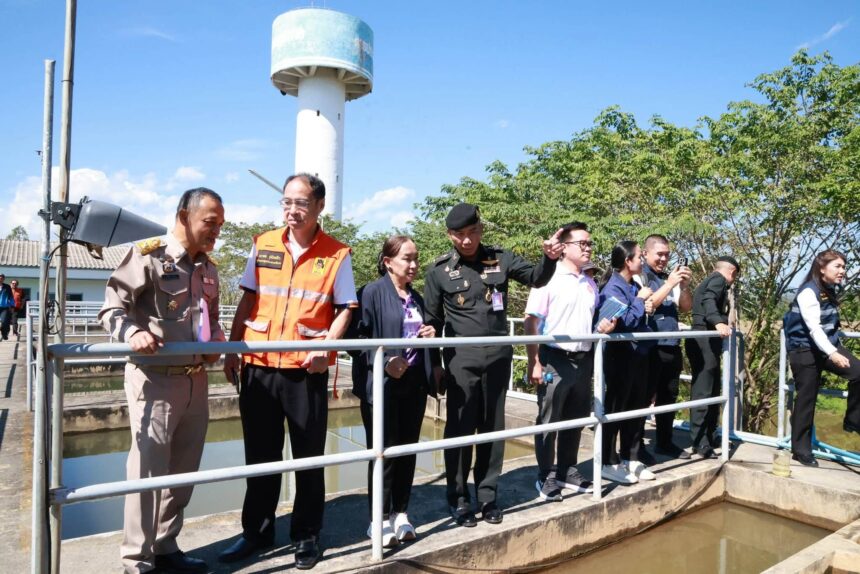
Deputy Permanent Secretary Rattapol Naradisorn and Department of Disaster Prevention and Mitigation Director-General Nirat Phongsitthithavorn inspected water treatment plants in Mae Sai and Ko Chang districts alongside Chiang Rai Gov. Chucheep Phongchai.
High turbidity and toxic arsenic levels in the Sai River recently halted production at the Provincial Waterworks Authority’s Mae Sai branch, cutting piped water to more than 23,000 households across at least 14 villages. Officials are now scrambling to replace cross-border river intakes with domestic water sources before shortages deepen.
Key Takeaways• More than 23,000 households in Mae Sai lost tap water after high arsenic levels shut down local waterworks. • Disaster relief teams are tapping domestic ponds, springs and reservoirs to replace polluted cross-border rivers. • Health officials screened over 2,000 residents and found no widespread arsenic poisoning, though 400 new tests are pending. |
Cross-Border Mining Fuels Northern Water Crisis
The water emergency stems from a broader environmental crisis across northern Thailand’s Mekong tributaries. Environmental monitors and Thai authorities have traced heavy metal spikes in the Kok, Sai and Ruak rivers to unregulated gold and rare earth mining upstream in Myanmar’s Shan State, prompting Bangkok to demand urgent diplomatic action.
Because these waterways originate outside Thai territory, downstream districts from Mae Sai to Chiang Saen and Chiang Khong remain vulnerable to sudden toxic runoff. Rattapol said the government is pairing immediate water delivery with medium- and long-term infrastructure to break local reliance on transboundary rivers.
Emergency Pipelines and Mass Health Screenings
Nirat said disaster mitigation crews are surveying domestic sources in Mae Sai, including Nong Nam Phu and Khun Nam Nang Non, to install emergency pipelines while authorities build longer-term links from Mae Chan district. Crews will also evaluate older groundwater wells as temporary backups.
Despite murky tap water and skin irritation reports, Chiang Rai Deputy Provincial Public Health Chief Dr. Narong Luecha said health screenings remain reassuring. Since toxic runoff was first flagged, officials tested more than 200 crop and livestock samples without finding unsafe arsenic levels. Out of 2,000 high-risk residents screened and 300 tested directly, only seven showed trace arsenic and just one chili farmer exceeded safety thresholds. Health teams recently launched sweep testing for 400 additional residents across five Mae Sai communities.
Local Villages Shift From Wells to Reservoirs
Not all contamination comes from cross-border mining. Out of 163 village waterworks in Chiang Rai, seven are currently offline due to arsenic—one in Rim Kok subdistrict and six in Chiang Khong district. Huai So Subdistrict Mayor Chan Taklai said geological surveys confirm local groundwater sits along natural gold-bearing rock veins, prompting a ban on drilling new wells.
Older community filters were built to clear sediment and bacteria, not heavy metals, leaving treated water in Ban Kaen Nuea at 0.2 milligrams per liter—20 times the safety limit. After successfully piping clean surface water from Huai Kiang Reservoir to nearly 10 villages, local officials approved an 800,000-baht ($23,000) plan to lay an 8-kilometer pipeline from the newly expanded Huai Yaek Sai Reservoir to four affected villages by next month.