Thai food’s bold flavors make eating your way through Thailand a pleasure, but hidden ingredients can complicate every meal when you have a food allergy. Fish sauce, curry pastes, and shared woks may introduce allergens you can’t see, while language barriers can make it hard to confirm what’s in a dish or how it’s prepared.
Careful planning can help you ask clearer questions and make informed choices, though no dish or restaurant can be assumed safe without reliable answers. A translated allergy card and knowledge of common ingredients can make those conversations easier; start by learning what may be in the food and Thai phrases for explaining food allergies.
Key Takeaways
- Name each allergen clearly, then ask about hidden ingredients such as fish sauce, shrimp paste, curry pastes, sauces, and broths.
- Check each dish rather than relying on its name; popular Thai dishes can contain common allergens.
- Ask whether cooks use shared woks, utensils, oil, or surfaces, and skip the meal if staff can’t confirm how it’s prepared.
- Carry a translated allergy card and prescribed emergency medication; the CDC advises travelers to keep epinephrine accessible.
Eating safely with food allergies in Thailand starts with knowing what may be in your food
Thai dishes can include allergens in seasonings and sauces that aren’t obvious from the plate. Learning the ingredient names helps you recognize potential risks, but recipes vary, so check each product or dish rather than relying on its name.
Learn the Thai names for your specific allergens
A translated allergy card can list your allergens in Thai and name ingredients that may contain them. Approximate terms include:
- Peanuts: ถั่วลิสง (thua li-song)
- Tree nuts: ถั่วเปลือกแข็ง (thua plueak khaeng); cashew: เม็ดมะม่วงหิมพานต์ (met ma-muang him-ma-phan)
- Shellfish: หอย (hoi); shrimp: กุ้ง (kung); fish: ปลา (pla)
- Egg: ไข่ (khai); milk: นม (nom)
- Soy: ถั่วเหลือง (thua lueang); wheat: แป้งสาลี (paeng sa-li)
Transliterations vary, and a sound-based spelling may not be clear to every reader. Have a fluent Thai speaker or professional translator check your card, and use the exact allergen rather than the broad word ถั่ว (thua), which can refer to different beans or nuts. A Thai-language food allergy guide can help you identify less obvious ingredients to include.
For fish and shellfish allergies, name ingredients that may be mixed into a dish: fish sauce, น้ำปลา (nam pla); shrimp paste, กะปิ (kapi); dried shrimp, กุ้งแห้ง (kung haeng); and oyster sauce, น้ำมันหอย (nam-man hoi). “Seafood” alone may not identify the particular ingredient that poses a risk.
Watch for sauces, curry pastes, toppings, and shared equipment
Recipes differ, but familiar dishes can offer useful clues. Pad thai may come with peanuts, satay may include peanut sauce, and som tam or other salads may contain peanuts or dried shrimp. Some curry pastes and dips include shrimp paste, while sauces, broths, and marinades can carry ingredients throughout a dish.
Removing a visible topping won’t remove an allergen already mixed into a sauce or paste. Shared oil, utensils, woks, and cooking surfaces can also transfer traces between foods, so the dish’s ingredients aren’t the only concern.
Treat packaged-food labels and restaurant answers as different things
Packaged foods provide ingredient and allergen information on the label, while a made-to-order meal may not come with a written ingredient list. Read labels carefully and check current local guidance; for more on packaged products, see how Thai food labels identify allergens.
Restaurant or street-stall staff may be able to ask the cook about a recipe, but a verbal answer may not cover every sauce or shared cooking surface. Likewise, a label may describe ingredients without addressing every preparation risk. Check each item and preparation method separately.
Prepare before you travel so you can explain your allergy clearly
A little preparation at home can make food conversations in Thailand clearer and reduce last-minute decisions. Prepare a concise explanation of your allergy, review your medical plan, and think through where and how you’ll eat.
Bring a clear allergy card in Thai and English
Have a professional translator prepare a card that names each specific allergen, any dangerous derivatives, and the risk of cross-contact. Ask the translator to make the warning direct and easy for restaurant staff to understand. If you have several allergies, list each one rather than relying on a broad term.
You can also learn a couple of short phrases:
- “I have a food allergy”: ผม/ฉันแพ้อาหาร (phom/chan phae a-han).
- “Could you ask the cook?”: ช่วยถามคนทำอาหารให้หน่อยได้ไหม (chuay tham khon tham a-han hai noi dai mai).
Show the card before ordering, then ask staff to confirm the details with the cook. Don’t rely on the card alone: staff still need to check the dish and how the kitchen prepares it. If they can’t get a clear answer, choose another option.
Pack prescribed medicine and make an emergency plan
Before departure, discuss your itinerary and medication needs with your clinician. Carry prescribed emergency medicine in your hand luggage, keep it accessible, and bring enough for the full trip plus a backup supply if your clinician advises one. A written action plan can help you and your companions recognize symptoms and follow the steps your clinician recommends.
Check medication travel requirements with your clinician or the relevant authority before packing. For more on preparation, see this guide to bringing prescription medication through Bangkok airport customs. The CDC’s guidance for severely allergic travelers also recommends discussing medical identification for travel. Thailand’s ambulance number is 1669; confirm emergency details for your destination before leaving.
Plan meals around your needs, not just convenience
Research restaurants near your lodging and planned activities, then contact them with specific questions about ingredients and preparation. A restaurant’s menu or online description can’t confirm that a dish fits your needs, so ask whether staff can check with the cook.
When useful, choose lodging with a kitchen or food storage, and pack safe snacks for travel days or meals that don’t work out. Share your allergy card, medication location, and emergency plan with travel companions before you arrive. That way, everyone knows how to help if a meal raises concerns or an emergency occurs.
How to order food safely in Thailand, from restaurants to street stalls
A consistent routine can make each meal easier to assess: explain your allergy before ordering, check ingredients and preparation, then decide whether the answers are clear enough. A dish’s name or appearance can’t confirm that it avoids your allergen.
Ask about every ingredient that matters to your allergy
Tell staff about your allergy before you place an order, then show your translated allergy card. Name the allergen and any related ingredients you need to avoid. For example, ask about fish sauce, shrimp paste, dried shrimp, and oyster sauce if they matter to your allergy. If the answer isn’t clear, ask the server to check with the cook.
For a peanut allergy, you can ask, “Does this contain peanuts?” (an ni mee thua li-song mai). Then ask, “Is it fried in the same oil?” (thot nam-man diao kan mai). A “no peanuts” answer only addresses the recipe, not shared utensils, oil, woks, or cooking surfaces. Food Allergy Research & Education also recommends asking what goes into a dish and how the kitchen prepares it. See its advice on talking with restaurant staff about food allergies.
Choose simpler dishes only when the cook can confirm how they’re made
A dish with fewer sauces, pastes, and toppings may be easier to discuss, but a short ingredient list doesn’t make it safe by itself. Ask about the broth, seasoning, marinade, cooking oil, and equipment used to prepare it. For instance, a plain-looking stir-fry may still include a sauce or share a wok with other dishes.
If staff understand your request, ask them to confirm it with the cook before you order. However, if they can’t explain the ingredients or preparation, choose another option rather than relying on a guess. The same care applies at restaurants and stalls, since recipes and kitchen practices vary.
Use extra care at busy stalls and buffets
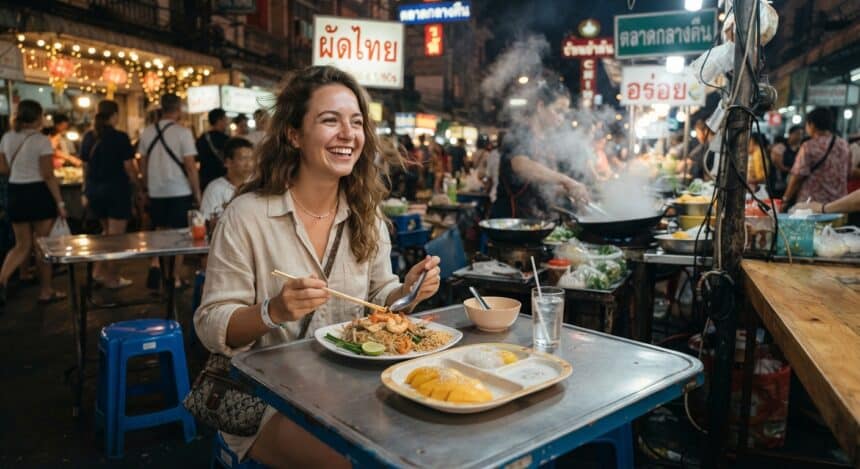
Fast service, open ingredients, and shared serving utensils can make it harder to trace what’s in a dish or prevent cross-contact. At a buffet, ask how the food was prepared and whether serving spoons are shared. At a stall, look for someone who can pause and check with the cook. Bangkok street food stalls vary in what they can confirm, so don’t assume a familiar dish is prepared the same way everywhere.
If you can’t get a reliable answer, it’s reasonable to skip that meal. Keep safe snacks or another backup option with you, especially when traveling between meals.
What to do if you have an allergic reaction in Thailand
A reaction can worsen quickly, so act on serious symptoms rather than waiting for certainty. Follow the person’s clinician-provided allergy action plan, use prescribed emergency medication as directed, and get medical help without delay.
Recognize when symptoms need urgent help
Breathing trouble, throat or tongue swelling, faintness, or sudden weakness can signal a severe allergic reaction. Symptoms affecting more than one body system, such as hives together with vomiting or breathing problems, also need urgent attention. These signs aren’t a complete diagnostic checklist, so follow the person’s action plan if a serious reaction is suspected.
If you’re with someone who may be reacting, stay with them and ask a companion to help. Keep their allergy card and medication nearby, and be ready to tell responders what they ate, when symptoms began, and what medication they received.
Use your action plan and call for emergency care
If the person’s action plan calls for epinephrine, use their prescribed medication promptly and as directed. Don’t wait to see whether symptoms pass. Call Thailand’s emergency medical number, 1669, or ask someone nearby to call while you follow the plan. Thailand’s government lists 1669 for emergency medical services.
Tell the dispatcher that the person may be having a severe allergic reaction. Give the exact location, including the hotel name, street address, building, room, or nearby landmark. If you’re staying at a hotel, have its address saved in Thai and English so you can share it quickly. Follow the dispatcher’s instructions and tell responders what happened and what medication was used. For more detail, see how to call Thailand’s 1669 emergency medical number.
Even if symptoms improve after epinephrine, seek medical assessment after a severe reaction. Keep the person with a companion and continue following their action plan while arranging care.
Frequently Asked Questions
Even with a plan and a translated allergy card, some meal decisions can feel uncertain. These answers cover common situations that still require a clear call before you eat.
Can I eat street food if I have a food allergy?
Street food isn’t automatically unsafe, but it can be harder to check every ingredient and prevent cross-contact when a stall is busy. If the cook can’t confirm what’s in the dish and how it’s prepared, choose something else. At stalls, a Thai allergy card can help you explain your needs, but you still need clear answers before ordering.
Is a food allergy the same as an intolerance?
No. A food allergy involves the immune system, while an intolerance usually affects digestion; FARE explains the difference between food allergies and intolerances. If a clinician diagnosed an allergy, tell restaurant staff you have an allergy and name the food, rather than describing it as a general dietary restriction.
Should I trust a translation app to explain my allergy?
Use an app as extra support, not as your only explanation. A translation may miss a specific ingredient or mistranslate the seriousness of a medical warning. Carry a professionally checked card in Thai and English, and show it to staff before ordering.
What if restaurant staff say a dish can be made without my allergen?
Removing one ingredient may not address sauces, curry pastes, shared oil, utensils, or other cross-contact. Ask whether the allergen is in the seasoning or sauce and whether the cook can use clean equipment and a separate preparation area. If staff can’t confirm those details, choose another meal.
Can I bring my prescribed allergy medicine into Thailand?
Check official travel and medication guidance before departure, and ask your clinician about your specific prescription and trip. Keep prescribed medicine in its original packaging, with supporting documentation when appropriate. Carry it according to your clinician’s instructions, and don’t assume a general rule covers every medication.
Conclusion
Eating safely with food allergies in Thailand starts with knowing the ingredients that matter to you and explaining your allergy clearly. Ask about sauces, pastes, cooking oil, and shared equipment, then choose another meal whenever staff can’t give you a clear answer. A request for mild or vegetarian food isn’t a substitute for explaining an allergy, as the guidance on Thai food allergy precautions makes clear.
Most importantly, keep your prescribed emergency medicine accessible and follow your action plan if a reaction occurs. With clear communication and a firm choice to skip uncertain meals, you can make safer food decisions throughout your trip.