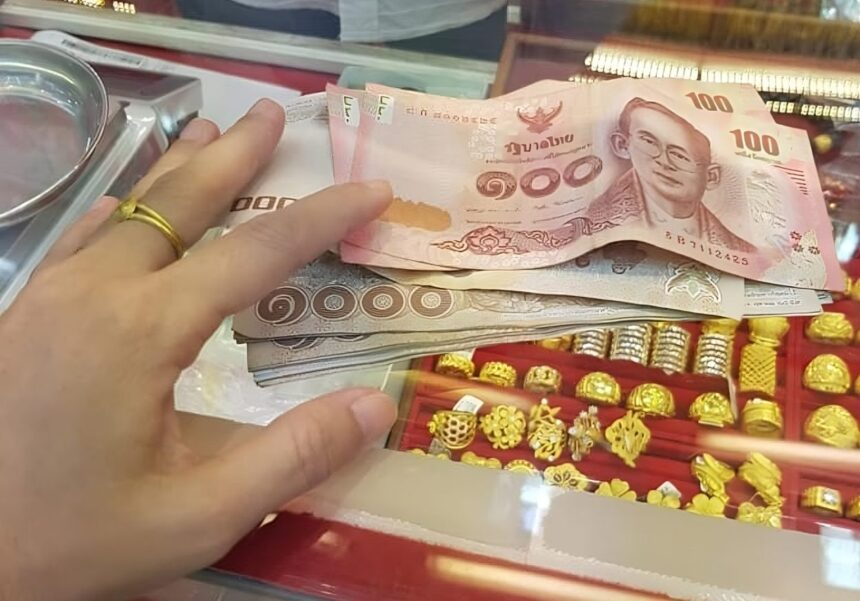
BANGKOK — Domestic gold bar prices tumbled 400 baht on Nov. 16 as global bullion retreated and the Thai currency hovered near a key psychological threshold against the U.S. dollar. The Gold Traders Association quoted 96.5% pure gold bars at 61,850 baht buying and 62,050 baht selling per baht-weight, creating immediate entry points for local buyers while testing the purchasing power of foreign residents.
That same day, the Bank of Thailand posted a reference exchange rate of 34.04 baht per dollar, reflecting a softer baht compared with early November levels near 33.60. Together, lower bullion valuations and a weaker local currency alter the math for expatriates converting overseas funds into Thai assets or everyday living expenses.
Key Takeaways
|
Global Headwinds and Local Pricing Mechanics
The 400-baht slide did not happen in isolation. International spot gold traded near $3,865 per troy ounce on Nov. 16, down roughly 7% over a 30-day stretch as global investors trimmed safe-haven holdings, according to Fortune market data. Because Thailand imports refined bullion priced in U.S. dollars before casting it into domestic 96.5% bars, overseas price drops flow directly onto Bangkok trading boards.
Historically, a weaker Thai baht cushions domestic gold prices against international declines. When the baht softens from 33.60 to 34.04 against the dollar, importing each ounce costs more in local terms. Without that currency buffer, the Nov. 16 drop in Hua Seng Heng and association quotes would have cut even deeper. Still, retail shops along Bangkok’s Yaowarat Road saw steady foot traffic as bargain hunters stepped in after weeks of steeper valuations above 64,000 baht. Thailand remains one of Southeast Asia’s most liquid retail bullion markets, where families treat gold bars both as portable savings and ceremonial gifts.
What the Dual Shift Means for Expatriates
For foreign retirees, remote workers, and investors living in Thailand, the twin movement delivers a rare double advantage. First, a reference rate near 34.04 baht per dollar stretches incoming wire transfers and pension payouts. Converting $3,000 yields 102,120 baht before bank spreads—about 1,300 baht more than the same transfer netted two weeks earlier. Expats funding long-term visa deposits or annual rent renewals gain immediate breathing room when the dollar approaches 34 baht.
Second, expatriates holding dollars who want to buy physical gold as an inflation hedge pay less on both ends of the transaction. At 62,050 baht per baht-weight—equivalent to 15.244 grams—one bar costs roughly $1,823 at the reference rate, down from more than $1,900 earlier in November. Buyers should still watch commercial bank telegraphic transfer rates, which typically shave 0.25 to 0.35 baht off the central bank’s benchmark figure, and confirm shop workmanship fees before locking in bullion or ornament purchases.
Trending News:
Bangkok’s Annual Golden Mount Temple Fair: A Complete Guide
Mekong Gold Mining in Laos Sparks Anger in Chiang Rai