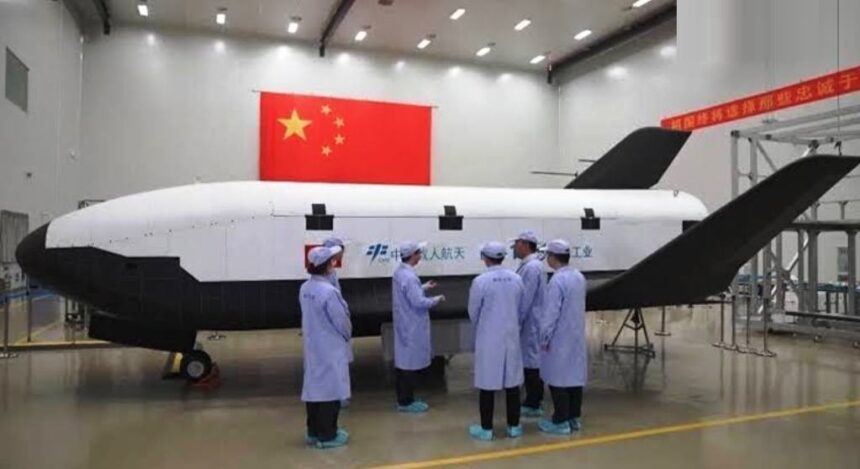
China Study Maps 40-Spaceplane Fleet for Rapid Global Reach
BEIJING — A fleet of 40 reusable China’s spaceplanes parked in low Earth orbit could begin descending toward almost any target on the planet within 2.5 minutes, according to a peer-reviewed simulation study published by aerospace engineers in Xian. For densely populated regions between 60 degrees north and south latitude, the wait time before starting a return dive drops to roughly one minute.
The findings, detailed by researchers at Northwestern Polytechnical University in the journal Acta Aeronautica et Astronautica Sinica, highlight the military potential behind Beijing’s secretive Shenlong reusable spacecraft program. While the calculations rely entirely on computer modeling rather than deployed hardware, the concept illustrates how an orbital constellation could bypass traditional rocket-launch delays and challenge existing missile defense networks.
Key Takeaways
- Rapid orbital response: Computer simulations show 40 spaceplanes stationed at an altitude of 400 kilometers could initiate descent toward any global point within a maximum 2.5-minute window.
- AI-driven constellation geometry: Researchers used reinforcement learning to arrange the spacecraft in an uneven, asymmetric pattern, eliminating the coverage gaps common in standard symmetrical satellite grids.
- Escalating space competition: The modeling coincides with fresh U.S. intelligence disclosures showing China’s experimental Shenlong spaceplane conducting complex orbital maneuvers and payload deployments.
AI Algorithms Reshape Orbital Geometry
Traditional orbital constellations rely on symmetrical layouts, known as Walker constellations, to provide predictable communications or surveillance coverage. Those rigid grids leave gaps, forcing ground commanders to wait hours for a specific satellite or spacecraft to pass over a target zone.
To eliminate that delay, lead researcher Du Chongrui and his colleagues turned to artificial intelligence. The team applied a reinforcement learning method called Proximal Policy Optimization, paired with a curiosity-driven search algorithm, to test thousands of orbital configurations. Instead of spacing the 40 uncrewed vehicles evenly, the AI skewed the fleet into a deliberately asymmetric pattern.
By customizing orbital inclinations and spacing individual craft unevenly at an altitude of 400 kilometers, the simulation ensured at least one vehicle is always positioned to deorbit toward any location on Earth. The 1-to-2.5-minute figures measure only the waiting period before a spacecraft fires its thrusters to begin reentry, not the total flight time required to glide through the atmosphere to a destination. Once deorbit burns begin, a hypersonic lifting body still requires tens of minutes to bleed off orbital velocity and steer toward a landing zone or target.
Inside China’s Secretive Shenlong Program
Beijing has never officially linked the Xian study to an active weapons program, describing its reusable spacecraft efforts strictly as peaceful research to lower the cost of space access. Yet defense analysts widely view the study through the lens of Shenlong, or “Divine Dragon,” China’s autonomous orbital test vehicle.
Developed in deep secrecy since the late 2000s, Shenlong launches vertically atop a Long March 2F rocket from the Jiuquan Satellite Launch Center in the Gobi Desert and lands horizontally on a runway at the remote Lop Nur test base. Its mission profiles mirror those of the U.S. Space Force’s Boeing X-37B, an uncrewed spaceplane that conducts long-duration classified experiments.
Across four orbital flights since September 2020, Shenlong has steadily expanded its endurance and technical complexity. Its first mission lasted just two days, demonstrating basic launch and autonomous runway recovery. Its second and third flights stretched to 276 and 268 days, respectively. On Feb. 7, 2026, China launched Shenlong on its fourth mission, keeping the spacecraft aloft for more than nine months while testing prolonged orbital operations.
Declassified Imagery and Dual-Use Realities
The academic paper arrived just weeks after the Pentagon pulled back the curtain on Shenlong’s physical design. In late October 2026, the Defense Intelligence Agency released an unclassified space security assessment featuring a high-resolution, satellite-to-satellite photograph of Shenlong captured during its 2024 flight. Taken by a commercial imaging satellite operated by Maxar Technologies, now rebranded as Vantor, the image showed a compact lifting-body craft with open cargo bay doors and an aft service module equipped with solar arrays.
Open payload doors confirm Shenlong can release and retrieve hardware in orbit. During its second, third, and fourth missions, U.S. space tracking networks observed the spaceplane ejecting smaller subsatellites and performing repeated rendezvous and proximity operations—a delicate orbital dance of approaching, inspecting, and recapturing co-orbital objects.
For satellite operators and military planners worldwide, those maneuvers carry immediate operational consequences. A spacecraft capable of grabbing a friendly test satellite can also approach, disable, or tamper with a foreign communications or early-warning satellite. China has also declined to register Shenlong or its ejected subsatellites with the United Nations, drawing criticism from international legal scholars who point to Beijing’s obligations under the 1975 Registration Convention.
While the Xian study notes that rapid-descent spaceplanes could deliver emergency relief supplies during disasters, defense officials focus on the dual-use reality. Unlike intercontinental ballistic missiles that follow predictable arcs from fixed launch silos, a hypersonic glider dropping from orbit can bank, change course mid-flight, and strike from unmonitored directions, complicating ground-based radar networks.
Hurdles Between Simulation and Reality
Building and maintaining a 40-plane orbital fleet presents steep engineering and financial barriers. China currently operates only a small number of experimental reusable vehicles, and turning around a spaceplane after a fiery atmospheric reentry requires extensive thermal tile inspections, structural checks, and engine refurbishment.
Sustaining 40 spacecraft in low Earth orbit simultaneously would require a massive surge in launch cadence, alongside heavy-lift boosters capable of hoisting multiple spaceplanes at once. At an altitude of 400 kilometers, residual atmospheric drag constantly pulls on orbiting hardware, forcing vehicles to burn precious propellant just to maintain their positions. Over months on orbit, station-keeping fuel demands would steadily shrink the payload capacity available for cargo or sensors.
Independent aerospace experts also note that an orbital bombardment or rapid-strike system remains far less cost-effective than ground-based hypersonic missiles, which sit safely in hardened silos without burning fuel in orbit. Even so, the Xian simulation underscores how Chinese engineers are merging artificial intelligence with reusable hypersonic flight, pushing space competition into faster, less predictable territory.