
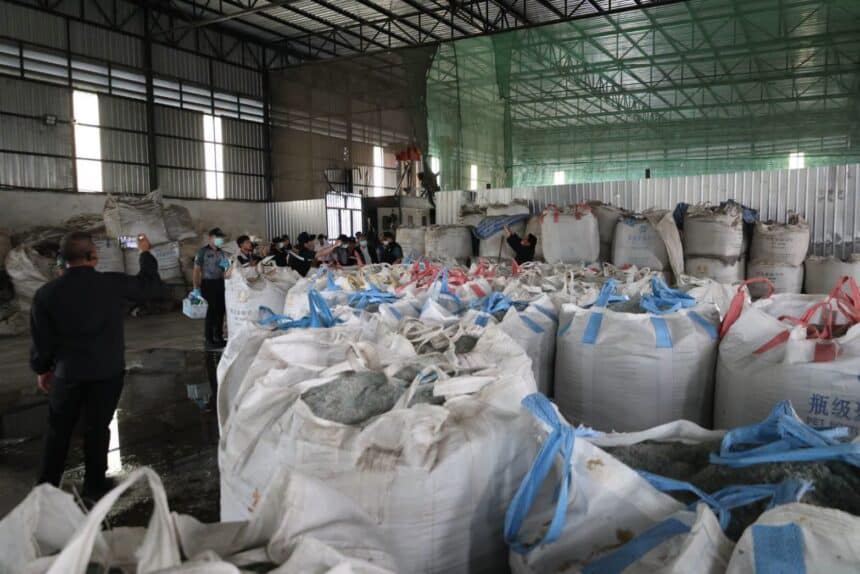
BANGKOK — Thailand environmental officials and police seized more than 6,000 metric tons of hazardous industrial waste from unlicensed warehouses in Chachoengsao province this week, halting an organized smuggling ring bound for rural dump sites in Saraburi. The Nov. 17–19 raids followed the highway interception of a heavily loaded commercial trailer truck, exposing a multi-province trafficking network that threatens groundwater aquifers, orchards and farming communities across eastern and central Thailand.
Preliminary laboratory tests confirmed the stockpiled waste contains six toxic elements, including lead, mercury and arsenic, according to the Pollution Control Department. Natural Resources and Environment Minister Suchart Chomklin ordered a joint task force of provincial police and environmental inspectors to trace the financial backers behind the warehouses in Plaeng Yao district after investigators discovered haulers were disabling GPS trackers to evade highway monitoring.
Key Takeaways
- Authorities intercepted a trailer truck in Saraburi on Nov. 17 and raided linked warehouses in Chachoengsao, uncovering over 6,000 metric tons of hazardous industrial waste laced with lead, mercury and arsenic.
- Smuggling crews paid site scouts 4,000 baht per trip and truckers up to 15,000 baht per 15-ton load while letting annual vehicle taxes lapse to bypass mandatory GPS tracking.
- The Ministry of Industry halted new licenses for recycling factories and launched nationwide inspections across 3,049 waste facilities while weighing asset-seizure laws.
Highway Stop Unravels Clandestine Hauling Ring
The investigation broke open late Tuesday night when Saraburi Provincial Police flagged down a suspicious commercial trailer truck traveling along rural highways toward Chaloem Phra Kiat district. Officers inspecting the cargo bed discovered crushed electronic circuit boards, shredded industrial wiring and chemical sludge lacking mandatory hazardous-waste manifests.
Questioning of the driver led investigators 170 kilometers southeast to a cluster of corrugated-metal warehouses hidden behind cassava and eucalyptus fields in Chachoengsao’s Plaeng Yao district. Inside, inspectors found heavy industrial shredding machinery operating without factory permits alongside towering heaps of toxic debris.
Pol. Lt. Gen. Itthiporn Pothong, chief of the environment ministry’s special pollution control task force, said the network operated with strict compartmentalization to shield its financiers. Site scouts earned roughly 4,000 baht per trip to locate remote quarries and abandoned laterite pits in Saraburi’s Phu Khae subdistrict, while transport operators collected 10,000 to 15,000 baht for every 15-ton load delivered under cover of darkness.
To avoid detection by the Department of Land Transport, truck owners deliberately let their annual vehicle tax registrations expire. Skipping registration allowed operators to avoid installing mandatory Global Positioning System transponders, leaving regulators blind to late-night runs between the eastern industrial corridor and central Thailand.
Toxic Floodwaters Batter Eastern Farming Villages
While police tracked trucks on the highways, seasonal floodwaters exposed the immediate human toll of illicit dumping across neighboring provinces. In Prachinburi province, heavy rains washed oil slicks and chemical runoff out of unlined waste pits and straight into residential canals and rice paddies.
Adisorn Lakonburee, a father of four living in eastern Thailand, stopped netting fish in local waterways after dark chemical films and acrid fumes blanketed his village. Local clinics nearby have recorded rising complaints of skin rashes, respiratory irritation and foul-smelling well water near unlicensed sorting yards.
Environmental advocates warn that slow bureaucratic sampling threatens legal accountability. During a Nov. 2 inspection of towering electronic and chemical waste mounds in Prachinburi, activist Sumet Rianpongnam urged officials to accelerate riverbed sediment testing before seasonal currents wash away chemical signatures linking pollutants to specific factories.
Somnuck Jongmeewasin, an environmental researcher monitoring eastern industrial zones, told reporters that delayed forensic testing hands polluters an easy escape. Without rapid soil and water chain-of-custody records, prosecutors struggle to prove which upstream plant generated the toxins dumped in rural ditches, leaving taxpayers to shoulder cleanup bills.
Investigative Context: Regulatory Loopholes and the Eastern Seaboard
Thailand’s toxic waste crisis stems from three decades of rapid industrial expansion along the Eastern Seaboard, where thousands of electronics, automotive and petrochemical plants cluster across Chonburi, Rayong and Chachoengsao. While manufacturing output surged, licensed hazardous-waste treatment capacity failed to keep pace.
A major regulatory blind spot emerged in 2016 when the former military government issued National Council for Peace and Order Order No. 4/2559, exempting certain recycling and waste-sorting plants from strict urban zoning rules. Hundreds of Category 105 and 106 factories—facilities licensed to sort, landfill or recycle industrial materials—sprang up beside orchards, schools and community watersheds.
At the same time, tightened import bans on electronic scrap in China and neighboring Asian nations pushed foreign waste brokers to reroute shipping containers toward Thai ports. Smugglers routinely mislabeled hazardous circuit boards and heavy-metal dust as mixed plastic scrap, feeding an underground network of unlicensed backyard smelters.
Because legitimate incineration and secure landfill disposal can cost factories thousands of baht per metric ton, unscrupulous manufacturers turned to middlemen who promised cheap disposal. Instead of neutralizing acids or encapsulating heavy metals, haulers simply paid cash-strapped landowners to bury drums in deep pits—creating chemical time bombs above shallow aquifers.
Massive Waste Pits Surface in Sa Kaeo and Samut Sakhon
The Chachoengsao raid represents only one front in a widening national emergency. In Sa Kaeo province, roughly 10 kilometers from the Mueang Sa Kaeo district office, community monitors recently uncovered an illicit dump spanning 300 rai—nearly 120 acres—and plunging 30 to 40 meters deep.
Initial field surveys of the Sa Kaeo waste pit revealed layers of industrial sludge mixed with household trash, medical waste and high concentrations of lead. Investigators suspect cross-border land buyers acquired the deep quarry specifically to absorb overflow waste after authorities shut down older dump sites in Prachinburi and Chonburi.
Closer to Bangkok, provincial inspection teams in Samut Sakhon flagged 134 waste-processing plants for suspected environmental and licensing violations during sweeps earlier this month. Inspectors found unlicensed smelting furnaces, unlined wastewater lagoons and falsified waste-transfer manifests.
Meanwhile, public health officials across seven provinces reported finding elevated arsenic levels in the blood and urine of 94 residents living near suspected industrial runoff zones. Local administrative leaders say village health volunteers are now mapping private household wells to warn families away from tainted groundwater.
Inside the Illegal Supply Chain and Fake Manifests
Under Thailand’s Factory Act and Ministerial Regulation No. 28 issued by the Department of Industrial Works, factories must track every kilogram of hazardous waste from generation to final disposal through an electronic manifest system. On paper, the system ensures cradle-to-grave accountability.
In practice, investigators say rogue operators exploit weak roadside enforcement and shell transport companies to break the paper trail. A factory pays a licensed broker for disposal, but the broker subcontracts the load to an unlicensed hauler who dumps the waste in an unmonitored quarry and submits forged disposal receipts.
Working-group chair Ploylapas Singtotong and task force deputy chief Dr. Chamlong Chuayrod noted that waste syndicates increasingly shift routes whenever provincial governors tighten local checkpoints. After recent closures of illegal pits in eastern provinces, brokers pivoted toward Saraburi’s limestone and laterite mining belt, betting that industrial dust from legal quarries would mask midnight dumping.
Provincial governors Monsit Paisanthanawat of Chachoengsao and Bancha Chaowarin of Saraburi have ordered district chiefs and subdistrict administrative organizations to inspect remote warehouses and vacant land parcels. Officials warn that ordinary agricultural barns are frequently leased by front companies to conceal illegal wire-shredding and acid-leaching lines.
Government Freezes New Licenses and Weighs Asset Seizures
Facing mounting public anger from rural communities, Industry Minister Varawut Silpa-archa ordered an immediate freeze on new operating permits for Category 105 and 106 waste plants and launched nationwide facility inspections targeting 3,049 licensed sites across the country.
Under the ministry’s five-point enforcement directive, 76 provincial inspection teams must track every violation notice under Sections 37 and 39 of the Factory Act, enforcing strict 60- to 90-day remediation deadlines without routine extensions. Factories that miss cleanup deadlines face immediate closure orders and criminal prosecution.
To dismantle the financial incentives behind illegal dumping, Permanent Secretary for Industry Pasakorn Chairat confirmed that officials are working with the Anti-Money Laundering Office to classify hazardous-waste trafficking as a predicate offense. The legal change would allow prosecutors to freeze bank accounts, trace shell companies and seize land and trucks owned by waste-crime financiers.
In Chachoengsao, Pollution Control Department Deputy Director-General Thananchai Wannasuk filed formal criminal complaints at Plaeng Yao Police Station against the warehouse operators. Police are auditing bank transfers to identify the true owners of the impounded machinery and force polluters to fund soil remediation.
New Legislation Aims to Hold Generators Liable
Beyond emergency raids, lawmakers and regulators are pushing the Draft Industrial Waste Management Act toward final enactment to close long-standing statutory gaps. The legislation explicitly defines electronic waste—including spent batteries and solar panels—alongside vehicle carcasses as strictly regulated industrial waste streams.
Under the draft framework, waste generators retain legal and financial liability until their hazardous byproducts are verified as safely neutralized at a licensed facility. Manufacturers can no longer absolve themselves simply by handing waste over to a third-party transporter.
The bill also establishes a Sustainable Industry Fund financed by mandatory guarantees from waste handlers, alongside compulsory third-party liability insurance covering environmental remediation and public health damages. Violators face license revocation, six-year industry bans and direct cost recovery if state agencies must step in to clean contaminated sites.
For villagers in Chachoengsao, Prachinburi and Saraburi, however, legal reforms will be measured by clean well water and restored farmland. Community leaders say sustained enforcement—not temporary sweeps—will determine whether Thailand sheds its reputation as a dumping ground for toxic industrial refuse.
Trending News:
Runoff From Toxic E-Waste Choking Prachin Buri Thailand
Thailand Customs Blacklists 7 Firms in E-Waste Bribery Probe