
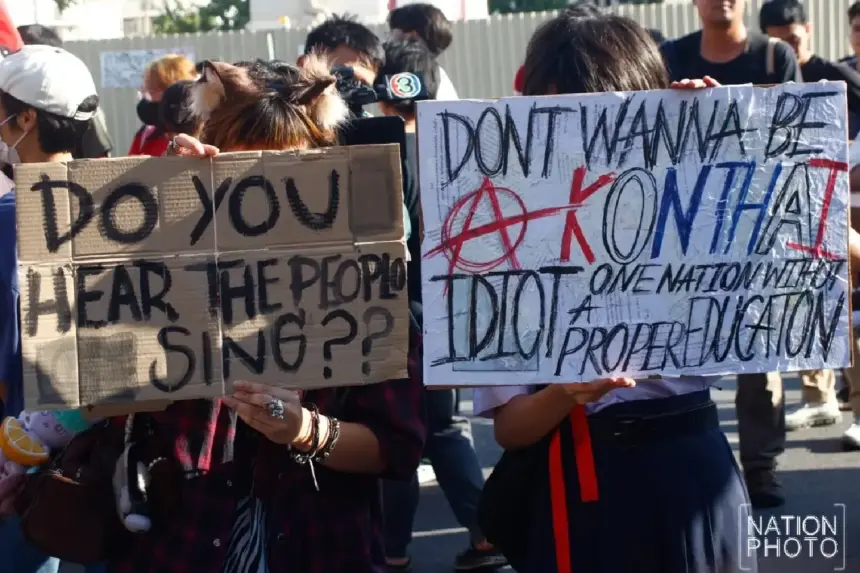
BANGKOK — Hundreds of Gen Z students and young activists rallied near Bangkok’s Democracy Monument on Friday afternoon, demanding sweeping education reforms and a formal voice in national policymaking. Gathering on Nov. 20 to mark World Children’s Day, demonstrators urged Prime Minister Anutin Charnvirakul’s administration to dismantle rigid school hierarchies and end policies that treat classrooms as training grounds for corporate labor.
The rally marks the first major street protest led by high school and university students since Anutin took office, signaling renewed youth mobilization after years of relative quiet. Organizers declared the event independent of any political party, warning officials that young voters will no longer accept top-down rules written without their input.
Key Takeaways• Gen Z activists rallied at Bangkok’s Democracy Monument on World Children’s Day to demand equal access to quality schooling, democratic school governance and youth inclusion in policymaking. • Protesters directly challenged Prime Minister Anutin Charnvirakul’s government while rejecting claims that established opposition parties backed the demonstration. • The action revives Thailand’s youth protest networks around concrete classroom grievances, including student debt, strict campus controls and the contested National Education Act. |
Four Core Demands Target Classroom Inequality
Demonstrators began assembling at 3 p.m. outside Satri Witthaya School along Ratchadamnoen Avenue, setting up a makeshift stage near the fenced-off monument. Many wore school uniforms topped with cat-ear headbands, a pointed play on Anutin’s Thai nickname, “Nu,” which translates to mouse or rat.
Organizing groups, including Studem Network and Free Thai Youth, centered their platform on four education demands. They called for equal access to quality schools regardless of family income, democratic freedoms inside classrooms, genuine youth seats at policy tables and a curriculum freed from commercial priorities. “We do not simply want an education that teaches us to compete and survive within the existing system,” Studem Network said in a statement. “Education should not produce people to serve capitalism; it should empower individuals to shape their own lives and build a fairer society.”
Speakers also rejected accusations from critics that political parties funded or directed the gathering. Teerapat, a youth network representative who addressed the crowd, insisted the movement answered only to students. “We are not slaves to political parties. Political parties are supposed to serve the people,” he told protesters, urging the public to examine student hardships rather than partisan rumors.
Roots of Frustration: Debt, Geography and the 2020 Precedent
The protest reflects deepening structural divides across Thailand’s public school system. Students outside Bangkok routinely face underfunded facilities, teacher shortages and wide gaps in university entrance scores compared with elite urban schools. Even those who reach higher education often graduate into a sluggish job market carrying heavy debt from the state Student Loan Fund.
Operational friction inside schools has fueled the anger. Under existing Ministry of Education regulations, administrators retain broad authority over hair length, dress codes and campus assemblies, leaving student councils with little real power. Activists also voiced alarm over drafts of the proposed National Education Act, noting that several committee members helped write Thailand’s military-backed 2017 Constitution.
Friday’s rally echoes the 2020 youth-led pro-democracy protests, when groups such as Bad Student staged flash mobs across Bangkok before legal crackdowns slowed street demonstrations. Unlike the broader constitutional battles six years ago, this new wave mobilized largely through TikTok and a 2,700-member Discord server, linking classroom grievances directly to cost-of-living pressures.
Government Response and Next Steps for Gen Z Networks
Beyond school policy, hand-painted placards along Ratchadamnoen Avenue criticized mandatory military conscription, industrial river pollution and rising living costs. Chana Songkhram police monitored the four-hour event, which ended peacefully at 7 p.m. without arrests or clashes.
Over the weekend, Anutin signaled openness to hearing student proposals, though the government has not announced formal talks with rally organizers. Student networks said they will continue coordinating online and plan follow-up campus forums to press lawmakers before Parliament reviews upcoming education legislation.
Trending News:
GLO Empowers Chiang Rai Gen Z to Combat Online Gambling Scams
China’s Gen Z Flee Beijing Over High Rents and Work-Life Imbalance