



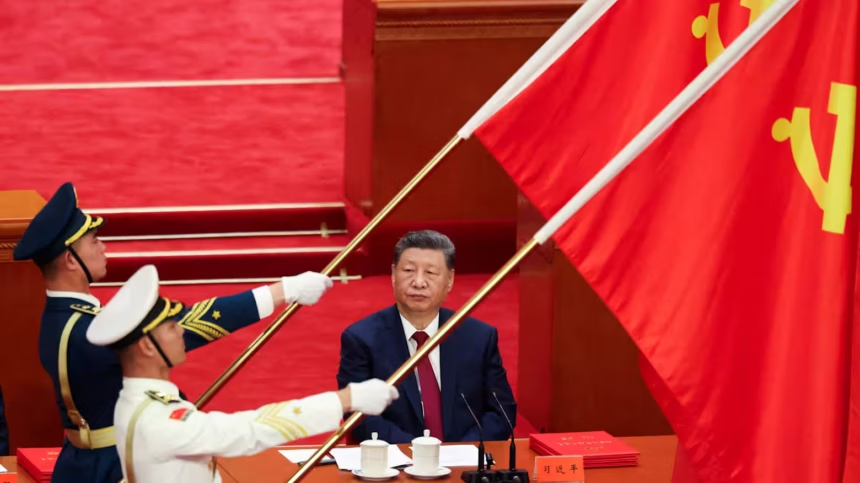
BEIJING – China’s President Xi Jinping vigorously defended his sweeping anti-corruption campaign as the ruling Communist Party concluded its high-stakes Fifth Plenum in Beijing. The Chinese leader declared rigorous self-governance a vital institutional guarantee for the nation’s continued global rise during an era of significant international friction.
Official communiqués confirmed that party watchdogs have penalized or expelled 963 centrally-managed senior officials across Xi’s fourteen-year leadership. This extensive figure highlights the vast scale of an enduring institutional campaign that has fundamentally reshaped China’s modern political landscape and governing apparatus.
Key Takeaways• President Xi Jinping declared strict internal self-governance a fundamental guarantee for China’s long-term rise, national rejuvenation, and global economic leadership. • Disciplinary bodies have penalized 963 high-ranking centrally managed officials over fourteen continuous years, setting unprecedented records for senior executive purges in modern China. • The Fifth Plenum concluded with historic high-level expulsions, cementing central authority and loyalty ahead of the upcoming Twenty-First National Party Congress. |
Rigorous Self-Governance Fuels China’s Strategic Rise
During the closed-door plenary gathering, senior delegates approved major resolutions aimed at deepening institutional supervision and party discipline. Xi addressed party members directly, emphasizing that genuine national modernization requires an exceptionally unified organization entirely free from internal corruption and divided loyalties.
The Chinese president stressed that persistent geopolitical challenges demand absolute political unity across all municipal departments and state enterprises. State media communiqués reported that senior leaders must eliminate administrative complacency and follow central directives with total diligence.
Official commentary highlighted that self-purification prevents ideological rot while protecting the historical mission of the ruling communist party. Top policymakers reiterated that unbending administrative discipline represents an essential shield against external economic pressures and volatile international financial markets.
Delegates also examined how effective governance directly supports China’s high-tech manufacturing initiatives and national self-reliance goals. Without strict oversight, party theoreticians argue, massive public investments in strategic sectors risk suffering from financial fraud and severe misallocation.
Furthermore, central authorities confirmed that ideological training programs will expand rapidly across every government level over the next twelve months. This widespread educational push seeks to instill unwavering loyalty among younger civil servants who will manage upcoming industrial and civil projects.
Unprecedented Purges Strike Centrally Managed Cadres
Disciplinary enforcement has expanded relentlessly across the nation, reaching deeply into provincial ministries, banking institutions, and strategic state corporations. The punishment of 963 centrally-managed senior officials demonstrates that high executive rank provides no protection from Beijing’s anti-graft inspectors.
The Fifth Plenum witnessed thirty-three formal expulsions from the Central Committee, marking the highest volume of dismissals at a single gathering. Key individuals named in recent disciplinary proceedings include prominent military leaders and former Politburo figures accused of serious disciplinary violations.
Official plenum attendance dropped below three hundred delegates, reaching its lowest recorded level during Xi Jinping’s entire fourteen-year tenure. This noticeable reduction reflects ongoing personnel reshuffling as disciplinary watchdogs continually remove compromised figures from the nation’s highest legislative bodies.
Investigators have steadily widened their investigative focus, pursuing political disloyalty alongside traditional financial crimes like bribery and illegal enrichment. Watchdogs now aggressively eliminate two-faced cadres who superficially profess central support while quietly delaying vital national policy programs.
In addition, state prosecutors have stepped up asset recovery efforts, retrieving tens of billions of yuan connected to corrupt administrative networks. These financial recoveries are redistributed directly into provincial development funds and local public infrastructure to rebuild broader citizen confidence.
Balancing Strict Oversight With Local Economic Initiative
Economic analysts observe that internal discipline remains central to achieving China’s ambitious industrial roadmap and new five-year development goals. Central authorities seek to direct capital into domestic semiconductors, clean energy, and artificial intelligence without waste or provincial favoritism.
Nevertheless, some public administration experts warn that intense supervisory pressure could cause regional bureaucrats to hesitate when handling complex economic challenges. When penalties for regulatory non-compliance become severe, regional administrators frequently choose bureaucratic caution over bold entrepreneurial policymaking.
To alleviate these operational concerns, Beijing introduced specialized mechanisms to distinguish honest administrative errors from deliberate acts of corruption. The central leadership intends to motivate innovative problem-solving while keeping civil servants strictly accountable to ethical standards and transparent procedures.
Central planners understand that maintaining municipal momentum is vital as China manages structural economic transitions and localized property market challenges. Striking the right balance between strict discipline and practical flexibility will largely determine local economic outcomes over the coming decade.
Consolidating Authority Ahead of Crucial Political Transitions
The successful conclusion of the Fifth Plenum solidifies Xi Jinping’s central position as the party prepares for upcoming political milestones. International analysts regard the proceedings as a decisive event that reinforces top-down command structures before the Twenty-First Party Congress convenes.
By characterizing internal discipline as a continuous operational requirement rather than a temporary initiative, Xi establishes an enduring governance model. This structural model integrates ethical monitoring into the routine fabric of governmental decision-making across all public administration departments.
Senior party leaders reaffirmed that ideological unity serves as the primary pillar supporting China’s expanding international diplomatic influence. As geopolitical competition intensifies across multiple regions, Beijing considers internal resilience its greatest strategic asset against external disruption.
Ultimately, the Fifth Plenum sends an unmistakable signal across the entire Chinese political system and the broader global community. Xi’s uncompromising disciplinary campaign will remain the dominant guiding force steering the country toward its long-term modernization objectives.
Trending News:
China’s Marriage Crisis: Women Lower Standards For Love
China Divorce Crisis: 90% of Women Regret Their Choice


