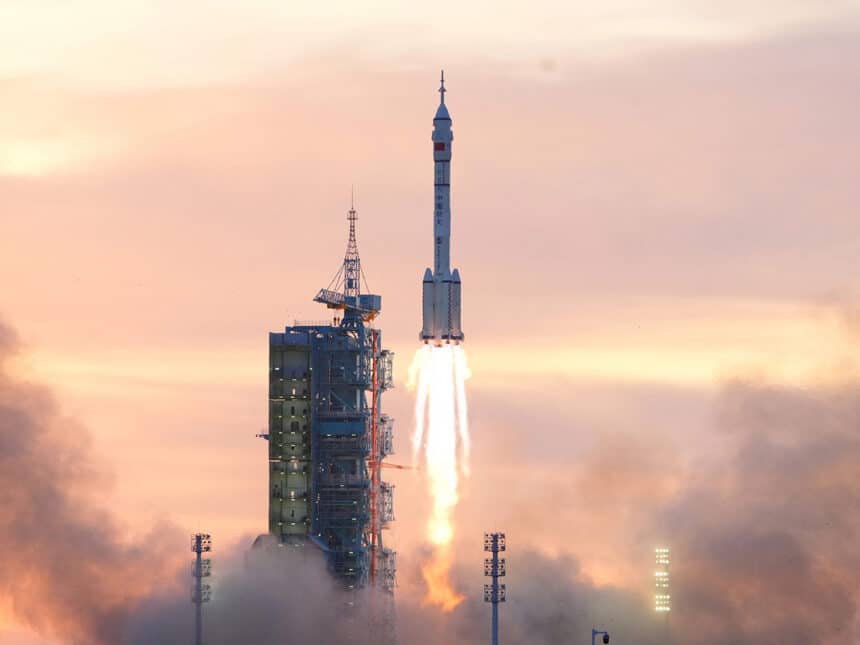
BEIJING — China launched Pakistani astronaut Muhammad Zeeshan Ali aboard the Shenzhou-24 spacecraft on Nov. 25, 2026, making the 40-year-old former Pakistan Air Force pilot the first foreign national to enter the Tiangong space station. A Long March-2F rocket lifted off from the Jiuquan Satellite Launch Center in northwestern China at 8:18 a.m. Beijing time, carrying Ali alongside Chinese commander Tang Hongbo and flight engineer Wu Yi.
The spacecraft docked with the three-module orbital outpost roughly three and a half hours later, launching a mission packed with more than 90 scientific experiments and technology tests, according to the China Manned Space Agency. While Ali’s weeklong stay marks a breakthrough for space diplomacy between Beijing and Islamabad, it reflects a tightly managed bilateral partnership rather than an immediate opening of Tiangong to broad international crews.
Key Takeaways
- Muhammad Zeeshan Ali became the first foreign astronaut to board China’s Tiangong space station after launching aboard Shenzhou-24 with Chinese crewmates Tang Hongbo and Wu Yi.
- The mission executes more than 90 scientific experiments and technology demonstrations, including four joint China-Pakistan studies in biotechnology and advanced materials.
- The flight stems from a February 2025 bilateral pact and highlights deep Sino-Pakistani alignment rather than open-door access for other foreign space agencies.
Inside the Agreement Behind the Flight
Ali’s seat on Shenzhou-24 resulted from a formal cooperation pact signed in Islamabad in February 2025 between the China Manned Space Agency and the Pakistan Space and Upper Atmosphere Research Commission, known as SUPARCO. That accord made Pakistan the first nation invited to participate directly in China’s human spaceflight program.
Selection moved on an accelerated schedule. Pakistani officials screened candidates through medical and psychological evaluations before sending finalists to the Astronaut Center of China in Beijing. Two finalists, Ali and backup candidate Khurram Daud, began intensive training alongside Chinese counterparts in April 2026, mastering centrifuge runs, emergency drills and Mandarin operational commands.
“The two great nations of China and Pakistan have turned a pilot into an astronaut in a remarkably short span of time,” Ali told reporters before liftoff. His assignment placed him alongside Tang Hongbo, who became the first astronaut to visit Tiangong three times, and rookie flight engineer Wu Yi.
Payload Specialist Duties in Orbit
Unlike Tang and Wu, who remain on the station for a standard six-month rotation, Ali flies as a payload specialist on a short visit lasting roughly one week. His duties focus on installing, calibrating and verifying four Pakistani scientific payloads selected from more than 300 proposals submitted by Pakistani universities and research institutes.
Inside the station’s laboratory modules, Ali is running a biotechnology experiment led by Dow University of Health Sciences and SUPARCO that cultures microalgae and cyanobacteria in microgravity to study oxygen and food production. Outside the hull, robotic arms and crew operations are mounting three external exposure tests: a graphene-based radiation shield, a self-healing carbon-fiber composite and 32 quinoa seed samples from the University of Agriculture Faisalabad. Those external experiments will remain in orbit for six to 12 months after Ali returns to Earth.
Across the broader mission, the Shenzhou-24 crew is executing over 90 experiments spanning space life sciences, microgravity fluid physics, space medicine and new materials testing. Chinese engineers also prepared a customized halal menu for Ali, including beef nihari and curried chickpeas.
Geopolitical Roots and Orbital Competition
The mission’s strategic logic traces back to parallel exclusions in low Earth orbit. China built Tiangong, completed in late 2022, after the 2011 U.S. Wolf Amendment barred NASA from bilateral cooperation with Chinese state entities and effectively shut Beijing out of the International Space Station. Pakistan, lacking an independent orbital rocket or membership in the five-partner ISS consortium, faced similar barriers to human spaceflight.
For Islamabad, partnering with Beijing bypassed decades of technical and financial hurdles. Pakistan’s space agency had previously relied on Chinese rockets to launch communications and remote-sensing satellites, along with the iCube-Qamar lunar orbiter aboard China’s Chang’e-6 mission in 2024. Putting a Pakistani officer inside Tiangong turns that customer-supplier relationship into operational human spaceflight experience ahead of a planned Pakistani rover on China’s Chang’e-8 lunar mission around 2028.
For Beijing, hosting a Pakistani flyer offers diplomatic visibility as the U.S.-led International Space Station approaches retirement at the end of the decade. Still, space policy analysts note that choosing Pakistan—China’s closest strategic and defense partner—underscores how selective Tiangong crew access remains.
What the Milestone Means for Space Cooperation
Shenzhou-24 proves that China’s spacecraft, life-support systems and ground training pipelines can integrate a non-Chinese crew member safely and quickly. That capability gives Beijing a tangible diplomatic tool when courting emerging space nations across Asia, Africa and Latin America.
Even so, Ali’s flight does not signal an imminent wave of multinational crews aboard Tiangong. Unlike the ISS, which operates under an intergovernmental treaty sharing module ownership and regular crew rotation slots among the United States, Russia, Europe, Japan and Canada, Tiangong remains wholly owned, funded and commanded by China.
Every foreign payload or visiting specialist requires bilateral negotiation, security vetting and Mandarin-language integration. Pakistani officials view the flight as a launchpad for deeper bilateral projects with Beijing rather than a multilateral framework. For now, Tiangong’s hatch has opened for a trusted ally, setting a precedent for targeted bilateral missions rather than broad international access.