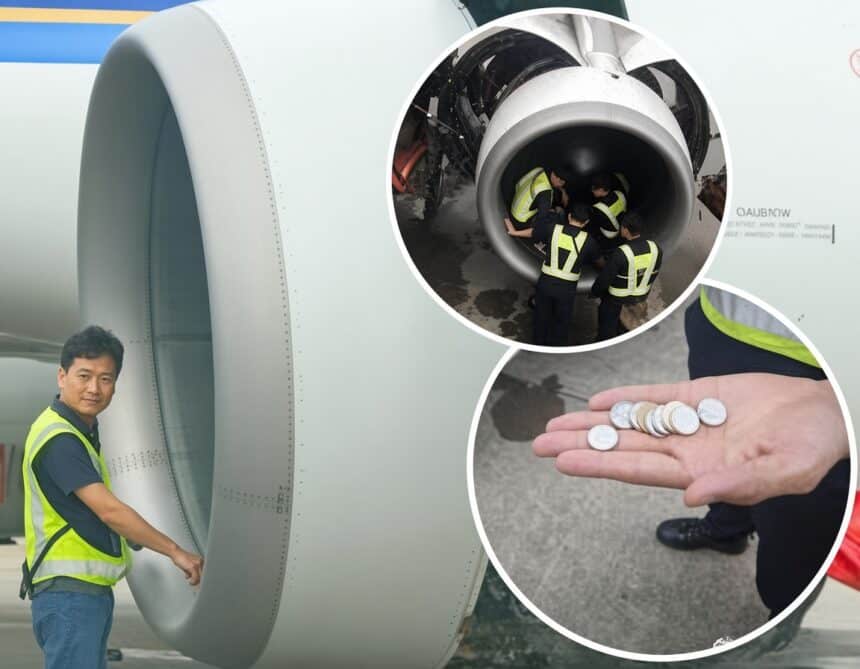
WUHAN, China — Chinese police detained a 61-year-old woman for five days after she threw four coins toward a passenger jet for good luck during boarding at Wuhan Tianhe International Airport, forcing an emergency safety sweep that delayed departure by 58 minutes.
The Nov. 16 incident disrupted a family flight bound for Sanya on Hainan Island and prompted a fresh warning from aviation authorities. Officials are cracking down on the persistent folk ritual because loose metal sucked into high-speed jet engines can shatter turbine blades and trigger catastrophic midair failure.
Key Takeaways• Police jailed a 61-year-old first-time flyer for five days under public order laws after she tossed four coins toward her aircraft in Wuhan. • Nearly 10 maintenance workers inspected the tarmac and engines, delaying the Hainan-bound flight by 58 minutes before clearing it for takeoff. • Chinese regulators continue to penalize coin-tossing passengers because foreign objects drawn into jet intakes can destroy engine components. |
Boarding Gate Mistake Triggers Tarmac Search
The disruption began as the passenger, identified only by her surname Zhou, boarded the aircraft with three relatives while carrying a young child. Reaching the cabin threshold, she pulled four coins from her pocket and tossed them toward the nose of the jet. The coins slipped through the narrow gap between the jet bridge and the fuselage, landing on the concrete apron below.
A sharp-eyed flight attendant spotted the toss and immediately notified the cockpit and ground crew. Airline staff halted boarding at once. According to local media reports, nearly 10 maintenance technicians fanned out across the tarmac to recover every coin and inspect the aircraft’s engines for hidden debris before the plane could push back.
Hubei Airport Police escorted Zhou off the flight for questioning. She told investigators she was flying for the first time and had acted on an old folk custom that tossing coins while crossing a bridge ensures safe passage. Officers charged her under Article 26 of China’s Public Security Administration Punishments Law for disrupting order on public transportation, ordering five days of administrative detention. Zhou later expressed regret and urged police to share her case online so other travelers would not repeat her mistake.
Superstition Meets High-Speed Jet Mechanics
Zhou’s arrest reflects a recurring clash between traditional Chinese blessing rituals and modern commercial aviation. For generations, travelers in China have tossed coins into temple wells, river crossings and wishing pools for protection. As domestic air travel expanded rapidly over the past decade, millions of older, first-time flyers entered airports for the first time, occasionally treating boarding bridges and gleaming turbine cowlings like good-luck shrines.
Aviation records show the pattern spans multiple airlines and hubs. In 2017, an 80-year-old passenger delayed a China Southern Airlines flight in Shanghai for more than five hours after throwing nine coins at an engine. Two years later, authorities detained two women after a Lucky Air flight in eastern China was grounded for two hours over a similar coin toss. Even steep fines have not stopped the habit; courts in several provinces have ordered offending passengers to pay carriers tens of thousands of yuan in delay damages.
To aviation engineers, a single coin poses an acute mechanical threat known as foreign object debris. Running jet engines generate immense intake suction, pulling loose tarmac items into compressor blades spinning at thousands of revolutions per minute.
A hard metal strike can chip titanium fan blades, spark internal fires or stall an engine during climb. Hubei Airport Police noted in a public advisory reported by state media that even minor blade damage requires tearing down an engine, grounding aircraft for days and rippling delays across crowded domestic schedules.