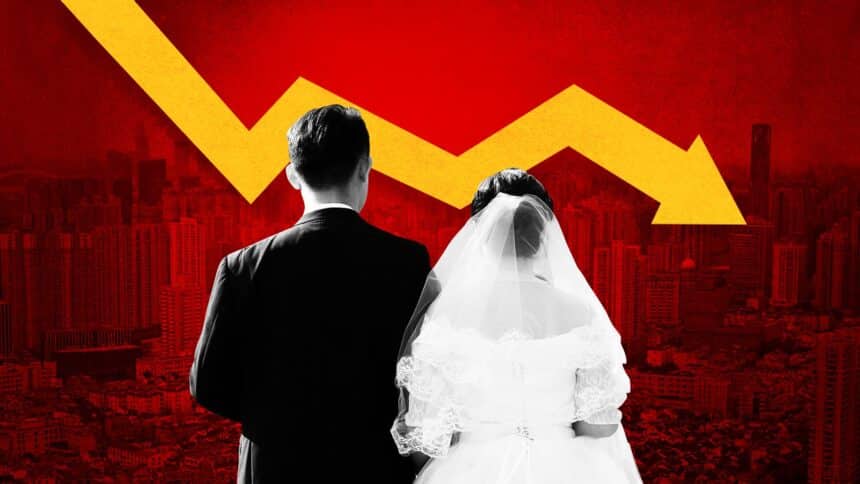
BEIJING — China’s marriage rate dropped to a record low in the first half of 2026, driven by soaring betrothal costs and strict real estate demands that have priced millions of young men out of matrimony, according to a report by The Infographics Show. Civil affairs data analyzed in the Nov. 5 report shows just 3.275 million couples registered to wed between January and June 2026, a 7.5% year-over-year drop that threatens to deepen the nation’s demographic contraction.
While popular commentary often frames the slump as a modern rejection of traditional family life, researchers and demographic data point to an acute financial squeeze. Across both rural counties and major cities, courtship has evolved into a high-stakes financial transaction requiring years of household savings, leaving empty banquet halls and shuttered wedding businesses in its wake.
| Key Takeaways
• Record Marriage Slump: Chinese marriage registrations fell to 3.275 million in the first half of 2026, the lowest six-month total since nationwide recordkeeping began in 1980. • Punishing Financial Barriers: Traditional betrothal payments, known as caili, average 140,000 yuan ($21,000) in rural areas and demand up to six years of a rural household’s disposable income, alongside mandatory urban apartment ownership. • Broad Economic Fallout: The collapse in nuptials has forced the closure of over 21,000 kindergartens, slashed jewelry and diamond revenues, and accelerated a trillion-dollar market catering to single-person households. |
The High Cost of Betrothal
Getting married in China operates on a vastly different financial model than in Western nations. Central to roughly three-quarters of Chinese unions is caili, an ancient custom requiring the groom’s family to pay a cash betrothal gift to the bride’s family. While the tradition dates back centuries, the financial sums involved have escalated rapidly over the past two decades.
Research from Wuhan University indicates that rural bride prices stood between 10,000 and 20,000 yuan ($1,500 to $3,000) in the early 2000s. By 2021, the rural average had jumped to 140,000 yuan ($21,000). Regional disparities push those figures even higher. The Jiangxi Women’s Federation reported a provincial average of 130,000 yuan ($19,000) in early 2023, while averages in wealthier Zhejiang province top 180,000 yuan ($27,000). In parts of Fujian province, families routinely demand up to 2 million yuan ($300,000).
These cash transfers collide directly with modest household earnings. China’s rural per capita disposable income sat at roughly 24,400 yuan ($3,700) in 2025. A 380,000 yuan betrothal payment consumes nearly six years of total disposable income for a typical rural family, or close to 15 years of savings for a single man working alone.
Paradoxically, lower-income men face steeper financial hurdles than wealthy peers. A study published in the Chinese Journal of Sociology found that bride prices are frequently higher for the poorest grooms, while affluent families with social status receive discounts. Matchmakers operate on a blunt calculus: families demand steep upfront cash from less established men to guarantee financial security for their daughters.
Legal disputes over these transactions have flooded the courts. More than 140,000 bride price lawsuits appear in China’s official court judgments database. A 2022 review of those filings revealed that contested payments typically ranged from three to 10 times the groom’s annual disposable income, with 69% of disputes involving sums between 50,000 and 150,000 yuan ($7,500 to $22,000). While the Supreme People’s Court issued judicial rules governing the return of betrothal gifts when engagements collapse, the directives do not cap initial asking prices.
Real Estate and the Matchmaking Floor
Cash payments represent only the opening bid in China’s marriage market. Prospective grooms are also expected to provide an apartment and a vehicle before a wedding takes place.
In urban parks across the country, parents treat matchmaking like an asset exchange. Every weekend at Shanghai’s People’s Park, parents clip printed resumes onto open umbrellas sorted by their children’s birth decade. An analysis of 874 ads by Sixth Tone and The Paper found that physical appearance, occupation, and property ownership dominated the listings. Personality traits appeared in just 38% of profiles, while personal hobbies were noted in 11%.
At Beijing’s Zhongshan Park, parents skip pleasantries and immediately ask where a prospective groom’s apartment is located. A viral Beijing blind date price list illustrated how rigidly the market ranks candidates, sorting singles from “top class” down to “no consideration.” Reaching the top tier for men required a net worth of at least 5.6 million yuan ($834,000), monthly earnings above 50,000 yuan ($7,500), and homeownership inside one of Beijing’s three central districts.
Physical standards can be equally unforgiving. In December 2024, a 30-year-old Hong Kong fashion blogger traveled three hours to Guangzhou’s Tianhe Park to test the matchmaking market. Mothers immediately dismissed her because she stood 5 feet, 1 inch tall—roughly an inch and a half below the national average—claiming her stature would hinder childbearing. Despite a dismal success rate, with a 2012 study finding only three matches out of 65 tracked cases in Shanghai, anxious parents return weekly rather than watch their sons remain unmarried.
The fixation on real estate stems from how Chinese families store wealth. Data from China’s central bank shows housing accounted for roughly 59% of all household assets in 2019, pushing total property-related wealth close to 70% of a typical family’s net worth. Urban homeownership stands at 96%, compared with 65% in the United States. Requiring a groom to own a central-city apartment forces his parents to liquidate decades of savings and pour three generations of wealth into a single illiquid asset. By late 2026, with secondhand properties accounting for over half of home sales amid a prolonged real estate downturn, families face mounting pressure to bet their entire financial future on falling property values.
Historical Roots and Demographic Strain
To understand why families price their own children out of marriage, economists point to a severe gender imbalance rooted in decades of state population control. Under China’s one-child policy, enforced from 1979 until 2015, strict birth quotas collided with a traditional cultural preference for male heirs. Sex-selective practices skewed birth ratios heavily toward boys for over 30 years.
The demographic fallout now shapes daily life across the country. China’s 2020 census counted 17.52 million more men than women in the prime 20-to-40 age bracket. Demographers estimate roughly 30 million “excess” males aged 20 to 45 live in China today, a surplus projected to peak near 41 million by the early 2040s.
This shortage of women is sharpest in rural inland provinces such as Jiangxi and Gansu, where lower wages and outward migration leave local men competing fiercely for a shrinking pool of brides. When supply tightens, prices rise. Families of daughters leverage their scarcity to secure financial insurance for their own retirement in regions with thin social safety nets.
At the same time, young men face a sluggish job market that makes saving nearly impossible. Youth unemployment for 16-to-24-year-olds hit 18.9%, even after officials removed enrolled students from the calculation methodology. Entry-level wages in cities fail to keep pace with urban apartment mortgages or rural betrothal demands.
Because childbearing in China remains tightly bound to legal wedlock, the marriage slump feeds directly into a historic population contraction. According to National Bureau of Statistics data, births dropped to 7.92 million in 2025, the lowest annual total since the founding of the People’s Republic in 1949, while the overall population shrank for a fourth straight year. By late 2026, Ministry of Civil Affairs figures confirmed that nine-month marriage registrations had tumbled nearly 10% year-over-year to 4.65 million, erasing a brief 2025 rebound sparked by relaxed residency registration rules.
Limits of State Intervention
Beijing has spent years trying to curb runaway wedding costs through administrative campaigns, yet local market forces repeatedly overwhelm state directives. Wedding custom reform has appeared in seven of the past eight “Number One Central Documents,” the government’s premier annual policy blueprint for rural affairs. In 2022, eight central ministries launched a coordinated crackdown on high bride prices.
Local authorities have tested strict caps and financial rewards with mixed results. Officials in Gansu province capped betrothal payments at 50,000 yuan ($7,300) and restricted wedding banquets to 20 tables. One village in Shandong rewrote its local charter to limit bride prices to between 20,000 and 30,000 yuan ($3,000 to $4,500). In Sichuan’s Xichong County, a pilot program offered symbolic low-cost weddings paired with discounted loans, free tourist site admission, and complimentary prenatal checkups.
Official statistics highlight the limits of these measures. While the share of surveyed families paying under 50,000 yuan rose from 16% to just over 27%, nearly three out of four families continued paying above the state threshold. A city official in Jiangxi acknowledged that betrothal payments of 188,000 to 288,000 yuan ($28,000 to $43,000) remain standard in poorer counties, conceding that banning the practice outright is unrealistic.
Rare enforcement wins underscore how difficult the problem is to scale. In one documented dispute, a groom petitioned local authorities after his girlfriend’s parents demanded 270,000 yuan ($40,000). Officials intervened, persuading the father to accept 60,000 yuan ($9,000) and return the remainder inside a local Communist Party office. While officials can broker a single settlement, they cannot police millions of private family negotiations across the country.
Fallout Across the Consumer Economy
The retreat from marriage is reshaping China’s retail and service sectors. Nationwide marriage registrations plunged from a peak of 13.47 million in 2013 to 6.11 million in 2024 before sliding again in 2026, starving the traditional wedding industry of customers.
In the first half of 2026, domestic jewelry sales fell by roughly a third, forcing national chains to shutter nearly 2,000 storefronts even as high gold prices masked declining unit volumes. The domestic diamond market contracted by $6.4 billion. Destination wedding photography giant Bojie suspended its wedding division in July 2025, stranding customers and employees. Meanwhile, luxury five-star hotels have set up street-side stalls outside their lobbies selling crayfish and roast duck to offset empty banquet halls.
The demographic ripple extends straight into early education and healthcare. China closed more than 21,000 kindergartens as preschool enrollment dropped roughly 10% in 2026, prompting a prominent Shanghai obstetrician to warn that his medical specialty faces collapse. Even so, parents who do have children are concentrating their resources, pushing projected child-rearing costs to 72,000 yuan ($10,700) per child by 2030.
As traditional family formation stalls, capital has flowed rapidly into a booming “single economy” valued at over $1 trillion annually, with one-person households now making up a quarter of all Chinese homes. Companies cater to solo living with hourly miniature karaoke booths, paid hiking and sightseeing companions, personal photographers, AI chat partners, and two-minute micro-dramas. A check-in safety app designed for solo residents—bluntly named “Are You Dead”—recently went viral, underscoring how thoroughly single life has reshaped modern Chinese society.