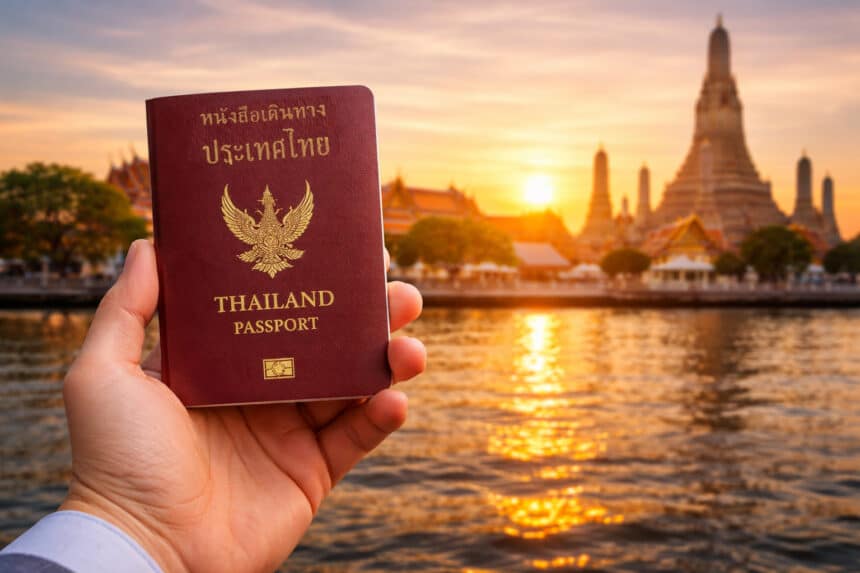
BANGKOK — Thailand’s Interior Ministry is reviewing a sweeping proposal that would raise the minimum investment required for Thai citizenship tenfold—from 10 million to 100 million baht—while stripping nationality from naturalised citizens caught holding dual passports. Deputy Interior Minister Polpeera Suwannachawi issued the review order on Tuesday, Nov. 17, giving officials seven days to submit an implementation report.
The proposed overhaul targets illicit identity networks, fraudulent civil registrations and illegal foreign-nominee land deals across the kingdom. While the rules remain strictly under review and are not yet law, approval would dramatically reshape the legal landscape for expatriates seeking permanent naturalisation in Thailand.
Key Takeaways
- Tenfold Investment Hike: The Interior Ministry is studying a jump from 10 million to 100 million baht ($2.9 million) for investment-based Thai naturalisation, with a preliminary report due Nov. 24.
- Strict Dual-Nationality Ban: Under the draft measures, naturalised foreigners found retaining a second citizenship would face mandatory revocation of their Thai nationality.
- Nominee & Fraud Crackdown: Officials aim to close loopholes exploited for fake ID cards, proxy land acquisitions and opaque charitable foundations, though existing laws remain unchanged for now.
Tightening the Gates on Naturalisation
Deputy Minister Polpeera instructed the Department of Provincial Administration and the Department of Business Development to examine raising the 10-million-baht investment benchmark tied to naturalisation applications. Raising that threshold by 900 percent would effectively price out individual entrepreneurs and small-scale investors who previously used capital injections to bolster residency and citizenship bids.
Alongside the financial hike, Polpeera ordered a legal review into revoking citizenship from naturalised foreign nationals who maintain dual nationality. Thailand’s Nationality Act already requires applicants to submit a formal declaration of intent to renounce their previous citizenship. In practice, however, enforcement gaps have allowed many naturalised residents to retain their original passports after taking the Thai oath.
To close administrative blind spots, the ministry is also upgrading its civil registration software and building a unified database linking more than 17,000 registered foundations nationwide. Investigators suspect certain non-profit foundations and shell companies have been used to mask foreign control over restricted Thai land.
Thai Fake ID Crackdown
Tuesday’s directive does not exist in a vacuum. It follows an aggressive nationwide sweep ordered last month by Prime Minister Anutin Charnvirakul to dismantle illegal foreign-nominee landholdings before a December 2026 enforcement deadline. Under Thailand’s Land Code and Foreign Business Act, foreign nationals are barred from owning freehold land, prompting some buyers to use Thai proxy shareholders or illegally obtained Thai ID cards to bypass ownership caps.
Recent scandals have exposed vulnerabilities in local district offices. Police and Interior Ministry probes over the past year uncovered dozens of fraudulent birth registrations and bribery schemes in which foreign nationals paid brokers tens of thousands of baht for genuine Thai national ID cards. Once armed with a Thai ID, buyers can purchase land directly without triggering foreign-ownership scrutiny. By centralising records across land, business and foundation registries, Bangkok aims to trace ultimate financial beneficiaries rather than relying solely on paper title deeds.
What this Means for Expats
For foreign residents currently weighing Thai naturalisation, legal experts stress that no statutory changes have taken effect. Standard applicants who qualify through long-term employment, tax payments and Thai marriage under Section 10 of the Nationality Act—rather than the high-net-worth investment route—are not the direct target of the 100-million-baht capital requirement.
Still, the dual-citizenship review introduces sharp new risks. Expats who naturalised in recent years while quietly keeping their birth passports could face retrospective audits if the ministry tightens post-naturalisation verification.
Prospective applicants should ensure their tax records, corporate shareholdings and immigration histories are spotless before filing paperwork, as cross-agency data sharing is already tightening across the kingdom.