
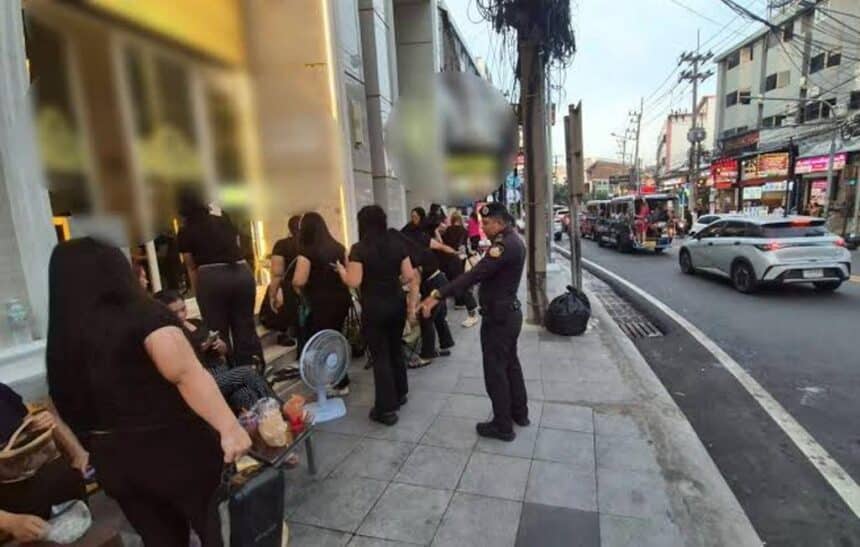
PATTAYA – City Hall has ordered shopkeepers and street merchants to remove chairs, display racks and commercial goods from public footpaths immediately, warning that repeat violators face formal legal prosecution.
The directive took sharp form on Nov. 19 when municipal enforcement officers in the Naklua district fined a sidecar vendor selling goods along Sukhumvit Road, signaling an end to informal warnings on crowded commuter arteries. City officials urged residents and visitors to report obstructed pavements directly through the 1337 municipal hotline, a move that restores safe passage for pedestrians forced into heavy vehicle traffic.
Key Takeaways• Pattaya City ordered businesses to clear chairs and merchandise off public sidewalks or face legal action. • Naklua enforcement officers fined an illegal sidecar vendor operating on the Sukhumvit Road footpath on Nov. 19. • Pedestrians can report blocked walkways anytime by calling the city’s 1337 contact center. |
Immediate Street-Level Enforcement in Naklua
Municipal inspectors patrolling northern Pattaya spotted the modified motorcycle sidecar parked squarely across the concrete walkway along Sukhumvit Road on Thursday afternoon. Officers ordered the operator to pack up the merchandise, issued an on-the-spot financial penalty and documented the violation under public cleanliness and highway obstruction statutes.
The Naklua citation followed a sweep two days earlier in which Pattaya teams cleared blocked footpaths along Thepprasit Road in the city’s south. Together, the operations mark a coordinated push across major transit corridors where retail spillover has steadily narrowed pedestrian lanes.
Shopfronts along secondary lanes and arterial highways routinely place plastic seating, promotional signs and drink coolers outside their property lines. When pavements disappear behind private inventory, commuters, parents pushing strollers and elderly residents must step directly into fast-moving lanes shared with tour buses and delivery trucks.
Decades of Encroachment Strain High-Season Walkability
The November crackdown arrives at the onset of Thailand’s peak tourist season, when surging visitor arrivals collide with chronic infrastructure bottlenecks across Chonburi province. For years, uneven enforcement allowed commercial encroachment to harden into daily habit, sparking public criticism over uneven sidewalk enforcement whenever temporary sweeps targeted mobile carts while leaving permanent storefront fixtures untouched.
Geography compounds the friction. Pattaya’s narrow coastal grid funnels north-south traffic onto a handful of parallel arteries—Beach Road, Second Road, Third Road and Sukhumvit Road—leaving little room for roadside parking or loading zones. Merchants squeezed by rising commercial rents frequently treat adjacent public easements as free floor space.
Earlier this year, municipal leaders tested stricter deterrence under a citywide campaign to keep roads and footpaths clear, confiscating illegally placed traffic cones and makeshift barriers. City administrators now say verbal warnings have exhausted their usefulness, particularly on high-speed corridors like Sukhumvit Road where pedestrian detours carry severe injury risks.
Hotline Reporting and Legal Penalties Ahead
Under Thailand’s Act on the Maintenance of the Cleanliness and Orderliness of the Country, placing goods or structures on public walkways without authorization carries fines of up to 10,000 baht. Pattaya City Hall confirmed that officers will escalate repeat offenses from administrative citations to formal court filings and equipment seizures.
To sustain pressure between scheduled patrols, city hall is leaning on crowdsourced enforcement via the 24-hour 1337 Pattaya Contact Center. Callers can submit photos and exact street locations, allowing district municipal squads to dispatch inspectors directly to chokepoints.
For daily walkers in Naklua and central Pattaya, the stricter rules offer overdue relief. Keeping sidewalks open depends on whether city hall maintains consistent inspections once the initial wave of citations fades.