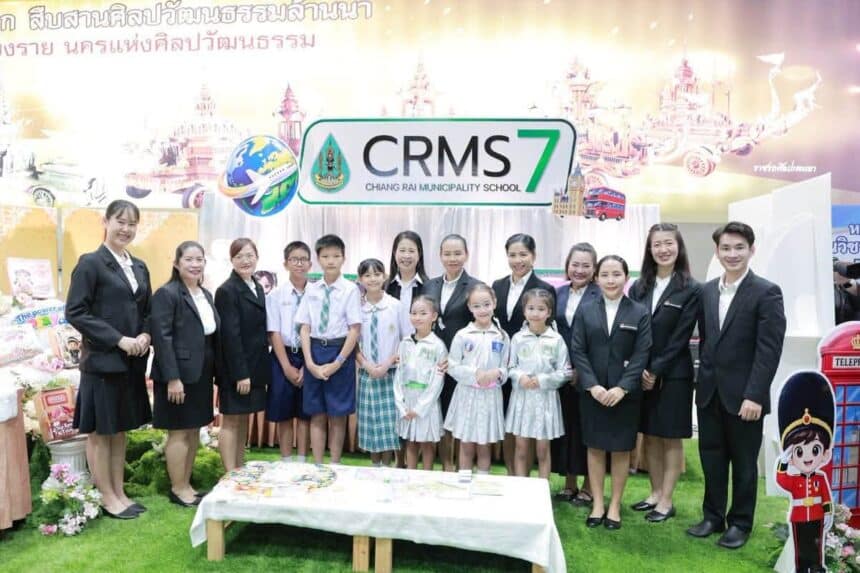
CHIANG RAI — Tessaban 7 Fangmin School presented its student-centered education model before national evaluators on Nov. 21 at the Chiang Rai City Convention Center, competing for the 2026 King Prajadhipok Award.
School Director Nonglak Duriyaphan led faculty, staff and students at the GMS Jiang Hai Building to demonstrate how community partnerships and modern classroom governance can elevate local public schools to international benchmarks.
Key Takeaways
• Nov. 21 Evaluation: Tessaban 7 Fangmin School completed its formal assessment for the fiscal year 2026 King Prajadhipok Award at the GMS Jiang Hai Building in Chiang Rai.
• Leadership Delegation: Director Nonglak Duriyaphan, alongside Deputy Directors Radabsin Duperier and Kanlapaphruek Chomphu-in, presented the school’s participatory management framework.
• International Benchmark: Administrators are using committee feedback to refine student-focused instruction and push the municipal campus toward global academic standards.
Governance Under the Microscope
The evaluation centered on measurable school administration rather than abstract policy goals. According to school records presented during the session, Duriyaphan and Deputy Directors Radabsin Duperier and Kanlapaphruek Chomphu-in detailed how teachers, parents and local stakeholders share decision-making power across daily campus operations.
Students joined the delegation directly, showcasing active-learning projects designed around individual student outcomes. Evaluators reviewed performance portfolios and questioned school leaders on how stakeholder input translates into classroom results. School officials noted that the committee’s critique will guide immediate operational adjustments for the upcoming academic term.
Why the King Prajadhipok Award Matters in Chiang Rai
Administered annually by King Prajadhipok’s Institute, the award serves as Thailand’s premier benchmark for transparency, citizen participation and local governance excellence. Under the institute’s 2026 framework, public agencies are audited on how effectively they reduce social inequality and build cross-sector networks.
Located along the Kok River in Tambon Rim Kok, Tessaban 7 Fangmin School serves families across northern Chiang Rai’s rapidly urbanizing corridor. Unlike centrally run Ministry of Education schools, municipal campuses rely heavily on local tax revenues and community buy-in to fund bilingual programs and digital infrastructure. The campus previously earned a Royal Award for large primary schools for the 2024 academic year, building institutional momentum ahead of the 2026 governance review.
Hosting the assessment at the GMS Jiang Hai Building underscores Chiang Rai’s strategic push as a Greater Mekong Subregion education hub. By aligning local classroom management with national transparency standards, municipal administrators aim to retain top local students who might otherwise commute to private institutions in Chiang Mai or Bangkok.