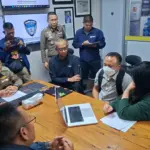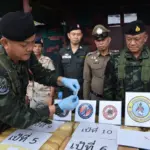
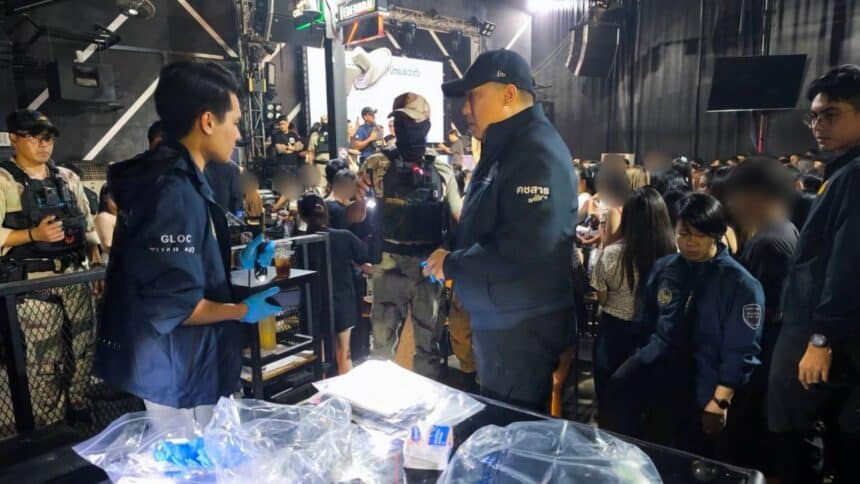
BANGKOK — Interior Ministry officials raided the unlicensed Planet BKK nightclub on Suksawat Road in Bangkok’s Chom Thong district at 1 a.m. Saturday, arresting an armed customer and finding 127 patrons positive for illegal drugs.
Led by Deputy Interior Minister Polapee Suwunchwee, special operations teams from the Department of Provincial Administration sealed every exit to trap 344 partygoers inside before seizing crystal methamphetamine, ecstasy and a loaded revolver. Authorities confirmed the venue faces an immediate five-year shutdown order, marking the second time the exact same address has been closed for narcotics violations.
Key Takeaways
- Interior Ministry agents raided the unlicensed Planet BKK pub on Suksawat Road at 1 a.m., detaining 344 customers and seizing a loaded revolver alongside crystal methamphetamine and ecstasy.
- On-site urine screenings showed 127 patrons tested positive for narcotics, prompting officials to seek a five-year closure order against the Chom Thong venue.
- The building previously operated as Infinity Indy before a 2018 raid forced a five-year shutdown, highlighting strict Thai laws that permit mass drug testing during nightlife sweeps.
Doors Sealed as 344 Partygoers Scatter
Undercover administrative agents slipped inside Planet BKK hours before the sweep to verify citizen complaints about after-hours alcohol sales and open drug use. When tactical officers breached the main entrance at 1 a.m., loud music cut out and panic broke across the dance floor.
Customers tossed small plastic sachets of crystal methamphetamine, known locally as ice, and ecstasy tablets under tables as they bolted toward emergency exits. Escape proved impossible. Administrative officers and Volunteer Defense Corps personnel had already locked down the perimeter.
During pat-downs, inspectors noticed security guards had failed to screen incoming guests for weapons. Officers arrested one patron carrying a loaded revolver and seized discarded narcotics scattered across the floor, according to police. Paramedics and forensic staff then lined up all 344 customers for mandatory urine tests, flagging 127 people for drug use before transferring venue managers to Bang Mod police for criminal prosecution.
A Repeat Offender on Thonburi’s Nightlife Corridor
Property records and Interior Ministry archives show the Suksawat Road building carries a troubled history. In 2018, authorities raided the exact same premises—then operating under the name Infinity Indy—after uncovering widespread drug abuse and underage drinking. That operation triggered a mandatory five-year closure under National Council for Peace and Order Directive 22/2015, a strict regulatory tool designed to shutter rogue entertainment venues.
Once the five-year ban expired, operators simply repainted the facade, registered a new trade name and reopened without securing a valid entertainment license. Located along a busy industrial artery in Bangkok’s Thonburi side, Suksawat Road sits outside central tourist zones, allowing late-night venues to operate quietly after midnight closing times until neighborhood complaints draw provincial task forces.
Deputy Interior Minister Polapee told reporters at the scene that officials will formally petition the Metropolitan Police Bureau chief to impose a fresh five-year closure order. Under Thai law, administrative shutdowns attach to the physical structure rather than the business license, preventing owners from dodging penalties through quick rebranding.
What Expats and Visitors Must Know About Nightlife Raids
High-profile task force sweeps rarely target expat districts exclusively, yet foreign residents and tourists frequently get caught in late-night dragnets across Bangkok, Pattaya and Phuket. Under Section 115 of Thailand’s Narcotics Code B.E. 2564, police and administrative officials hold broad authority to order immediate urine screenings during entertainment venue inspections without obtaining individual search warrants.
Refusing a urine test during an official narcotics operation constitutes a separate criminal offense punishable by up to one year in prison or a 20,000-baht fine. Because Thai law penalizes the presence of banned substances in the bloodstream regardless of where or when they were consumed, travelers who used recreational drugs abroad days earlier still face arrest, detention and deportation.
Legal advisers urge foreign nationals to carry passport copies and valid medical prescriptions at all times, as certain attention-deficit medications can trigger false positives for amphetamines on rapid field tests.