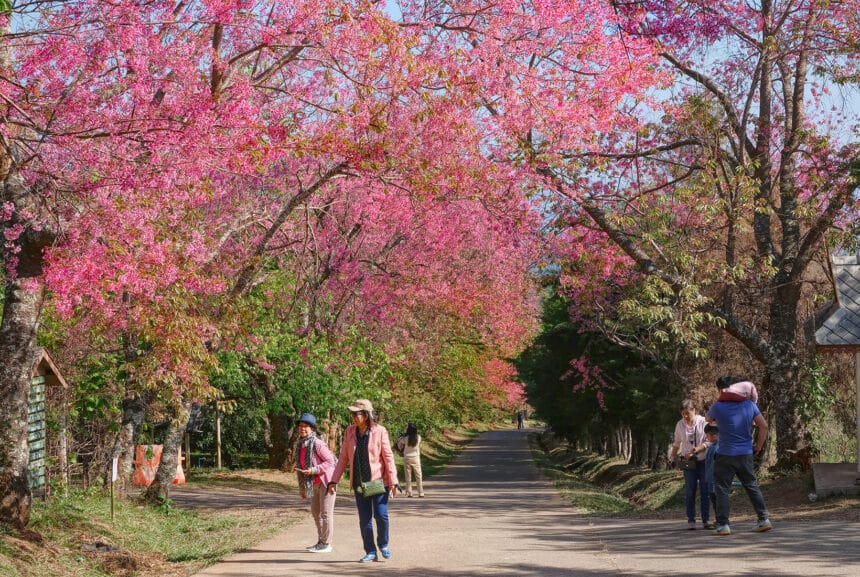
Pink flowers on bare branches brighten Chiang Rai’s highlands during the cool season, but the view has a history that reaches beyond tourism. Wild Himalayan cherry is native to northern Thailand; how it became linked with the province’s mountain roads and blossom trips is less fully recorded.
Regional references describe roadside planting across northern Thailand from around 1980 and later use in forest-regeneration programs. However, they don’t establish the first planting date in Chiang Rai. The tree’s natural history and the rise of blossom viewing offer clues to how that association grew. For practical trip planning, see this guide to Chiang Rai cherry blossom season and viewing locations.
Key Takeaways
- Wild Himalayan cherry is Prunus cerasoides, native to northern Thailand; “Thai sakura” is a popular nickname, not its botanical identity. (e-Flora of Thailand)
- A plant reference reports roadside planting in northern Thailand from around 1980, but no source confirms Chiang Rai’s first planting date.
- By 2012, Doi Mae Salong had become an established blossom-viewing destination; available records don’t date the start of the tourism tradition.
- Doi Mae Salong and Doi Chang are associated with highland blossoms, while Doi Mae Salong’s history also reflects its Yunnanese community and tea culture. (Explore Doi Mae Salong’s history and attractions)
- Flowers generally appear from December to February, but elevation and weather shift the peak, so timing varies by location and year.
The history of Chiang Rai’s wild Himalayan cherry blossoms begins with a native mountain tree
Before wild Himalayan cherry became a reason to visit Chiang Rai’s highlands, it was part of the region’s native mountain flora. Its botanical identity and seasonal growth help explain why it suits cool slopes, and why its local story should be separated from the popular name “Thai sakura.”
Where Prunus cerasoides grows naturally
Wild Himalayan cherry is Prunus cerasoides, a deciduous tree native to parts of the Himalaya, southern China and mainland Southeast Asia. Its recorded range includes Myanmar, Thailand, northern Vietnam and northern Laos. In Thai, it is called nang phaya suea khrong. The name “Thai sakura” is a popular comparison to Japanese cherry blossoms, based on the flowers’ appearance. It doesn’t mean the tree is Japanese cherry, Prunus serrulata, or that its history in Thailand began in Japan. Kew’s botanical profile of Prunus cerasoides places the species’ range across the Indian subcontinent and Indo-China.
The tree grows in mountain forests, including subtropical montane forests and ravines. Its habitat is associated with elevation, but botanical references don’t give one universal range. The e-Flora of Thailand account describes it at around 1,500 meters, while a broader plant reference reports forests from roughly 700 to 3,700 meters. Those figures reflect different accounts, so neither should be treated as a strict boundary for every population.
In northern Thailand, cool highland conditions help explain where the tree grows and flowers well. A Chiang Rai report on wild Himalayan cherry in cool mountain areas also notes that trees planted at lower, hotter sites may grow without producing the same flowering display. That setting links the species’ natural habitat with the highland routes where visitors now look for blossoms, without establishing when or by whom a particular site was first planted.
Why the blossoms appear in the cool season
Prunus cerasoides follows a seasonal cycle. As a deciduous tree, it sheds its leaves before flowering, so pink or pale blossoms stand out on largely bare branches. Flowers generally appear during the cool season, often in December and January, and fruit develops in spring. The World Flora Online species account records flowering in December and January, followed by fruit in April and May.
In Thailand, the wider flowering window can extend into February. However, bloom timing changes with elevation, temperature and local weather. Trees at different heights, or on slopes with different conditions, may flower at different times. Field observations in Chiang Rai show that higher-elevation trees can peak later than those at lower sites, so a single date cannot describe the whole province.
That variation matters when interpreting the blossom season’s history. The sight of flowers in winter is a botanical feature of this native mountain tree; the label “Thai sakura” is a later popular shorthand for its resemblance to Japanese cherry blossoms. The nickname helps describe the view, but it doesn’t establish the tree’s origin or the start of Chiang Rai’s blossom-viewing tradition.
How wild Himalayan cherry planting spread across northern Thailand
The record points to a gradual shift: wild Himalayan cherry was planted along roads and used in forest-regeneration work across northern Thailand, then became part of the highland tourism draw. However, regional evidence cannot fill in every local detail. It does not identify who first planted the trees in Chiang Rai or when visitors began traveling there for the blossoms.
What the record says about planting from around 1980
A plant reference reports that wild-collected Prunus cerasoides seeds had been planted along roadsides in northern Thailand since around 1980. It also describes the species as one used in forest-regeneration programs. That gives a regional context for deliberate planting, rather than an exact history for any one mountain or province. The plant reference on Prunus cerasoides does not establish that 1980 was the first planting year across northern Thailand.
Most importantly, a broad regional account is not a site record. It doesn’t confirm when trees first went into the ground at Doi Mae Salong or Doi Chang, who planted them, or whether they were part of a named project. Nor does it show that one agency led all planting across the region. Those details require local records, such as forestry documents, community histories, or dated accounts tied to a specific site.
The same caution applies to planting purposes. Although the reference mentions forest regeneration, that does not prove the trees at a particular Chiang Rai location were planted for that reason. Claims that planting aimed to prevent erosion at one site in Chiang Mai cannot be assigned to Doi Mae Salong or Doi Chang without separate evidence. The safest reading is that planting occurred in the broader region, while Chiang Rai’s local planting history remains incomplete.
When Doi Mae Salong became a blossom destination
Travel coverage shows that Doi Mae Salong was already part of northern Thailand’s cherry-blossom itinerary by 2012. A 2018 Bangkok Post report described it as one of the original viewing sites, and discussed its seasonal draw alongside the mountain’s Chinese communities and tea plantations. Read together, the reports document established tourism interest by those years, not the date of the first planting or the first visitor who came for the flowers. The 2018 report on the annual blossom hunt also notes that bloom timing differs by location.
That distinction matters because tourism coverage captures a moment when a destination was already known. It rarely records the beginning of a custom. By the time travel writers were sending readers to Doi Mae Salong for blossoms, trees and visitor interest were already part of the highland experience. The available reporting doesn’t show how many years earlier that association began.
Doi Mae Salong also has a local history that extends beyond seasonal sightseeing. The mountain is known for its Chinese heritage, tea culture, and communities whose stories shape visitors’ experience of the area. Readers interested in that context can explore Mae Salong’s Chinese heritage and Cherry Blossom Festival. Still, cultural history and tourism reporting do not substitute for planting records.
For now, the evidence supports a careful timeline: regional roadside planting dates to around 1980, while Doi Mae Salong was a recognized blossom destination by 2012 and 2018. It leaves the first planting dates at Doi Mae Salong and Doi Chang, and the start of blossom tourism, unresolved.
Why Doi Mae Salong’s blossoms are tied to a living community history
The blossoms along the road to Doi Mae Salong are part of a lived-in highland area, not an isolated flower-viewing site. The landscape visitors see includes the village of Santi Khiri, its history of migration and settlement, and livelihoods shaped by farming and trade.
A highland village shaped by migration and settlement
Santi Khiri was formerly known as Ban Mae Salong Nok. The Tourism Authority of Thailand’s Chiang Rai–Phayao tourism site says two battalions from Myanmar’s Division 93 migrated to the area after 1961, and the 5th Battalion settled at Ban Mae Salong Nok. That account gives important context for the village’s history, though it is only one part of the area’s broader story.
Migration and settlement help explain why Doi Mae Salong has a distinct community history alongside its mountain scenery. Families built lives in the highlands, and the area’s identity developed through work, farming, and contact among different communities. For more on that history, see this guide to Doi Mae Salong’s tea and KMT history.
The blossoms belong in this history as part of the landscape visitors encounter today. Regional references document roadside planting of wild Himalayan cherry in northern Thailand from around 1980, but they do not establish when trees were first planted at Doi Mae Salong or who planted them. The flowers therefore cannot be credited to one community or treated as the result of a single settlement story.
Tea, markets, and the communities visitors encounter
Doi Mae Salong is known for tea, local markets, and temperate-climate produce. These daily activities give visitors a fuller view of the area than a seasonal stop for flowers alone. The Tourism Authority of Thailand also names Chinese, Shan, Akha, Lahu, Lisu, Mien, and Luo communities in its account of the area. These are distinct communities, with different histories and traditions, not one shared group identity.
Markets and tea-growing areas bring visitors into contact with a working highland community. During blossom season, the pink flowers add another element to the mountain roads and village surroundings. However, the presence of blossoms does not mean every community has the same relationship to the trees, or that any one group began the blossom-viewing tradition.
The Tourism Authority’s Doi Mae Salong visitor information connects the mountain road, blossoms, markets, tea, produce, and community life. Together, these details place the flowers within a changing, inhabited landscape. Visitors can enjoy the seasonal display while recognizing that Doi Mae Salong’s history is broader than its role as a blossom destination.
How Doi Mae Salong, Doi Chang, and Doi Tung each fit the story
Chiang Rai’s highland blossom sites offer different kinds of evidence. Doi Mae Salong has the clearest record as a long-established viewing destination, Doi Chang appears in travel coverage as a scenic farm region, and Doi Tung provides a useful example of how elevation affects bloom timing. None of these accounts, on its own, identifies who first planted the trees at a particular site.
Doi Mae Salong and the road to Santi Khiri
The road up Doi Mae Salong is the best-documented setting for Chiang Rai’s blossom-viewing tradition. The Tourism Authority of Thailand describes wild Himalayan cherry blossoms along the route to the mountain, near Santi Khiri, a village known for its Yunnanese heritage, tea, markets, and highland produce. The flowers are part of a lived-in mountain landscape, where visitors travel through farms and village surroundings rather than to a single, isolated grove. The official visitor information for Doi Mae Salong describes the blossoms along the climb.
Travel reporting also confirms that visitors knew the area as a blossom destination by the early 2010s. A 2012 account of northern Thailand’s blossom-viewing sites included Doi Mae Salong, while later coverage described it as one of the original viewing locations. That record supports a well-established reputation, but it does not reveal the first planting date or the beginning of the local visitor custom. Regional reports of roadside planting from around 1980 cannot fill in those site-specific details.
Doi Chang’s blossoms among farms and viewpoints
Doi Chang presents a different highland setting. Travel coverage describes blossoms among tea gardens, coffee farms, and viewpoints, placing the flowers within a working agricultural area as well as a scenic destination. The combination helps explain why visitors may encounter blossoms while exploring the mountain, rather than visiting a formal arboretum or a single named viewing site.
However, the available accounts do not establish when wild Himalayan cherry was planted on Doi Chang. They also do not name a local organization or conservation project responsible for planting or protecting the trees. That means Doi Chang adds to the picture of Chiang Rai’s blossom destinations, but it cannot yet support a precise planting timeline. Its tourism profile is clearer than its planting history.
What Doi Tung’s flowering observations reveal
Doi Tung contributes a different kind of evidence: observations that show how flowering can vary with altitude. At Mae Fah Luang Arboretum, trees above 1,500 meters were past peak during the first week of February in the reported season. By contrast, trees around 1,200 meters along the route toward Chiang Rai city were in full bloom at the same time.
This comparison helps explain why a single province-wide peak date can mislead visitors. Higher and lower sites may flower at different times, even within the same season. The observation records conditions in one particular season, not a permanent calendar for Doi Tung or the rest of Chiang Rai. For broader trip ideas during the cool season, see these Chiang Rai winter destinations.
Together, the three locations show how the evidence varies: Doi Mae Salong has the strongest documented viewing history, Doi Chang has a travel identity linked to farms and viewpoints, and Doi Tung offers site-specific flowering observations. None confirms a first planting across the province.
What the changing bloom season tells us about the trees’ future
Chiang Rai’s blossoms depend on more than a date on the calendar. Elevation, local weather, habitat, and planting history all shape what visitors see, while gaps in local records limit what we can say about the trees’ future.
Why there is no single reliable peak-bloom date
Wild Himalayan cherry generally flowers during the cool season, roughly December to February. That window is a useful guide, not a guaranteed forecast: trees at different elevations can bloom at different times, and conditions vary from year to year.
A flowering study recorded trees above 1,500 meters at Mae Fah Luang Arboretum on Doi Tung past peak in the first week of February, while trees around 1,200 meters along the route toward Chiang Rai city were in full bloom. These observations show how altitude can shape the display within one area and season. They do not establish a permanent schedule for either site. The study of Prunus cerasoides flowering patterns also connects flowering timing with temperature and elevation.
For travelers, that variation means a date that worked one year may miss the peak the next. Check local Chiang Rai blossom updates before setting out, especially if you are planning around a particular mountain or viewpoint.
Over time, regular observations could show whether flowering dates are shifting at specific sites. However, isolated travel reports and single-season field notes cannot establish a long-term trend or explain its cause. Weather and elevation already help explain why bloom dates differ; claims about broader climate effects need consistent records across multiple years.
A grounded view of conservation and local stewardship
Wild Himalayan cherry is native to northern Thailand, and regional plant references also describe its use in forest-regeneration efforts. Roadside planting across northern Thailand has been reported from around 1980, but that regional history does not tell us when trees were planted at Doi Mae Salong, Doi Chang, or other Chiang Rai sites.
Public information about planting dates, site-specific programs, and local stewardship remains limited. Without those records, it would be speculation to assign the trees at a particular destination to a named conservation project or to say who planted them. Nor does the available evidence support describing the species as endangered or botanically rare in Thailand.
The distinction matters for understanding the trees’ future. A planted roadside line and a naturally regenerating forest stand may face different conditions, but the public record does not consistently identify which applies at individual viewing sites. To assess change, local records would need to track flowering dates alongside elevation, tree condition, planting history, and natural regeneration.
For now, the blossoms offer a clear seasonal experience, but not a complete measure of forest health. Better site-level records would help communities and visitors understand whether flowering patterns are changing and how the trees are growing in the landscapes where people encounter them.
Frequently Asked Questions
The record answers some questions about Chiang Rai’s blossoms clearly, while leaving others open. These distinctions help separate what is known about the trees from what remains uncertain about local planting and tourism.
Are Chiang Rai’s wild Himalayan cherry trees the same as Japanese sakura?
No. Chiang Rai’s wild Himalayan cherry is Prunus cerasoides, while Japanese cherry blossoms commonly refer to other species, including Prunus serrulata. The name “Thai sakura” is a familiar nickname based on the flowers’ pink color and appearance, not a botanical classification. The trees are native to northern Thailand, so the nickname describes how people compare the blossoms, not where the species originated.
When did people first plant cherry blossoms in Chiang Rai?
Available sources do not establish a precise first planting date for Chiang Rai or for individual highland sites such as Doi Mae Salong and Doi Chang. A plant reference reports roadside planting across northern Thailand from around 1980, but that regional account does not provide a local timeline or name a first planting project. In other words, it offers useful background, not proof of when the trees arrived at a specific Chiang Rai site.
When is the best time to see the blossoms in Chiang Rai?
The broad viewing season runs from December to February, during the cool months. However, the peak varies by elevation, site, and weather, and trees in different parts of the province can flower at different times. A fixed January date may work in one year and miss the best display in another, so check local reports close to your trip. For season and location details, see this Chiang Rai blossom viewing guide.
Which Chiang Rai area has the longest-established blossom-viewing reputation?
Doi Mae Salong has the clearest record as a long-established viewing area. A 2012 travel report included it among northern Thailand’s blossom destinations, and a 2018 report on the annual blossom hunt described it as one of the original viewing sites. Those accounts confirm that the area had a recognized reputation by then, but they do not prove Doi Mae Salong was the first place planted or identify when its viewing tradition began.
Do the blossoms have a documented festival or single origin story?
The available sources do not establish a formal festival history or one origin story for Chiang Rai’s blossom tourism. They document regional roadside planting and later travel interest, but they do not connect those developments to one organizer, community, or event. Popular accounts can add local color, yet readers should treat them as stories rather than established history unless local records support their details.
Conclusion
Wild Himalayan cherry has a long natural history in northern Thailand, where Prunus cerasoides grows in mountain habitats. Its more recent story in Chiang Rai is less settled: regional roadside planting is reported from around 1980, and Doi Mae Salong was a recognized blossom destination by 2012, but the local history remains only partly documented.
The flowers are best appreciated as part of a wider highland setting, shaped by ecology and the histories of communities such as those around Doi Mae Salong. More local archival research could clarify when planting began and how blossom tourism took root. Until then, the blossoms tell a vivid seasonal story, even as parts of their human history remain open.