BANGKOK — Thailand claimed the Gold Award as the world’s most desirable country for gastronomy at the Wanderlust Reader Travel Awards 2026 in London on Wednesday, handing tourism officials a timely marketing boost as the kingdom battles a 4.59% drop in foreign arrivals this year.
Deputy Government Spokeswoman Lalida Persvivatana announced the honor in Bangkok, noting that British readers favored Thailand over culinary powerhouses Italy, France and Japan. The recognition arrives at a critical juncture for Southeast Asia’s second-largest economy, where international tourist arrivals slipped to 25.46 million through October and foreign visitor spending fell 2.85% to 1.24 trillion baht ($36.5 billion), according to Tourism and Sports Minister Surasak Phancharoenworakul.
Key Takeaways• Thailand won the Gold Award for gastronomy at the 2026 Wanderlust Reader Travel Awards in London, outranking Italy, France and Japan. • The accolade spans street stalls, regional specialties like northern khao soi and northeastern som tam, and 43 Michelin-starred venues. • Officials are leveraging culinary tourism to offset a 4.59% year-on-year decline in foreign arrivals recorded during the first 10 months of 2026. |
From Roadside Woks to Three Michelin Stars
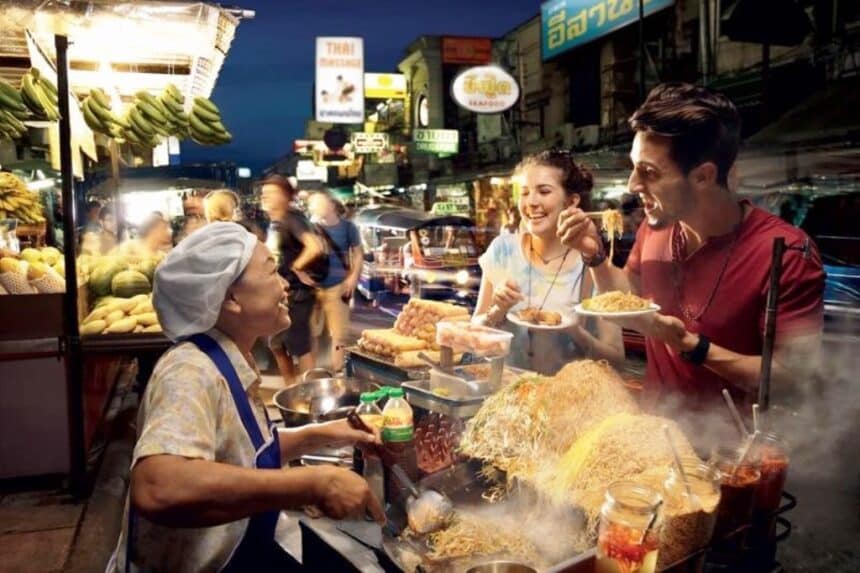
Judges and voters cited the sheer range of Thailand’s food ecosystem. That spectrum runs from plastic-stool night markets to white-tablecloth tasting rooms. In the north, coconut-curry khao soi noodles anchor Chiang Mai’s culinary identity. Across the arid northeastern plateau of Isan, mortar-pounded green papaya salad, or som tam, anchors daily meals alongside grilled meats and sticky rice.
At the top end of the market, international inspectors have steadily expanded the country’s fine-dining footprint. The Michelin Guide Thailand now lists 43 starred restaurants, led by Bangkok three-star establishments Sorn and Sühring, alongside 137 Bib Gourmand eateries recognized for affordable local cooking. Phetchaburi province, south of Bangkok, also carries designation as a UNESCO Creative City of Gastronomy for its palm-sugar desserts and coastal salt traditions.
Food now accounts for roughly a quarter of all tourist spending in Thailand, according to industry estimates tracked by the Tourism Authority of Thailand. Unlike beach resorts tied to seasonal monsoons, culinary travel operates year-round and draws repeat visitors who book cooking classes, market tours and multi-stop regional itineraries.
Thailand’s Arrival Numbers Slip in 2026
Behind Wednesday’s celebration lies a sobering post-pandemic reality for Thailand’s tourism planners. After surging back in 2024 and 2025, visitor momentum stalled in 2026 under pressure from uneven regional economies, shifting airline capacity and fierce competition from neighbors.
Ministry data through October shows stark divergence across source markets. While Chinese arrivals climbed 12.44% to 4.24 million, traffic from Malaysia—Thailand’s second-largest feeder market—tumbled 16.34% to 3.23 million. South Korean arrivals dropped even harder, plunging 26.86% as a weaker won and aggressive flight promotions diverted travelers toward Japan and Vietnam.
Domestic operational hurdles compounded the slowdown. A firmer Thai baht made hotel rooms and dining pricier for regional short-haul tourists. Meanwhile, airfare bottlenecks and safety concerns circulating on East Asian social media early in the year dampened group bookings, forcing hotels in secondary provinces to discount room rates.
To break that slump, the Tourism Authority of Thailand pivoted toward high-yield thematic campaigns rather than raw headcount targets. In August, the agency partnered with media group Thairath to stage “A Journey of Taste and Culture” in Bangkok, pairing regional farmers and community cooks with urban chef’s-table menus to push visitor spending into rural supply chains.
Spreading Tourism Baht Beyond Bangkok
For local vendors and provincial restaurateurs, global awards translate into tangible foot traffic only when travelers leave well-worn routes. Over 70% of international visitors still cluster in Bangkok, Phuket, Chiang Mai and Chon Buri, leaving agricultural provinces in Isan and the lower north with a fraction of tourism receipts.
State planners are using the London gold medal to market secondary cities ahead of the December peak season. New gastronomy trails link Chiang Rai’s highland tea and coffee estates with Udon Thani’s Isan kitchens and Surat Thani’s southern seafood markets.
Hospitality operators say culinary travelers stay longer and spend more per day than package sightseers. If Thailand can convert its London accolade into winter flight bookings, officials expect food-focused visitors to cushion the revenue gap left by softer regional arrivals.