
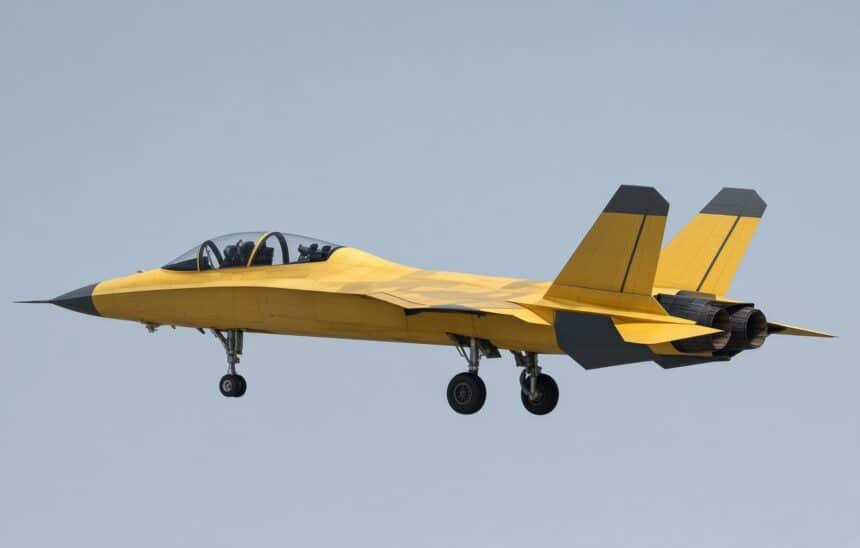
ZHUHAI, China — The People’s Liberation Army Navy will publicly unveil its new JL-15 carrier-based trainer jet at the 30th anniversary edition of the Zhuhai Airshow, ending months of online speculation over blurry prototype photos. Military officials confirmed this week that the twin-engine aircraft will perform live flight demonstrations alongside China’s frontline naval fighters in southern Guangdong province.
The debut marks a major step in Beijing’s effort to train pilots for its expanding fleet of aircraft carriers, including ships fitted with electromagnetic catapults. By fielding a dedicated deck-landing trainer, the Chinese navy aims to clear a persistent pilot bottleneck that has slowed the pace of its carrier aviation expansion.
Key Takeaways• The PLA Navy will fly the JL-15 carrier trainer publicly for the first time at Airshow China 2026 in Zhuhai. • Unofficial photos and satellite images of a tailhook-equipped prototype circulated online for months before Beijing confirmed the program. • The jet will prepare student aviators for catapult launches and arrested landings on the carrier Fujian and future warships. |
From Leaked Photos to Public Flight
For more than a year, defense watchers tracked grainy images of an unidentified naval trainer on Chinese social media and commercial satellite feeds. A tailhook-equipped mockup first appeared next to the carrier Fujian in 2024, signaling that engineers were testing deck-handling gear at coastal facilities.
Beijing stayed silent until Monday, when naval planners released their official exhibition roster. According to The War Zone, the JL-15 will join formation flypasts, low-level passes and simulated airfield raids during the show, which marks three decades since Zhuhai first hosted the exhibition in 1996.
The naval air wing will share the tarmac with the J-35 stealth fighter, the upgraded J-15T heavy fighter and the KJ-600 early warning plane. Displaying the trainer alongside combat jets highlights a complete carrier air group rather than isolated experimental prototypes.
Solving China’s Carrier Pilot Bottleneck
Why does a training jet matter as much as a stealth fighter? Aircraft carrier landings rank among the hardest tasks in military aviation, requiring pilots to slam a 20-ton aircraft onto a pitching steel deck at over 130 mph while catching a single steel arresting wire.
Historically, the PLA Navy relied on the land-based JL-10 advanced trainer to prepare recruits at shore bases before moving them straight into heavy J-15 fighters. That steep leap carried high safety risks and limited how many aviators could graduate each year, especially when China operated only two ski-jump carriers, the Liaoning and Shandong.
The arrival of the 80,000-ton carrier Fujian changed the operational math. Unlike older ships, Fujian uses electromagnetic catapults to launch heavier aircraft at higher sortie rates. Defense analysts cited by the South China Morning Post note that the JL-15 carries a distinct designation rather than a simple variant code, pointing to reinforced landing gear, a strengthened airframe and arrestor hooks built specifically for repeated catapult shots.
By replicating the cockpit layout and flight handling of the J-35 and J-15T, the JL-15 lets student pilots master carrier approaches without burning costly flight hours on frontline combat airframes. Similar to how the U.S. Navy uses the T-45 Goshawk before pilots touch an F/A-18 or F-35C, China now has a dedicated bridge from basic flight school to blue-water operations.
Expanding Maritime Reach in the Western Pacific
The timing of the Zhuhai reveal reflects broader shifts in regional naval power. As Beijing commissions larger surface warships and amphibious assault vessels, sustained carrier deployments in the Western Pacific depend on deep rosters of qualified flight crews and deck technicians.
Chinese military commentator Zhang Junshe told state media that the five carrier-related aircraft flying at Zhuhai cover fighter, electronic warfare, early warning and anti-submarine missions. Separate reports from Zona Militar note that China is also displaying all four variants of its J-15 family 14 years after its first carrier landing, alongside open-house tours of Type 075 assault ships and Type 055 destroyers at nearby Gaolan Port.
For neighboring navies and defense planners across the Indo-Pacific, the JL-15 is a clear signal. China is no longer just building flattops at record speed; it is building the industrial and human pipeline needed to keep their flight decks staffed around the clock.