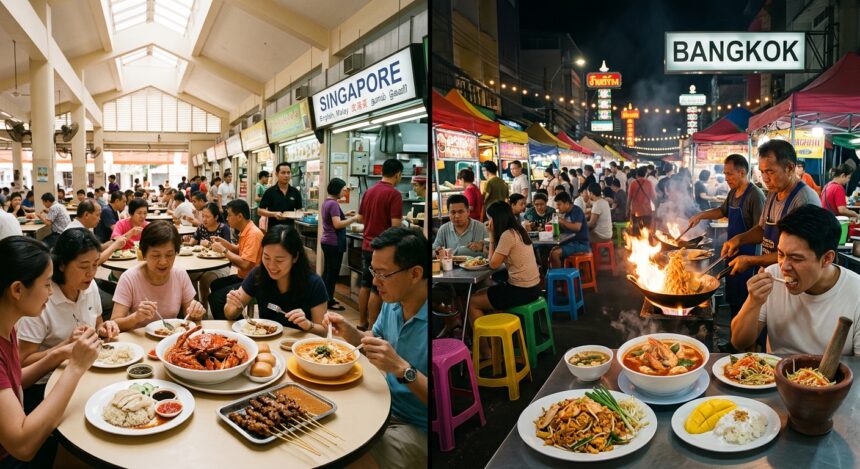
Bangkok’s street-food scene spreads across sidewalks, markets, and food stalls, while Singapore brings independent vendors together in shared hawker centers. The setting shapes the meal as much as the menu, so the better fit depends on the food, atmosphere, and value you want.
In Bangkok, different neighborhoods offer distinct ways to eat, while Singapore’s centers make it easy to browse stalls in one place. This comparison looks at dishes, costs, and the practical experience of dining in each city, with a closer look at Bangkok’s street-food neighborhoods.
Key Takeaways
- Bangkok street food is spread across sidewalks, markets, and food districts, while Singapore brings independent vendors together in shared hawker centers.
- For Bangkok stall locations, timing, and local dining options, explore Bangkok’s best street food neighborhoods.
- Singapore hawker centers offer a broad mix of cuisines, including Hainanese chicken rice, laksa, satay, and roti prata.
- Hawker meals often cost S$3 to S$10, but Bangkok prices vary by vendor and venue, so direct comparisons need care.
- Singapore’s hawker culture joined UNESCO’s Intangible Cultural Heritage list in 2020, recognizing its shared dining traditions, not a specific center or dish. UNESCO’s hawker culture listing
Bangkok Street Food Vs. Singapore’s Hawker Centers: What Sets Them Apart?
The main difference is where the food is served. Bangkok’s vendors are spread across streets, markets, and food courts, while Singapore’s hawker stalls cluster around shared dining areas. In both cities, the experience changes by location, so compare specific neighborhoods and centers rather than treating either food scene as uniform.
Bangkok’s food scene spills into streets and markets
In Bangkok, street food can mean a cart serving a few dishes, a sidewalk stall with nearby tables, or rows of vendors inside a market. Some areas also have organized food courts, where several stalls share a dining space. The setup depends on the location, and a market visit can feel quite different from eating beside a busy road.
Yaowarat Road in Chinatown is known for its evening stalls, while Banthat Thong Road offers another distinct stretch of food vendors. These examples show why the city doesn’t have one standard street-food experience. Hours, seating, and stall arrangements vary, so check the details for the area you plan to visit. For a closer look at one part of the city, see this guide to Bangkok’s Chinatown street food.
Singapore brings many food traditions under one roof
Singapore’s hawker centers gather independent food stalls around communal tables, often in a covered setting. You choose a stall, order there, then find a seat in the shared dining area. This makes it easy to compare menus in one visit, although finding a table can take extra patience during busy periods.
The food reflects Chinese, Malay, Indian, and Peranakan traditions. A single center may offer dishes such as chicken rice, laksa, satay, or roti prata, but each stall has its own menu and character. Maxwell Food Centre and Chinatown Complex sit in Chinatown, while Tekka Centre is in Little India; Old Airport Road Food Centre has a different neighborhood setting. Check individual stall hours before you go, since a center’s schedule doesn’t guarantee every vendor is open.
Singapore’s centers are more than collections of food stalls. UNESCO describes hawker centers as community dining spaces where people from different backgrounds gather, and Singapore’s hawker culture listing recognizes that shared tradition. In practical terms, Bangkok rewards exploring one vendor area at a time, while Singapore lets you sample several cuisines in one place.
What Should You Order in Bangkok and Singapore?
Order a few signature dishes in each city, then compare their flavors and how they fit into a meal. Bangkok often puts sweet, sour, salty, and spicy notes on one plate; Singapore’s hawker menus span several culinary traditions. Stall menus and recipes vary, so treat these dishes as useful starting points, not guaranteed offerings.
Bangkok favorites bring bold, layered flavors
Pad Thai is a good first order if you want a filling noodle dish. Vendors stir-fry rice noodles with ingredients such as egg, tofu, tamarind, and fish sauce, then add toppings like bean sprouts, peanuts, and lime. The balance of tangy, savory, and slightly sweet flavors changes by stall, and chili may come on the side.
For something fresher and hotter, try som tam, a salad of shredded green papaya pounded with lime, garlic, fish sauce, and chilies. Some versions include dried shrimp, peanuts, tomatoes, or fermented fish, so ask about ingredients and heat if you have preferences. Michelin’s guide to som tam styles and ingredients outlines some of the regional variations.
Boat noodles offer a more savory, comforting option. Expect rice noodles in a dark, richly seasoned broth, usually with meat and herbs; recipes differ, and some bowls include blood as a thickener. Portions are often small, making the dish easy to sample alongside other food. For more Thai classics, see this guide to popular Thai dishes.
Singapore hawker classics reflect a mix of cultures
Hainanese chicken rice pairs poached or roasted chicken with fragrant rice, broth, and dipping sauces. Laksa brings noodles in a spicy coconut-based broth, while char kway teow features flat rice noodles stir-fried with soy sauce and ingredients that can include egg, seafood, and Chinese sausage.
Satay is grilled meat on skewers, commonly served with peanut sauce and accompaniments such as cucumber. Roti prata, a flaky griddled flatbread with Indian roots, often comes with curry for dipping. These choices range from a substantial rice plate to a snack or shared side, so you can build a meal around your appetite. This Singapore hawker food guide offers further examples.
A stall may specialize in one dish, change its recipe, or close on certain days. Check the menu at the center you visit, and ask about ingredients when needed.
Compare Cost, Convenience, and the Feel of a Meal
A meal in Bangkok can mean a quick stop at one sidewalk stall or a longer visit to a market. In Singapore, you can browse several vendors in one shared dining area. Your budget and pace depend on what you order, how much you eat, and the kind of venue you choose.
Prices depend on the dish, venue, and portion
A fair price comparison starts with similar meals. Compare a full noodle dish with another full noodle dish, not a small snack with a plated meal. Portion size matters too, as does the setting: a Bangkok market stall and a sit-down food court may price food differently.
Accor’s guide, dated November 2025, gives a broad estimate of S$3 to S$10 for a Singapore hawker meal. Treat that as a guide, not a fixed rate; a dish, stall, or portion can fall outside the range. Bangkok has no single price that applies across its street stalls and markets, so avoid assuming the cheapest snack represents a complete meal. For more context, see this guide to Bangkok street food prices in 2026.
Street-side energy and shared tables create different moods
In Bangkok, the meal may unfold beside a busy road, at a market table, or in a more organized food court. Some spots have limited seating, and outdoor locations expose diners to heat, rain, and street noise. Crowds and comfort vary by neighborhood and time of day.
Singapore hawker centers are usually covered, with stalls arranged around communal tables. That makes it easier to order from several vendors in one visit, although you may need to find a seat during busy periods. Ordering generally means queuing at each stall, then carrying your food to a shared table. In either city, the pace depends on the location and the crowd.
Plan around stall hours and local dining habits
Check the hours of the specific stalls you want to try, since a center’s opening hours don’t guarantee every vendor is serving. Popular dishes can sell out, so arriving earlier gives you a better chance of ordering them. If you want to sample several foods, choose smaller dishes and leave room for another stop.
In Singapore, diners sometimes “chope” an unoccupied seat by leaving a small item, often a tissue packet, on the table while they order. It’s a local custom, not a formal reservation, and practices can vary. A Singapore hawker culture guide explains the custom for first-time visitors.
Food Safety, Rules, and Hawker Heritage Are Not the Same Story
Food safety and cultural recognition answer different questions. A busy stall can be a sensible choice, but its appearance alone can’t confirm compliance with local rules. And UNESCO recognition honors a living tradition, not a guarantee about every meal.
Check current food-safety guidance instead of relying on stereotypes
Avoid assuming that Bangkok or Singapore is automatically safer. Instead, check whether food is prepared and served with care: look for steady customer turnover, clean utensils, covered ingredients, and cooked food served hot. These signs can help you make a choice, but no visual check guarantees safety.
In Bangkok, practices and requirements may vary by location and type of vendor. For practical pointers on judging a stall, see these Thailand street food safety tips. Singapore has its own licensing requirements: the National Environment Agency (NEA) says cooked-food stall operators must obtain a Food Safety Course certificate before the stall license is issued. Check the NEA’s hawker licensing guidance for the applicable requirements, and consult official local guidance for current inspection information.
UNESCO recognition belongs to Singapore’s hawker culture
In 2020, Hawker Culture in Singapore was inscribed on UNESCO’s Representative List of the Intangible Cultural Heritage of Humanity. The inscription recognizes the broader tradition: hawker centers as shared dining spaces, the knowledge and practices involved in preparing food, and the social connections formed around meals. Singapore’s National Heritage Board provides details about the 2020 hawker culture inscription.
That recognition applies to the cultural practice, not to every hawker center, dish, or individual vendor. It also isn’t a food-safety certification or an inspection result. Keep those distinctions in mind when comparing the two cities: safety depends on current rules and individual food handling, while the UNESCO listing recognizes Singapore’s shared hawker tradition.
Choose the Food Experience That Fits Your Trip
The choice comes down to how you want to spend your time eating. Bangkok suits travelers who enjoy following changing street and market scenes, while Singapore works well for sampling several independent stalls in one shared space. Neither city is the better choice for every itinerary.
Pick Bangkok for variety across different street settings
Bangkok’s food options are spread across neighborhoods, markets, and street corners, so meals can become part of exploring the city. You might stop for a quick bite along a busy road one day, then browse a market on another outing. That variety appeals to travelers who like a less fixed plan and don’t mind traveling between food stops.
The scene also changes by time of day. Vendors often follow local meal patterns, but schedules differ by location, so check details before setting out. The guide to Bangkok street-food areas and meal times can help you choose a starting point. For one walkable food-focused area, see this Song Wat Road food and café guide.
Pick Singapore for an easy, shared-stall meal
Hawker centers suit travelers who want plenty of choices without making separate trips to find them. Independent stalls share a dining area, so each person can order something different and meet at a communal table. That setup makes it simple to sample a few cuisines in one stop, especially when traveling with a group.
Still, a center’s convenience depends on where it sits in your day. Check its location against your route, then look at the stall selection and individual hours. A nearby center may be a better fit than a famous one across town, particularly if you have limited time or a specific dish in mind.
Use a simple plan to make the most of either city
Before heading out, check opening times for the particular market, center, or stalls you want to visit. Hours can vary, and some vendors may close or sell out before the larger venue does. Choose a couple of dishes to share or sample, then leave room to adjust if a stall is closed or the line is long.
Carry a flexible payment option, such as cash and a card or digital payment method. Payment methods vary by stall in both cities, so don’t assume every vendor accepts the same options. A little planning helps you spend less time searching and more time enjoying the food, whether you’re hopping between Bangkok stops or settling in at a Singapore hawker center.
Frequently Asked Questions
A few practical details can make ordering easier in both cities. Since practices vary by vendor and location, check the stall’s signs and ask before you order.
Do I need to tip at a hawker center or street-food stall?
Tipping expectations vary by venue, but a restaurant-style tip isn’t a safe assumption at a hawker stall or street-food cart. Check the bill for a posted service charge, and follow any local guidance; in Bangkok, tipping etiquette for Thai street-food vendors can help you understand when a small tip may be appropriate.
Can I eat alone at hawker centers and street stalls?
Yes. Solo dining is practical in both cities, and you can order a single dish without needing a group. In Singapore, shared tables may mean sitting beside other diners, while a busy center can make finding an open seat harder. In Bangkok, seating depends on the stall or market, so you may need to wait or choose another stop.
Can I find vegetarian or halal food in both cities?
Yes, but choices depend on the stall and neighborhood. Ask vendors about ingredients and cooking methods, since a dish that appears vegetarian may contain fish sauce or shrimp paste, and shared equipment can matter. For halal food, look for clear certification where available and ask whether the stall’s preparation meets your needs.
Do Singapore hawker stalls accept cards or digital payments?
Payment options vary by stall and center, so carry a backup method, including some cash. Check signs before joining the queue or ask the vendor before ordering. Singapore has promoted cashless payments at hawker centers, but that doesn’t mean every stall accepts cards or digital wallets; a Singapore hawker payment study discusses the range of payment options.
Is bargaining expected when buying street food?
In Singapore, posted prices are the norm, and bargaining isn’t typical at hawker stalls. In Bangkok, prices and setups vary, so check the displayed price or politely confirm the cost before ordering. That simple step helps avoid confusion without assuming every vendor follows the same pricing practice.
Conclusion
Bangkok street food offers a more dispersed experience, with vendors and markets spread across the city. Singapore’s hawker centers bring many stalls together in shared dining spaces, making it easier to sample different cuisines in one stop.
Both cities reward curiosity. Choose Bangkok if you want to explore street-food areas, or Singapore if you prefer browsing stalls under one roof. Above all, let the dishes and dining style you want guide your choice. For planning on a budget, see this Bangkok street food price guide.