BANGKOK – Reports of waste moving from China to Thailand raise serious concerns, but the evidence needs careful reading. Trade figures, documented illegal shipments, and waste handled by Chinese-owned firms describe different things, and none alone proves that a specific toxic shipment came from mainland China.
IPEN cites China-to-Thailand waste-trade figures for 2014 and 2018, but those numbers don’t establish the cargo’s hazard level or legality. The 2018 Laem Chabang case involved illegal e-waste, yet reports named origins outside mainland China. This introduction to the evidence separates what the numbers show from what remains unproven, with attention to waste types and Thailand’s rules.
Key Takeaways
- IPEN-cited figures show China-to-Thailand waste trade rose from 1.4 million kilograms in 2014 to 1.84 million kilograms in 2018, but the data don’t identify waste types or legality. IPEN’s report provides the figures.
- Those trade totals don’t prove that every shipment was hazardous, illegal, or loaded in mainland China.
- Thailand’s import surge after China’s waste restrictions shows changing trade patterns, but national totals don’t establish cargo origins. China’s waste ban and Thailand’s e-waste problem offers more context.
- In 2018, officials found about 154 tonnes of e-waste in seven Laem Chabang containers, reportedly shipped from Hong Kong, Singapore, and Japan.
- Thailand prohibited e-waste imports in 2020 and plastic-scrap imports from January 2025, though enforcement cases continued.
Toxic Waste: China to Thailand, What the Evidence Shows
Trade figures can show that waste moved between two countries, but they cannot tell the full story of a shipment. The available China-to-Thailand numbers are useful evidence of reported trade, not proof that every load contained toxic material or broke the law.
What the China-to-Thailand figures do, and do not, prove
A 2025 IPEN report cites figures showing that nearly 1.4 million kilograms of waste went from China to Thailand in 2014, with a reported value of US$24.49 million. In 2018, the reported volume rose to 1.84 million kilograms, while the value fell to US$14.93 million. The figures describe a larger reported quantity but a lower stated value in 2018.
Those totals don’t identify the waste categories or establish that the material was hazardous. They also don’t name individual exporters or Thai importers, identify ports or shipping routes, or show whether authorities considered the shipments legal. In other words, they are trade figures, not a verified count of toxic or illegal shipments.
The distinction matters because “China-to-Thailand” can describe the reported trading relationship without showing where a particular container was loaded. Cargo originating in mainland China is also different from waste handled by a Chinese-owned company in Thailand, or from shipments linked to wider Chinese trade patterns. Company ownership and national import trends can provide context, but neither proves the origin of specific cargo.
Why the 2018 port case is often confused with China-origin waste
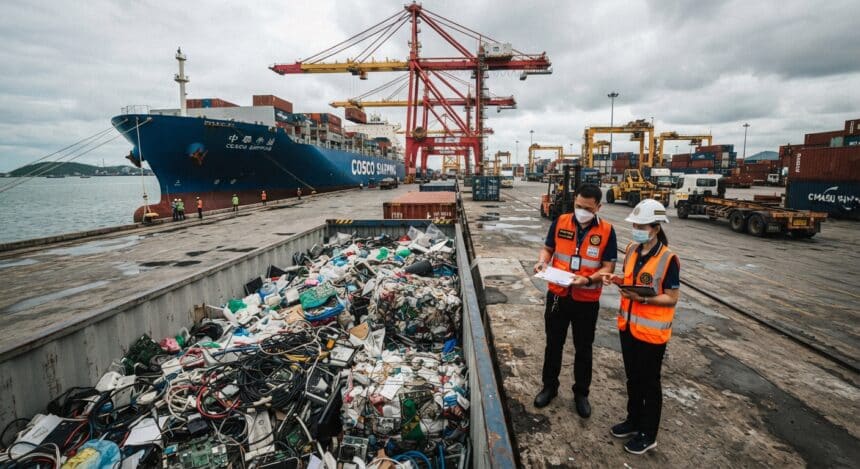
On May 29, 2018, authorities at Laem Chabang showed seven containers holding about 22 tonnes of electronic refuse each, roughly 154 tonnes in total. The reported contents included crushed gaming consoles and circuit boards. Reuters identified the cargo origins as Hong Kong, Singapore, and Japan, not mainland China. Thai authorities said some companies lacked the permits required to import the material and pursued legal action against three Thai recycling and waste-management firms. (Reuters’ account of the Laem Chabang case)
The case documents illegal e-waste imports and supports concerns about waste being diverted into Southeast Asia after China restricted imports. However, it does not establish that the seven containers came from mainland China. Hong Kong’s inclusion among the reported origins should not be silently converted into a mainland China origin claim.
Keep these records separate: the 2014 and 2018 figures describe reported bilateral waste trade, while the port case documents a specific enforcement action with different reported origins. Later accounts of Thailand’s crackdown on illegal e-waste imports add context about enforcement, but they do not change the provenance reported for these seven containers.
Why Thailand saw a surge in waste imports after China tightened its rules
China’s 2017 restrictions changed the options available to companies exporting waste for recycling. When China announced that it would stop accepting 24 categories of solid waste, including household plastic waste, it raised concerns that exporters would redirect shipments to Southeast Asia. Thailand’s import figures show a sharp rise during this period, but they don’t establish where each shipment came from.
Thailand’s import numbers show the scale of the pressure
Thailand imported 30,745 tonnes of used electrical and electronic equipment in 2017. Separately, the reported volume of e-waste and e-scrap reached 53,291 tonnes. These figures describe different categories, and neither is a total for waste imported from China.
Plastic-waste imports rose even more sharply the following year. Thailand imported 553,000 tonnes in 2018, 3.6 times the previous year’s volume, according to a peer-reviewed study of China’s waste restrictions and Thailand. That increase fits the broader concern about waste trade shifting after China’s restrictions took effect.
However, national import totals don’t reveal the origin of individual shipments. They also don’t show whether the material was hazardous, improperly declared, or accepted in violation of Thai rules. The figures establish the scale of pressure on Thailand’s waste system, not a count of China-origin cargo.
Trade routes, false labels, and the risk of weak oversight
Waste shipments can be difficult to track when paperwork misstates what’s inside. Thai investigations have documented e-waste labeled as plastic waste, a practice that can make inspections harder because customs officials may assess cargo according to its declared category. A false description can also obscure the material’s hazards and complicate efforts to determine whether the shipment complies with import rules.
The timing of Thailand’s import growth supports concern that exporters sought new destinations after China restricted waste imports. Yet that wider pattern doesn’t prove a specific load came from China. A national import statistic, a report of Chinese-linked business ownership, and a shipment’s country of origin are separate pieces of evidence.
Reports that Chinese firms owned or controlled Thai recycling companies may help explain who operated some facilities. They don’t establish where a particular shipment was generated, exported, or loaded. Likewise, the presence of a China-linked company in Thailand doesn’t turn the company’s waste into China-origin cargo.
For any specific shipment, the evidence needs to identify the cargo itself and document its provenance. That means treating import totals as context, while relying on verified shipment records or enforcement findings to support claims about origin. Thailand’s experience with e-waste imports and enforcement shows why waste volumes and shipment-level evidence should be kept distinct.
What kinds of waste are involved, and how can they cause harm?
The records name several different materials, and each creates distinct handling risks. Their presence in Thai enforcement cases does not establish that China-origin shipments caused measured health effects or contamination.
E-waste, batteries, and plastics are not all the same
Used electronics intended for repair or reuse differ from broken equipment and scrap shipped for material recovery or disposal. The distinction matters: reusable equipment can have a further service life, while scrap may need dismantling. Thailand’s reported imports of used electrical and electronic equipment and its separate e-waste figures also describe different categories.
Circuit boards and other electronic parts can contain lead, cadmium, and flame-retardant chemicals. When workers break devices apart without proper controls, dust and residues can reach them; burning wires or plastic casings can release hazardous smoke. The World Health Organization describes exposure risks linked to informal e-waste recycling, especially for children. These are established hazards of unsafe handling, not evidence of measured exposure from the reported China-to-Thailand trade.
Plastic scrap, used electrical parts, lead-acid batteries, and used tires also require appropriate sorting and processing. Battery damage can expose workers to lead and corrosive materials, while uncontrolled burning of plastic or tires can produce harmful smoke. Poorly managed waste can also spread beyond a worksite through dust, runoff, or dumped material. Thailand’s plastic-scrap import ban reflects a separate waste-control issue, not proof that every plastic shipment was hazardous or illegal.
What documented Thai enforcement cases reveal
The May 2018 Laem Chabang case involved seven containers carrying about 154 tonnes of electronic refuse, including crushed gaming consoles and circuit boards. Reuters reported that the cargo came from Hong Kong, Singapore, and Japan. Thai authorities said some companies lacked required import permits and pursued legal action against three firms. The case documents illegal e-waste imports, but it does not identify the containers as mainland China-origin cargo. (Reuters’ report on the 2018 seizure)
A separate seizure took place at Laem Chabang in January 2025. Thai customs found ten containers holding 256 tonnes of smuggled e-waste, falsely declared as “used metal scraps.” Authorities reported that the cargo originated in Japan and Hong Kong, not mainland China. (Thai PBS World’s seizure report)
Both cases show why officials need to inspect cargo and verify declarations: a shipment’s label may not match its contents. They do not quantify health outcomes or contamination from China-origin trade. Likewise, reports about unsafe processing at a Chinese-operated e-waste plant in Thailand concern facility ownership and handling, not proof of where its waste originated.
How Thailand’s waste-import rules have changed
Thailand’s rules have tightened in stages, but announcements and effective bans are not the same thing. The key shift is from controlling cross-border hazardous-waste shipments through permits and consent to prohibiting specific waste categories outright.
From the Basel Convention to Thailand’s import bans
Thailand ratified the Basel Convention in 1997. The treaty does not ban all international waste trade. Instead, it controls cross-border movements of hazardous waste through procedures that generally require advance notice, the consent of relevant authorities, and movement documents. Thailand’s Department of Industrial Works handles the country’s consent process. The Convention’s transboundary-movement control procedures explain the notification and consent steps.
In simple terms, authorities need accurate information about the waste and approval from the countries involved before a covered shipment moves. Domestic permits may also apply. A false cargo description can defeat that process by hiding what officials are being asked to approve.
Thailand’s later restrictions target specific imports. A Thai government update states that the country prohibited e-waste imports beginning in 2020. The government also prohibited imports of plastic scrap under Customs Tariff Code 3915 effective January 1, 2025. On June 24, 2025, Thailand expanded the e-waste list covered by its import prohibition from 428 to 463 tariff items.
Those dates matter because proposed measures did not automatically become law when announced. In 2018, reports described plans to ban incoming electronic and other waste by the end of June and to stop renewing permits for 2019. Those reports show what the government said it intended to do at the time; they do not establish that every announced measure took effect then. The later government timeline confirms the 2020 prohibition and the 2025 changes.
Why seizures continued even after new restrictions
A ban gives officials a legal basis to stop prohibited imports, but it does not prevent every shipment from being misdeclared or smuggled. That difference appears in Thailand’s January 2025 enforcement figures. Between October 1, 2024, and January 14, 2025, authorities reported 19 e-waste cases involving more than 256,000 kilograms, plus six plastic-scrap cases totaling nearly 323,000 kilograms.
These figures describe enforcement activity, not the origin of every intercepted load. Unless the records identify a country of origin, the totals cannot establish that the cargo came from China. That distinction is especially important in an article about China-to-Thailand trade: a seizure count shows what Thai authorities found, while shipment records are needed to establish provenance.
The figures also show why restrictions and enforcement records need to be read together. A prohibited category may still appear in case reports because inspectors discovered attempted imports, sometimes under misleading declarations. For more on the difference between a ban and its practical enforcement, see Thailand’s waste-import enforcement gaps.
How to judge claims about toxic waste moving from China to Thailand
A headline may describe a real waste-trade concern but overstate what the evidence proves. To assess a claim, look for shipment-specific records, distinguish the different meanings of “origin,” and treat national trade patterns as context rather than proof about a particular load.
Check the shipment’s origin, contents, and legal status
Start with the container or shipment, not the headline. Strong evidence identifies a shipment through customs records, bills of lading, inspection reports, or enforcement documents. Check whether those records name the country of origin, the exporter, the port of loading, and any transit locations. These details are not interchangeable: cargo may pass through a country without originating there, while an exporter’s address or a company’s ownership does not establish where the waste was generated.
Next, compare the declared contents with inspection findings. A manifest might describe scrap metal, for example, while inspectors report electronic waste inside. The inspection record can support a claim about what officials found, but the cargo’s hazard classification may require further testing or documentation. Likewise, proof that a shipment contained e-waste does not automatically prove it was toxic or illegal.
Check the legal basis too. Relevant records may include import permits, required prior consent, customs decisions, and court or enforcement findings. The Basel Convention’s movement-control procedures explain the written notification and consent process for covered waste shipments. A report that authorities opened an investigation is not the same as a court finding that a named company broke the law.
Until records verify the details, describe the account as an allegation or reported claim. Precise wording keeps the article aligned with what the evidence shows.
Separate regional trends from individual cases
Country-level figures can show that imports rose or trade patterns changed. They cannot, by themselves, identify the contents, route, or legality of a specific shipment. Thailand’s 2018 plastic-waste import surge, for example, occurred amid China’s restrictions on many waste imports. That context supports concern about possible diversion to Southeast Asia, but Thailand’s national total does not prove that the waste came from China.
The 2018 Laem Chabang case shows why shipment-level details matter. Authorities found about 154 tonnes of electronic refuse in seven containers, and reporting identified Hong Kong, Singapore, and Japan as origins. The case documents an illegal-import enforcement action, but it does not establish that those containers originated in mainland China. Hong Kong’s appearance in the reported origins should not be silently turned into a China-origin claim.
Apply the same discipline to company links. A Chinese-owned or Chinese-controlled Thai firm may be relevant to a facility investigation, but ownership alone does not establish a shipment’s source. For example, reports on Thailand’s e-waste bribery probe can help readers follow customs enforcement, while each cargo’s origin still needs its own documentation.
Frequently Asked Questions
The trade figures and enforcement cases answer some questions, but they don’t settle every issue around imported waste. These answers clarify how to interpret waste categories, legal violations, and customs actions.
Does “e-waste” mean every used electronic device?
No. A working device imported for reuse differs from broken equipment or discarded parts intended for recovery or disposal. That distinction matters because trade reports may count used electrical and electronic equipment separately from e-waste or e-scrap. A category label alone doesn’t confirm the condition or intended use of every item in a shipment.
Can a waste shipment be illegal if officials haven’t confirmed it is toxic?
Yes. A shipment can violate import rules because the material is prohibited, the importer lacks a required permit, or its paperwork misstates the contents. Toxicity is a separate question that may require inspection or testing. Thailand’s rules also target particular waste categories, including plastic scrap under tariff code 3915, as described in its plastic waste import rules.
Does recycling make an imported waste shipment safe?
No. Recycling describes what someone plans to do with a material, not whether the shipment is lawful or safe to handle. Electronics may contain hazardous components, and workers can face exposure if dismantling or processing lacks proper controls. The material’s contents, handling conditions, permits, and applicable restrictions all matter.
What happens when Thai authorities seize illegal e-waste?
Authorities can inspect the cargo, investigate the importer, and take enforcement action under Thai law. In one separate case, Thai customs said it would return 284 tonnes of e-waste to the United States after finding the cargo mislabeled as scrap metal. The outcome can depend on the shipment and the case record; a seizure alone doesn’t establish the cargo’s country of origin. Read more about Thailand’s e-waste import enforcement.
What evidence shows whether a shipment contains hazardous waste?
A headline or cargo description may not be enough, especially if officials suspect the paperwork is inaccurate. Inspection reports can document what customs found, while testing or other technical records may help establish the material’s composition and hazard classification. For cross-border shipments covered by the treaty, the Basel Convention text sets out international controls; Thai permits and import rules also apply.