
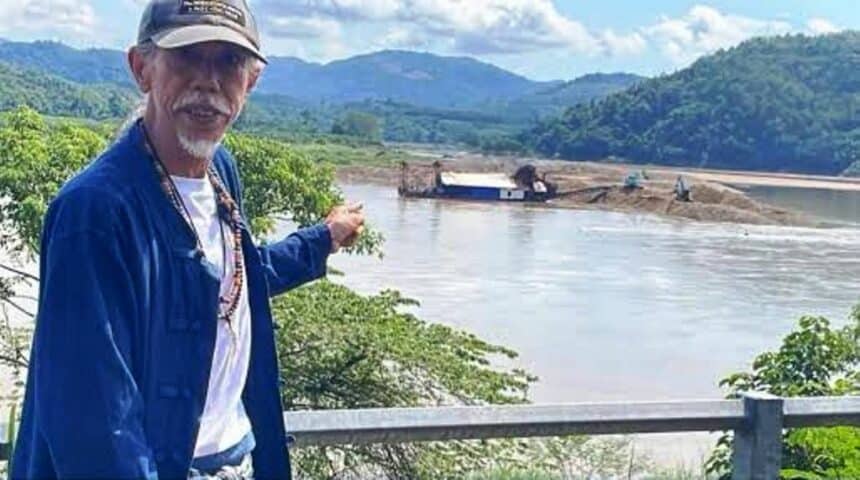
CHIANG RAI – Civic groups and artists in northern Thailand are pressing Bangkok to launch a cross-border investigation into suspected gold dredging on the Lao side of the Mekong River, rejecting official Lao claims that the barges are merely extracting construction sand.
Following a Nov. 15 field inspection opposite Laos’ Bokeo province, activists warned that heavy machinery stirring up riverbeds threatens local fisheries and could release toxic heavy metals already detected downstream. The coalition is combining formal diplomatic petitions with an art exhibition in Chiang Rai to demand joint action from Thailand, Laos, Myanmar and China.
Key Takeaways• Civic monitors documented at least 15 dredging sites along the Lao Mekong from Bokeo to Pak Beng, using conveyor and water-jet equipment typical of gold panning rather than sand extraction. • Lao provincial media denied gold mining allegations after a Nov. 6 inspection, claiming contractors were dredging chemical-free sand for public road projects. • Environmentalists warn that riverbed disruption compounds severe upstream arsenic pollution from unregulated mines in Myanmar, turning Chiang Rai into a “sacrifice zone.” |
Dispute Over Riverbed Dredging Operations
During Sunday’s inspection at Ban Mueang Kan pier in Chiang Khong district, reporters and community leaders observed two backhoes and two dump trucks parked across the river at Ban Pak Ngao in Laos’ Houayxay district. Villagers said operators halted work three days earlier after Thai media reported on the barges.
Bokeo provincial television and radio broadcasters recently stated that Lao officials inspected the site on Nov. 6 and confirmed the work involved chemical-free sand dredging for local infrastructure. Niwat Roykaew, chair of the Rak Chiang Khong conservation group, disputed that account. He noted that backhoes scoop riverbed stones onto conveyor belts for high-pressure washing far out in the main channel—a method matching alluvial gold recovery rather than sand collection.
Niwat warned that tearing up the riverbed destroys shared Thai-Lao fishing grounds, locally known as lang, where traditional drift nets snag on altered shoals. His network submitted formal petitions to Thailand’s prime minister, the Ministry of Foreign Affairs and the Office of the National Water Resources, urging probes through the Thai-Lao Joint Boundary Commission and the Mekong River Commission.
Upstream Toxins and Hydropower Compound Risks
The dredging dispute unfolds amid a broader transboundary pollution crisis across the Golden Triangle. Satellite research by the Stimson Center shows unregulated rare earth and gold mines have proliferated across Myanmar’s Shan State over the past four years, discharging runoff into the Kok and Sai rivers before they join the Mekong.
In April, Thailand’s Pollution Control Department detected arsenic levels nine times the safety threshold in river sediments near Chiang Saen, threatening municipal tap water intakes down to Chiang Khong. Environmental defender Pianporn Deetes said nearly 3,000 mines operate around the clock across the wider Mekong basin, supplying minerals to China.
“Chiang Rai residents cannot accept becoming a sacrifice zone for expanding mining industries,” Pianporn said, noting the irony of Beijing’s slogan that Mekong nations drink from the same river while clear headwaters turn muddy and toxic at the Thai border. Activists also fear the downstream Pak Beng Dam reservoir will slow currents, trapping heavy-metal sediments.
Art Exhibition Amplifies Calls for Accountability
To rally public pressure, local creators launched the “Chiang Rai River Basin, Now!” exhibition at the Chiang Rai Contemporary Art Museum, running through Nov. 20. Curator Photchawan Phanchinda divided the showcase into four sections featuring community weaves and works previously shown in Bangkok.
Musician Kitti Trirach also organized four painters to document Kaeng Pha Dai and Khon Phi Long rapids before dam backwaters submerge them. “Art bridges public awareness to push for concrete solutions before the damage becomes irreversible,” Kitti said.